Thank you for visiting SNEWPapers!
Sign up free
Gazette Of The United States
New York, New York County, New York
What is this article about?
Report from Paris on October 8, 1789, details an aborted aristocratic plot to aid the King's escape from Versailles, involving the Flanders regiment. Women's march forces King Louis XVI, Queen Marie Antoinette, and family to relocate to Paris under Lafayette's guard, thwarting civil war and affirming revolutionary triumph.
Clipping
OCR Quality
Full Text
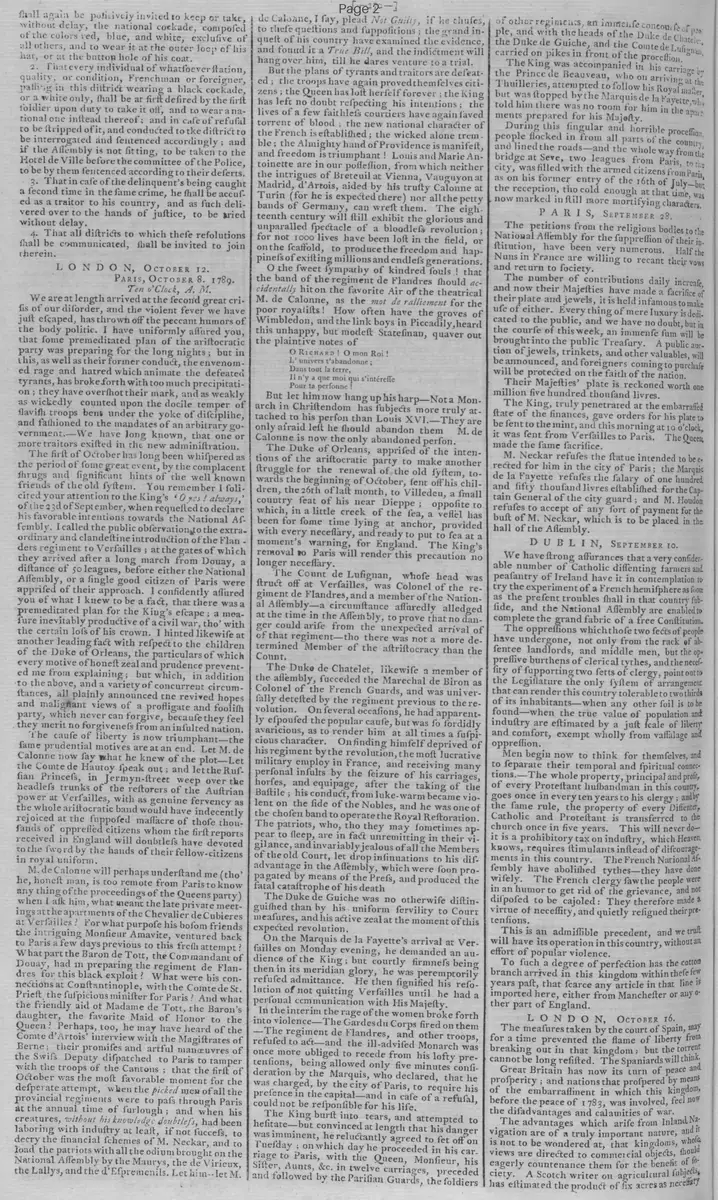
Paris, October 8. 1789.
Ten o'Clock, A. M.
We are at length arrived at the second great crisis of our disorder, and the violent fever we have just escaped, has thrown off the peccant humors of the body politic. I have uniformly assured you, that some premeditated plan of the aristocratic party was preparing for the long nights; but in this, as well as their former conduct, the envenomed rage and hatred which animate the defeated tyrants, has broke forth with too much precipitation; they have overshot their mark, and as weakly as wickedly counted upon the docile temper of slavish troops bent under the yoke of discipline, and fashioned to the mandates of an arbitrary government.—We have long known, that one or more traitors existed in the new administration. The first of October has long been whispered as the period of some great event, by the complacent shrugs and significant hints of the well known friends of the old system. You remember I solicited your attention to the King's 'O yes! always,' of the 23d of September, when requested to declare his favorable intentions towards the National Assembly. I called the public observation to the extraordinary and clandestine introduction of the Flanders regiment to Versailles; at the gates of which they arrived after a long march from Douay, a distance of 50 leagues, before either the National Assembly, or a single good citizen of Paris were apprised of their approach. I confidently assured you of what I knew to be a fact, that there was a premeditated plan for the King's escape; a measure inevitably productive of a civil war, tho' with the certain loss of his crown. I hinted likewise at another leading fact with respect to the children of the Duke of Orleans, the particulars of which every motive of honest zeal and prudence prevented me from explaining; but which, in addition to the above, and a variety of concurrent circumstances, all plainly announced the revived hopes and malignant views of a profligate and foolish party, which never can forgive, because they feel they merit no forgiveness from an insulted nation.
The cause of liberty is now triumphant—the same prudential motives are at an end. Let M. de Calonne now say what he knew of the plot. Let the Comte de Hautoy speak out; and let the Russian Princes, in Jermyn-street weep over the headless trunks of the restorers of the Austrian power at Versailles, with as genuine fervency as the whole aristocratic band would have indecently rejoiced at the supposed massacre of those thousands of oppressed citizens whom the first reports received in England will doubtless have devoted to the sword by the hands of their fellow-citizens in royal uniform.
M. de Calonne will perhaps understand me (tho' he, honest man, is too remote from Paris to know any thing of the proceedings of the Queen's party) when I ask him, what meant the late private meetings at the apartments of the Chevalier de Cubieres at Versailles? For what purpose his bosom friends the intriguing Monsieur Amavite, ventured back to Paris a few days previous to this fresh attempt? What part the Baron de Tott, the Commandant of Douay, had in preparing the regiment de Flandres for this black exploit? What were his connections at Constantinople, with the Comte de St. Priest the suspicious minister for Paris? And what the friendly aid of Madame de Tott, the Baron's daughter, the favorite Maid of Honor to the Queen? Perhaps, too, he may have heard of the Comte d'Artois' interview with the Magistrates of Berne; their promises and artful manoeuvres of the Swiss Deputy dispatched to Paris to tamper with the troops of the Cantons; that the first of October was the most favorable moment for the desperate attempt, when the picked men of all the provincial regiments were to pass through Paris at the annual time of furlough; and when his creatures, without his knowledge doubtless, had been laboring with industry at least, if not success, to decry the financial schemes of M. Necker, and to load the patriots with all the odium brought on the National Assembly by the Maurys, the de Virieux, the Lallys, and the d'Esprémnils. Let him— let M. de Calonne, I say, plead Not Guilty, if he chooses, to these questions and suppositions; the grand inquest of his country have examined the evidence, and found it a True Bill, and the indictment will hang over him, till he dares venture to a trial.
But the plans of tyrants and traitors are defeated; the troops have again proved themselves citizens; the Queen has lost herself forever; the King has left no doubt respecting his intentions; the lives of a few faithless courtiers have again saved a torrent of blood; the new national character of the French is established: the wicked alone tremble; the Almighty hand of Providence is manifest, and freedom is triumphant! Louis and Marie Antoinette are in our possession, from which neither the intrigues of Breteuil at Vienna, Vauguyon at Madrid, d'Artois, aided by his trusty Calonne at Turin (for he is expected there) nor all the petty bands of Germany, can wrest them. The eighteenth century will still exhibit the glorious and unparalleled spectacle of a bloodless revolution; for not 1000 lives have been lost in the field, or on the scaffold, to produce the freedom and happiness of existing millions and endless generations.
O the sweet sympathy of kindred souls! that the band of the regiment de Flandres should accidentally hit on the favorite Air of the theatrical M. de Calonne, as the mot de ralliement for the poor royalists! How often have the groves of Wimbledon, and the link boys in Piccadilly, heard this unhappy, but modest Statesman, quaver out the plaintive notes of
ORCHARD! O mon Roi!
L'univers t'abandonne;
Dans toute la terre,
Il n'y a que moi qui s'intéresse
Pour ta personne!
But let him now hang up his harp—Not a Monarch in Christendom has subjects more truly attached to his person than Louis XVI.—They are only afraid lest he should abandon them. M. de Calonne is now the only abandoned person.
The Duke of Orleans, apprised of the intentions of the aristocratic party to make another struggle for the renewal of the old system, towards the beginning of October, sent off his children, the 26th of last month, to Villers, a small country seat of his near Dieppe; opposite to which, in a little creek of the sea, a vessel has been for some time lying at anchor, provided with every necessary, and ready to put to sea at a moment's warning, for England. The King's removal to Paris will render this precaution no longer necessary.
The Count de Lusignan, whose head was struck off at Versailles, was Colonel of the regiment de Flandres, and a member of the National Assembly—a circumstance assuredly alleged at the time in the Assembly, to prove that no danger could arise from the unexpected arrival of that regiment tho there was not a more determined Member of the aristocracy than the Count.
The Duke de Chatelet, likewise a member of the assembly, succeeded the Marechal de Biron as Colonel of the French Guards, and was universally detested by the regiment previous to the revolution. On several occasions, he had apparently espoused the popular cause, but was so sordidly avaricious, as to render him at all times a suspicious character. On finding himself deprived of his regiment by the revolution, the most lucrative military employ in France, and receiving many personal insults by the seizure of his carriages, horses, and equipage, after the taking of the Bastile; his conduct, from luke-warm became violent on the side of the Nobles, and he was one of the chosen band to operate the Royal Restoration. The patriots, who, tho they may sometimes appear to sleep, are in fact unremitting in their vigilance, and invariably jealous of all the Members of the old Court, let drop insinuations to his disadvantage in the Assembly, which were soon propagated by means of the Press, and produced the fatal catastrophe of his death.
The Duke de Guiche was no otherwise distinguished than by his uniform servility to Court measures, and his active zeal at the moment of this expected revolution.
On the Marquis de la Fayette's arrival at Versailles on Monday evening, he demanded an audience of the King; but courtly firmness being then in its meridian glory, he was peremptorily refused admittance. He then signified his resolution of not quitting Versailles until he had a personal communication with His Majesty. In the interim the rage of the women broke forth into violence—The Gardes du Corps fired on them—The regiment de Flandres, and other troops, refused to act—and the ill-advised Monarch was once more obliged to recede from his lofty pretensions, being allowed only five minutes consideration by the Marquis, who declared, that he was charged, by the city of Paris, to require his presence in the capital and in case of a refusal, could not be responsible for his life.
The King burst into tears, and attempted to hesitate—but convinced at length that his danger was imminent, he reluctantly agreed to set off on Tuesday; on which day he proceeded in his carriage to Paris, with the Queen, Monsieur, his Sister, Aunts, &c. in twelve carriages, preceded and followed by the Parisian Guards, the soldiers
What sub-type of article is it?
What keywords are associated?
What entities or persons were involved?
Where did it happen?
Foreign News Details
Primary Location
Versailles
Event Date
October 8, 1789
Key Persons
Outcome
plans of tyrants defeated; troops proved citizens; king and family removed to paris; few courtiers killed including count de lusignan, duke de chatelet, duke de guiche; bloodless revolution affirmed with under 1000 lives lost overall.
Event Details
Aristocratic plot for King's escape from Versailles using Flanders regiment thwarted; women's march to Versailles turns violent; Guards fire but regiment refuses to act; Lafayette demands King's move to Paris; King relents and family escorted to capital by Parisian Guards.