Thank you for visiting SNEWPapers!
Sign up free
Atlanta Daily World
Atlanta, Fulton County, Georgia
What is this article about?
In 1953, the pink bollworm spread to 15 new counties in Arkansas, Oklahoma, and Louisiana, though infestations remained light due to effective clean-up efforts. USDA entomologists note reduced movement compared to prior years and ongoing research to control the pest threatening the cotton industry.
Clipping
OCR Quality
Full Text
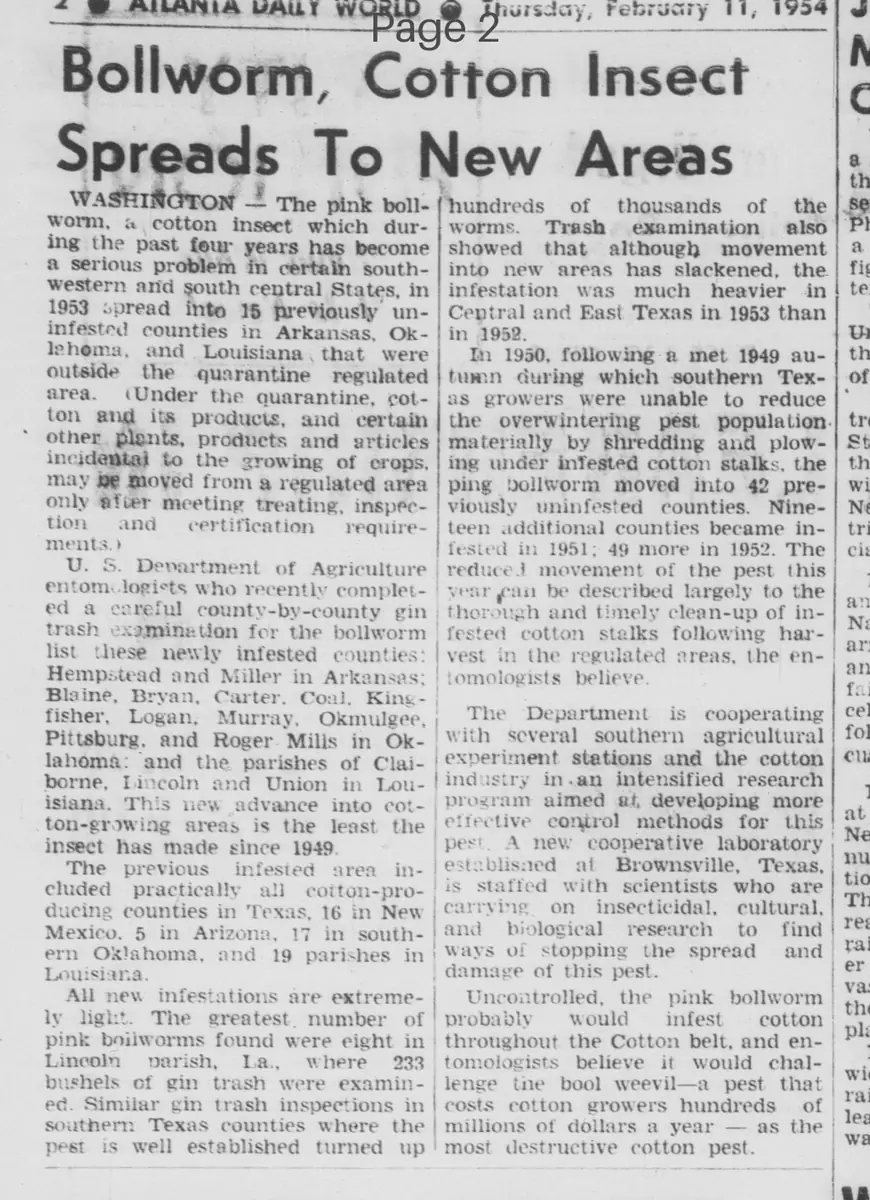
WASHINGTON - The pink bollworm, a cotton insect which during the past four years has become a serious problem in certain southwestern and south central States, in 1953 spread into 15 previously uninfested counties in Arkansas, Oklahoma, and Louisiana that were outside the quarantine regulated area. (Under the quarantine, cotton and its products, and certain other plants, products and articles incidental to the growing of crops, may be moved from a regulated area only after meeting treating, inspection and certification requirements)
U. S. Department of Agriculture entomologists who recently completed a careful county-by-county gin trash examination for the bollworm list these newly infested counties: Hempstead and Miller in Arkansas; Blaine, Bryan, Carter, Coal, Kingfisher, Logan, Murray, Okmulgee, Pittsburg, and Roger Mills in Oklahoma; and the parishes of Claiborne, Lincoln and Union in Louisiana. This new advance into cotton-growing areas is the least the insect has made since 1949.
The previously infested area included practically all cotton-producing counties in Texas, 16 in New Mexico, 5 in Arizona, 17 in southern Oklahoma, and 19 parishes in Louisiana.
All new infestations are extremely light. The greatest number of pink bollworms found were eight in Lincoln Parish, La., where 233 bushels of gin trash were examined. Similar gin trash inspections in southern Texas counties where the pest is well established turned up hundreds of thousands of the worms.
Trash examination also showed that although movement into new areas has slackened, the infestation was much heavier in Central and East Texas in 1953 than in 1952.
In 1950, following a wet 1949 autumn during which southern Texas growers were unable to reduce the overwintering pest population materially by shredding and plowing under infested cotton stalks, the pink bollworm moved into 42 previously uninfested counties. Nineteen additional counties became infested in 1951; 49 more in 1952. The reduced movement of the pest this year can be ascribed largely to the thorough and timely clean-up of infested cotton stalks following harvest in the regulated areas, the entomologists believe.
The Department is cooperating with several southern agricultural experiment stations and the cotton industry in an intensified research program aimed at developing more effective control methods for this pest. A new cooperative laboratory established at Brownsville, Texas, is staffed with scientists who are carrying on insecticidal, cultural, and biological research to find ways of stopping the spread and damage of this pest.
Uncontrolled, the pink bollworm probably would infest cotton throughout the Cotton Belt, and entomologists believe it would challenge the boll weevil—a pest that costs cotton growers hundreds of millions of dollars a year—as the most destructive cotton pest.
What sub-type of article is it?
What keywords are associated?
Where did it happen?
Domestic News Details
Primary Location
Arkansas, Oklahoma, Louisiana
Event Date
1953
Outcome
new infestations in 15 counties are extremely light; movement slackened due to clean-up of infested cotton stalks; intensified research program underway.
Event Details
The pink bollworm spread into 15 previously uninfested counties in Arkansas, Oklahoma, and Louisiana outside the quarantine area. Newly infested counties listed: Hempstead and Miller (Arkansas); Blaine, Bryan, Carter, Coal, Kingfisher, Logan, Murray, Okmulgee, Pittsburg, Roger Mills (Oklahoma); Claiborne, Lincoln, Union parishes (Louisiana). Infestations lighter than previous years; heaviest in Lincoln Parish, La. with eight worms found. Previously infested areas include most of Texas, parts of New Mexico, Arizona, southern Oklahoma, and Louisiana. Department of Agriculture cooperating on research at new lab in Brownsville, Texas.