Thank you for visiting SNEWPapers!
Sign up free
Portland Gazette, And Maine Advertiser
Portland, Cumberland County, Maine
What is this article about?
William M. Simmons, dismissed Accountant of the War Department, addresses Congress to explain his removal, alleging fraud by Quarter-Master General Col. James Thomas and agent Michael T. Simpson involving over $130,000 in public funds, implicating Secretary John Armstrong, and urging legislative investigation into departmental abuses.
Clipping
OCR Quality
Full Text
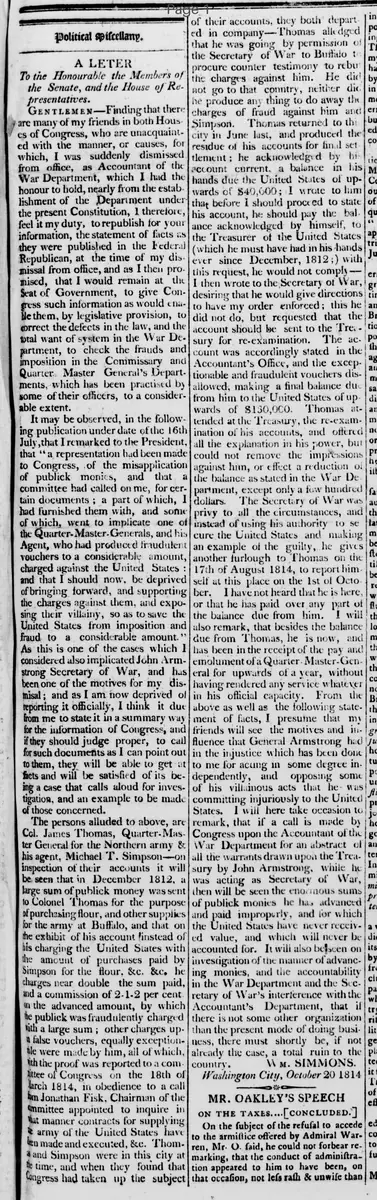
A LETTER
To the Honourable the Members of the Senate, and the House of Representatives.
GENTLEMEN—Finding that there are many of my friends in both Houses of Congress, who are unacquainted with the manner, or causes, for which, I was suddenly dismissed from office, as Accountant of the War Department, which I had the honour to hold, nearly from the establishment of the Department under the present Constitution, I therefore, feel it my duty, to republish for your information, the statement of facts as they were published in the Federal Republican, at the time of my dismissal from office, and as I then promised, that I would remain at the Seat of Government, to give Congress such information as would enable them, by legislative provision, to correct the defects in the law, and the total want of system in the War Department, to check the frauds and imposition in the Commissary and Quarter Master General's Departments, which has been practised by some of their officers, to a considerable extent.
It may be observed, in the following publication under date of the 16th July, that I remarked to the President, that "a representation had been made to Congress, of the misapplication of publick monies, and that a committee had called on me, for certain documents; a part of which, I had furnished them with, and some of which, went to implicate one of the Quarter-Master-Generals, and his Agent, who had produced fraudulent vouchers to a considerable amount, charged against the United States: and that I should now, be deprived of bringing forward, and supporting the charges against them, and exposing their villainy, so as to save the United States from imposition and fraud to a considerable amount."
As this is one of the cases which I considered also implicated John Armstrong Secretary of War, and has been one of the motives for my dismissal: and as I am now deprived of reporting it officially, I think it due from me to state it in a summary way for the information of Congress, and if they should judge proper, to call for such documents as I can point out to them, they will be able to get at facts and will be satisfied of its being a case that calls aloud for investigation, and an example to be made of those concerned.
The persons alluded to above, are Col. James Thomas, Quarter-Master General for the Northern army & his agent, Michael T. Simpson—on inspection of their accounts it will be seen that in December 1812, a large sum of publick money was sent to Colonel Thomas for the purpose of purchasing flour, and other supplies for the army at Buffalo, and that on the exhibit of his account instead of his charging the United States with the amount of purchases paid by Simpson for the flour &c. &c. he charges near double the sum paid, and a commission of 2 1/2 per cent. on the advanced amount, by which the publick was fraudulently charged with a large sum; other charges upon false vouchers, equally exceptionable were made by him, all of which, with the proof was reported to a committee of Congress on the 18th of March 1814, in obedience to a call from Jonathan Fisk, Chairman of the committee appointed to inquire into the manner contracts for supplying the army of the United States have been made and executed, &c. Thomas and Simpson were in this city at the time, and when they found that Congress had taken up the subject of their accounts, they both departed in company—Thomas alleged that he was going by permission of the Secretary of War to Buffalo to procure counter testimony to rebut the charges against him. He did not go to that country, neither did he produce any thing to do away the charges of fraud against him and Simpson. Thomas returned to this city in June last, and produced the residue of his accounts for final settlement; he acknowledged by his account current, a balance in his hands due the United States of upwards of $40,600; I wrote to him that before I should proceed to state his account, he should pay the balance acknowledged by himself, to the Treasurer of the United States (which he must have had in his hands ever since December, 1812;) with this request, he would not comply—I then wrote to the Secretary of War, desiring that he would give directions to have my order enforced; this he did not do, but requested that the account should be sent to the Treasury for re-examination. The account was accordingly stated in the Accountant's Office, and the exceptionable and fraudulent vouchers disallowed, making a final balance due from him to the United States of upwards of $130,000. Thomas attended at the Treasury, the re-examination of his accounts, and offered all the explanation in his power, but could not remove the impressions against him, or effect a reduction of the balance as stated in the War Department, except only a few hundred dollars. The Secretary of War was privy to all the circumstances, and instead of using his authority to secure the United States and making an example of the guilty, he gives another furlough to Thomas on the 17th of August 1814, to report himself at this place on the 1st of October. I have not heard that he is here, or that he has paid over any part of the balance due from him. I will also remark, that besides the balance due from Thomas, he is now, and has been in the receipt of the pay and emolument of a Quarter. Master-General for upwards of a year, without having rendered any service whatever in his official capacity. From the above as well as the following statement of facts, I presume that my friends will see the motives and influence that General Armstrong had in the injustice which has been done to me for acting in some degree independently, and opposing some of his villainous acts that he was committing injuriously to the United States. I will here take occasion to remark, that if a call is made by Congress upon the Accountant of the War Department for an abstract of all the warrants drawn upon the Treasury by John Armstrong, while he was acting as Secretary of War, then will be seen the enormous sums of publick monies he has advanced and paid improperly, and for which the United States have never received value, and which will never be accounted for. It will also be seen on investigation of the manner of advancing monies, and the accountability in the War Department and the Secretary of War's interference with the Accountant's Department, that if there is not some other organization than the present mode of doing business, there must shortly be, if not already the case, a total ruin to the country.
W M. SIMMONS.
Washington City, October 20 1814
What sub-type of article is it?
What themes does it cover?
What keywords are associated?
What entities or persons were involved?
Letter to Editor Details
Author
W M. Simmons
Recipient
The Honourable The Members Of The Senate, And The House Of Representatives
Main Argument
simmons was dismissed for exposing fraud in the war department, particularly by col. james thomas and michael t. simpson who overcharged the u.s. by over $130,000, implicating secretary john armstrong; he urges congress to investigate and reform the department to prevent further abuse of public funds.
Notable Details