Thank you for visiting SNEWPapers!
Sign up free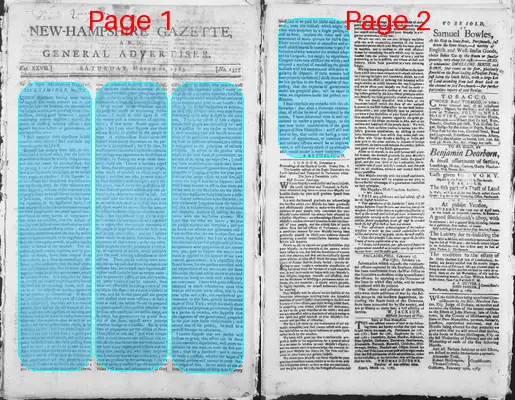
The New Hampshire Gazette And General Advertiser
Portsmouth, Exeter, Rockingham County, New Hampshire
What is this article about?
In 'The Examiner, No. VII,' a Republican defends New Hampshire's proposed constitution against objections concerning judicial salaries and independence, county registers, militia officer elections, and government expenses, arguing for its superiority and efficiency.
Merged-components note: This is a continuation of the editorial essay 'THE EXAMINER, NO. VII.' from page 1 to page 2, discussing objections to a proposed government plan. The second component was mislabeled as 'letter_to_editor' but is part of the same opinion piece.
Clippings
1 of 2
OCR Quality
Full Text
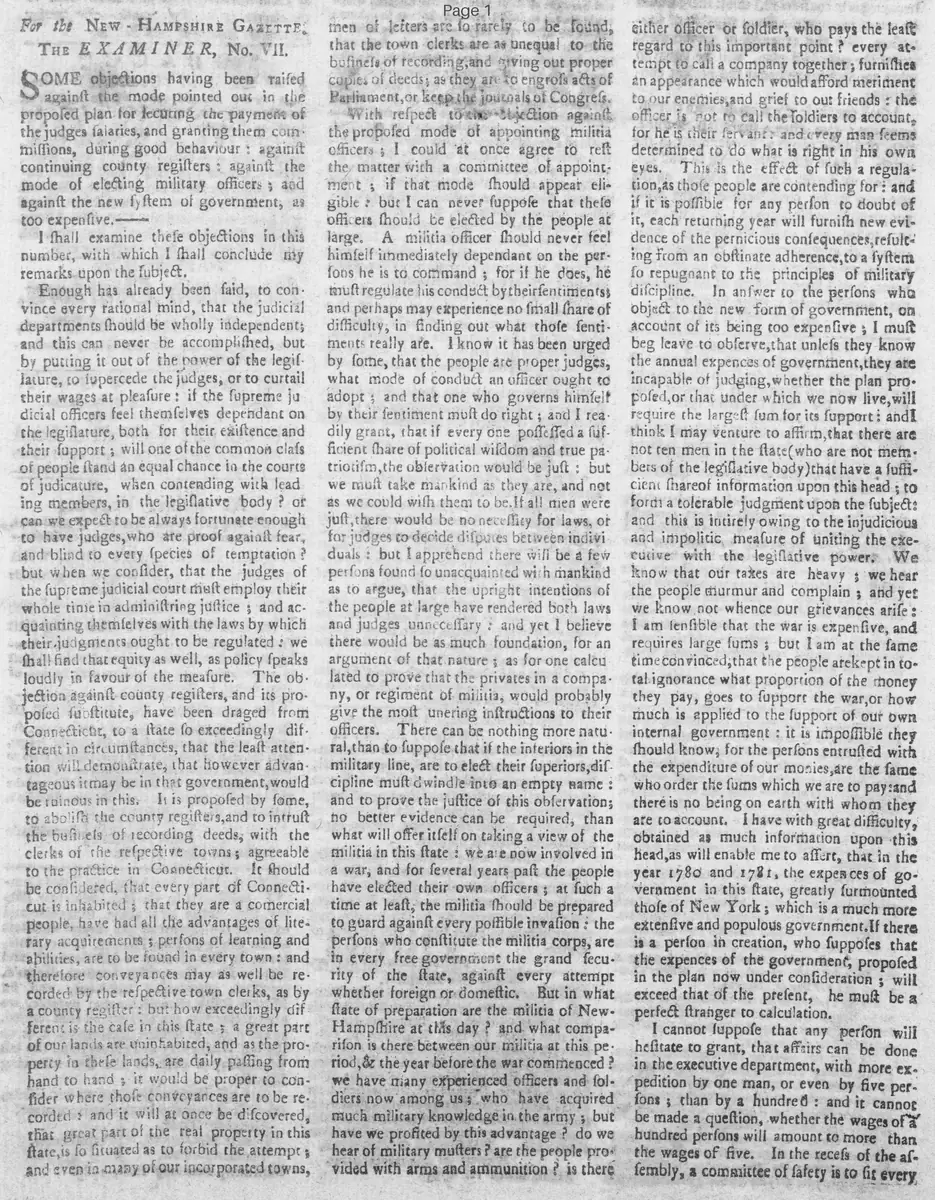
THE EXAMINER, NO. VII.
SOME objections having been raised against the mode pointed out in the proposed plan for securing the payment of the judges salaries, and granting them commissions, during good behaviour: against continuing county registers: against the mode of electing military officers; and against the new system of government, as too expensive.--
I shall examine these objections in this number, with which I shall conclude my remarks upon the subject.
Enough has already been said, to convince every rational mind, that the judicial departments should be wholly independent; and this can never be accomplished, but by putting it out of the power of the legislature, to supersede the judges, or to curtail their wages at pleasure: if the supreme judicial officers feel themselves dependent on the legislature, both for their existence and their support; will one of the common class of people stand an equal chance in the courts of judicature, when contending with leading members, in the legislative body? or can we expect to be always fortunate enough to have judges, who are proof against fear, and blind to every species of temptation?
But when we consider, that the judges of the supreme judicial court must employ their whole time in administering justice: and acquainting themselves with the laws by which their judgments ought to be regulated: we shall find that equity as well, as policy speaks loudly in favour of the measure. The objection against county registers, and its proposed substitute, have been dragged from Connecticut, to a state so exceedingly different in circumstances, that the least attention will demonstrate, that however advantageous it may be in that government, would be ruinous in this. It is proposed by some to abolish the county registers, and to intrust the business of recording deeds: with the clerks of the respective towns; agreeable to the practice in Connecticut. It should be considered, that every part of Connecticut is inhabited; that they are a commercial people, have had all the advantages of literary acquirements; persons of learning and abilities, are to be found in every town: and therefore conveyances may as well be recorded by the respective town clerks, as by a county register: but how exceedingly different is the case in this state; a great part of our lands are uninhabited, and as the property in these lands, are daily passing from hand to hand; it would be proper to consider where those conveyances are to be recorded: and it will at once be discovered, that great part of the real property in this state, is so situated as to forbid the attempt; and even in many of our incorporated towns,
men of letters are so rarely to be found, that the town clerks are as unequal to the business of recording, and giving out proper copies of deeds; as they are to engross acts of Parliament, or keep the journals of Congress.
With respect to the objection against the proposed mode of appointing militia officers; I could at once agree to refer the matter with a committee of appointment: if that mode should appear eligible: but I can never suppose that these officers should be elected by the people at large. A militia officer should never feel himself immediately dependent on the persons he is to command: for if he does, he must regulate his conduct by their sentiments; and perhaps may experience no small share of difficulty, in finding out what those sentiments really are. I know it has been urged by some, that the people are proper judges, what mode of conduct an officer ought to adopt; and that one who governs himself by their sentiment must do right: and I readily grant, that if every one possessed a sufficient share of political wisdom and true patriotism, the observation would be just: but we must take mankind as they are, and not as we could wish them to be. If all men were just, there would be no necessity for laws, or for judges to decide disputes between individuals: but I apprehend there will be a few persons found so unacquainted with mankind as to argue, that the upright intentions of the people at large have rendered both laws and judges unnecessary: and yet I believe there would be as much foundation, for an argument of that nature; as for one calculated to prove that the privates in a company, or regiment of militia, would probably give the most unerring instructions to their officers. There can be nothing more natural, than to suppose that if the inferiors in the military line, are to elect their superiors, discipline must dwindle into an empty name: and to prove the justice of this observation; no better evidence can be required, than what will offer itself on taking a view of the militia in this state: we are now involved in a war; and for several years past the people have elected their own officers; at such a time at least; the militia should be prepared to guard against every possible invasion: the persons who constitute the militia corps, are in every free government the grand security of the state, against every attempt whether foreign or domestic. But in what state of preparation are the militia of New-Hampshire at this day? and what comparison is there between our militia at this period, & the year before the war commenced? we have many experienced officers and soldiers now among us; who have acquired much military knowledge in the army; but have we profited by this advantage? do we hear of military musters? are the people provided with arms and ammunition? is there
either officer or soldier, who pays the least regard to this important point? every attempt to call a company together; furnishes an appearance which would afford merriment to our enemies, and grief to our friends: the officer is not to call the soldiers to account, for he is their servant: and every man seems determined to do what is right in his own eyes. This is the effect of such a regulation, as those people are contending for: and if it is possible for any person to doubt of it, each returning year will furnish new evidence of the pernicious consequences, resulting from an obstinate adherence, to a system so repugnant to the principles of military discipline. In answer to the persons who object to the new form of government, on account of its being too expensive; I must beg leave to observe, that unless they know the annual expenses of government, they are incapable of judging, whether the plan proposed, or that under which we now live, will require the largest sum for its support: and I think I may venture to affirm, that there are not ten men in the state (who are not members of the legislative body) that have a sufficient share of information upon this head: to afford a tolerable judgment upon the subject: and this is entirely owing to the injudicious and impolitic measure of uniting the executive with the legislative power. We know that our taxes are heavy: we hear the people murmur and complain; and yet we know not whence our grievances arise: I am sensible that the war is expensive, and requires large sums: but I am at the same time convinced; that the people are kept in total ignorance what proportion of the money they pay, goes to support the war, or how much is applied to the support of our own internal government: it is impossible they should know, for the persons entrusted with the expenditure of our monies, are the same who order the sums which we are to pay: and there is no being on earth with whom they are to account. I have with great difficulty, obtained as much information upon this head, as will enable me to assert, that in the year 1780 and 1781, the expenses of government in this state, greatly surpassed those of New York; which is a much more extensive and populous government. If there is a person in creation, who supposes that the expenses of the government, proposed in the plan now under consideration; will exceed that of the present, he must be a perfect stranger to calculation.
I cannot suppose that any person will hesitate to grant, that affairs can be done in the executive department, with more expedition by one man, or even by five persons; than by a hundred: and it cannot be made a question, whether the wages of a hundred persons will amount to more than the wages of five. In the recess of the assembly, a committee of safety is to meet every week, and to be paid for travel and attendance: even the business which might be done with propriety by a single person, in half an hour, requires the voice and the attendance of many persons for half a day. Have we not a number of expensive and almost useless boards & committees to pay? in imitation of what was once the method adopted by Congress: but taught by experience, Congress have now abolished the whole: and adopted a method of transacting the public business with less expense and with more regularity & dispatch. If these matters had been properly considered, I think there would be few persons in the state, capable of supposing, that the expenses of government under the proposed plan, will be equal to what we experience under the present constitution.
I shall conclude my remarks with this observation: that after a thorough examination, of all the forms of government in the union, I have discovered none so well calculated to render a people happy, as the one now under consideration of the good people of New Hampshire: and I will venture to say, that unless the having a committee of appointment, to nominate civil and military officers would be an improvement, it will scarcely admit of an alteration that would render it more complete.
A REPUBLICAN.
What sub-type of article is it?
What keywords are associated?
What entities or persons were involved?
Editorial Details
Primary Topic
Defense Of Proposed New Hampshire Constitution Against Objections On Judiciary, Registers, Militia, And Expenses
Stance / Tone
Strongly Supportive Of The Proposed Government Plan
Key Figures
Key Arguments