Thank you for visiting SNEWPapers!
Sign up free
The Enquirer
Richmond, Henrico County, Virginia
What is this article about?
An article from the American Daily Advertiser explores how heat from burning improves soil fertility, citing Judge Peters' paper, Virgil's Georgics, and a 1813 experiment by Mr. John Bowyer in Hunslet, England, where burnt soil produced luxuriant crops for years without manure, outperforming the rest of the field.
Clipping
OCR Quality
Full Text
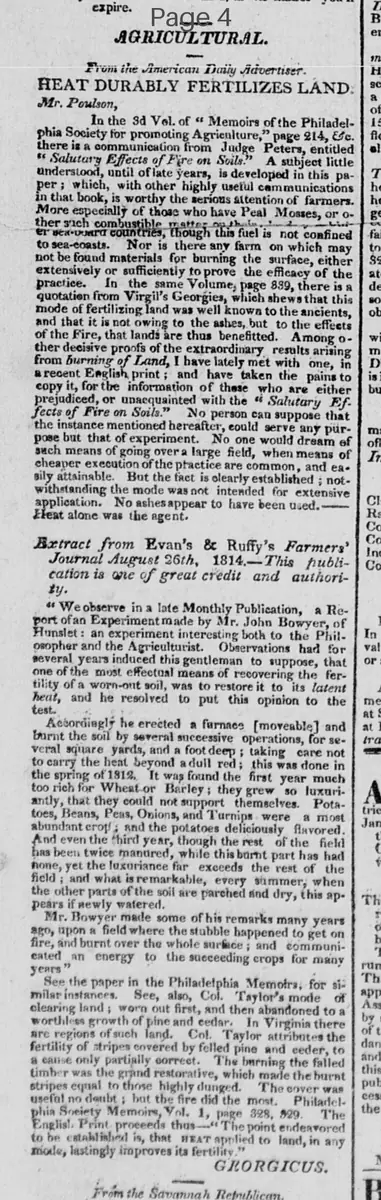
From the American Daily Advertiser.
HEAT DURABLY FERTILIZES LAND.
Mr. Poulson,
In the 3d Vol. of "Memoirs of the Philadelphia Society for promoting Agriculture," page 214, &c. there is a communication from Judge Peters, entitled "Salutary Effects of Fire on Soils." A subject little understood, until of late years, is developed in this paper; which, with other highly useful communications in that book, is worthy the serious attention of farmers. More especially of those who have Peat Mosses, or other such combustible matter on their farms in sea-vera countries, though this fuel is not confined to sea-coasts. Nor is there any farm on which may not be found materials for burning the surface, either extensively or sufficiently to prove the efficacy of the practice. In the same Volume, page 389, there is a quotation from Virgil's Georgics, which shews that this mode of fertilizing land was well known to the ancients, and that it is not owing to the ashes, but to the effects of the Fire, that lands are thus benefitted. Among other decisive proofs of the extraordinary results arising from burning of Land, I have lately met with one, in a recent English print; and have taken the pains to copy it, for the information of those who are either prejudiced, or unacquainted with the Salutary Effects of Fire on Soils." No person can suppose that the instance mentioned hereafter, could serve any purpose but that of experiment. No one would dream of such means of going over a large field, when means of cheaper execution of the practice are common, and easily attainable. But the fact is clearly established ; notwithstanding the mode was not intended for extensive application. No ashes appear to have been used.- Heat alone was the agent.
Extract from Evan's & Ruffy's Farmers' Journal August 26th, 1814.-This publication is one of great credit and authority.
" We observe in a late Monthly Publication, a Report of an Experiment made by Mr. John Bowyer, of Hunslet: an experiment interesting both to the Philosopher and the Agriculturist. Observations had for several years induced this gentleman to suppose, that one of the most effectual means of recovering the fertility of a worn-out soil, was to restore it to its latent heat, and he resolved to put this opinion to the test. Accordingly he erected a furnace [moveable] and burnt the soil by several successive operations, for several square yards, and a foot deep; taking care not to carry the heat beyond a dull red; this was done in the spring of 1813. It was found the first year much too rich for Wheat or Barley; they grew so luxuriantly, that they could not support themselves. Potatoes, Beans, Peas, Onions, and Turnips were a most abundant crop; and the potatoes deliciously flavored. And even the third year, though the rest of the field has been twice manured, while this burnt part has had none, yet the luxuriance far exceeds the rest of the field; and what is remarkable, every summer, when the other parts of the soil are parched and dry, this appears as if newly watered.
Mr. Bowyer made some of his remarks many years ago, upon a field where the stubble happened to get on fire, and burnt over the whole surface; and communicated an energy to the succeeding crops for many years"
See the paper in the Philadelphia Memoirs, for similar instances. See, also, Col. Taylor's mode of clearing land; worn out first, and then abandoned to a worthless growth of pine and cedar. In Virginia there are regions of such land. Col. Taylor attributes the fertility of stripes covered by felled pine and cedar, to a cause only partially correct. The burning the felled timber was the grand restorative, which made the burnt stripes equal to those highly dunged. The cover was useful no doubt ; but the fire did the most. Philadelphia Society Memoirs, Vol. 1, page 328, 329. The English Print proceeds thus-" The point endeavored to be established is, that heat applied to land, in any mode, lastingly improves its fertility."
GEORGICUS.
What sub-type of article is it?
What themes does it cover?
What keywords are associated?
What entities or persons were involved?
Where did it happen?
Story Details
Key Persons
Location
Hunslet, Virginia, Philadelphia
Event Date
Spring Of 1813, August 26th, 1814
Story Details
The article presents evidence that heat from fire improves soil fertility, referencing ancient knowledge from Virgil, Judge Peters' paper on fire's effects, Col. Taylor's land clearing in Virginia, and Mr. Bowyer's 1813 experiment burning soil in Hunslet, resulting in superior crops for years without manure.