Thank you for visiting SNEWPapers!
Sign up free
Literary
January 15, 1857
Yorkville Enquirer
York, York County, South Carolina
What is this article about?
The text explores the immense number of stars observable by naked eye and telescopes, referencing estimates by Sir John Herschel and his father, and concludes that nebulae are galaxies akin to the Milky Way, resolved by advanced instruments like Lord Rosse's reflector.
Clipping
OCR Quality
100%
Excellent
Full Text
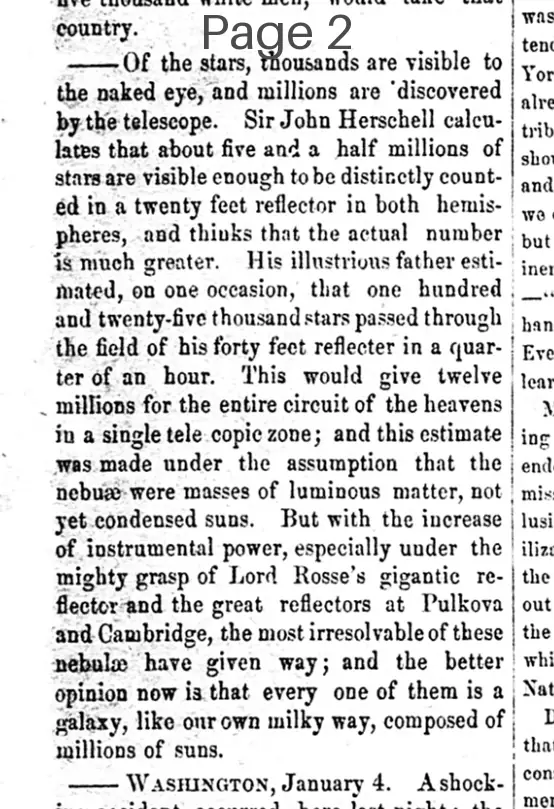
Of the stars, thousands are visible to the naked eye, and millions are discovered by the telescope. Sir John Herschel calculates that about five and a half millions of stars are visible enough to be distinctly counted in a twenty feet reflector in both hemispheres, and thinks that the actual number is much greater. His illustrious father estimated, on one occasion, that one hundred and twenty-five thousand stars passed through the field of his forty feet reflector in a quarter of an hour. This would give twelve millions for the entire circuit of the heavens in a single telescopic zone; and this estimate was made under the assumption that the nebulae were masses of luminous matter, not yet condensed suns. But with the increase of instrumental power, especially under the mighty grasp of Lord Rosse's gigantic reflector and the great reflectors at Pulkova and Cambridge, the most irresolvable of these nebulae have given way; and the better opinion now is that every one of them is a galaxy, like our own milky way, composed of millions of suns.
What sub-type of article is it?
Essay
What themes does it cover?
Nature
What keywords are associated?
Stars
Telescopes
Herschel
Nebulae
Galaxies
Astronomy
Reflectors
Literary Details
Key Lines
Of The Stars, Thousands Are Visible To The Naked Eye, And Millions Are Discovered By The Telescope.
Sir John Herschel Calculates That About Five And A Half Millions Of Stars Are Visible Enough To Be Distinctly Counted In A Twenty Feet Reflector In Both Hemispheres, And Thinks That The Actual Number Is Much Greater.
His Illustrious Father Estimated, On One Occasion, That One Hundred And Twenty Five Thousand Stars Passed Through The Field Of His Forty Feet Reflector In A Quarter Of An Hour.
But With The Increase Of Instrumental Power, Especially Under The Mighty Grasp Of Lord Rosse's Gigantic Reflector And The Great Reflectors At Pulkova And Cambridge, The Most Irresolvable Of These Nebulae Have Given Way; And The Better Opinion Now Is That Every One Of Them Is A Galaxy, Like Our Own Milky Way, Composed Of Millions Of Suns.