Thank you for visiting SNEWPapers!
Sign up free
Story
November 16, 1906
The Sisseton Weekly Standard
Sisseton, Roberts County, South Dakota
What is this article about?
Judge Carland rules against United States Express Company in Sioux Falls, affirming state railroad commissioners' jurisdiction over express companies as common carriers. The case challenged an order requiring acceptance of bank money shipments at reasonable hours, including overnight.
Clipping
OCR Quality
95%
Excellent
Full Text
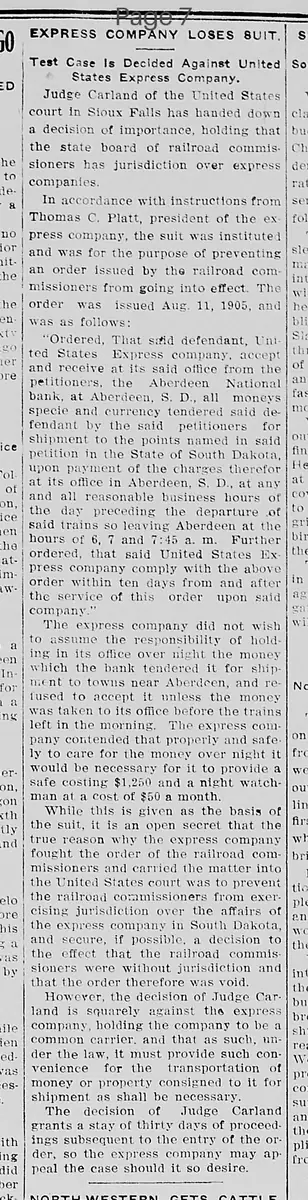
EXPRESS COMPANY LOSES SUIT,
Test Case Is Decided Against United
States Express Company.
Judge Carland of the United States
court in Sioux Falls has handed down
a decision of importance, holding that
the state board of railroad commis-
sioners has jurisdiction over express
companies.
In accordance with instructions from
Thomas C. Platt, president of the ex-
press company, the suit was instituted
and was for the purpose of preventing
an order issued by the railroad com-
missioners from going into effect. The
order was issued Aug. 11, 1905, and
was as follows:
"Ordered, That said defendant, Uni-
ted States Express company, accept
and receive at its said office from the
petitioners, the Aberdeen National
bank, at Aberdeen, S. D., all moneys,
specie and currency tendered said de-
fendant by the said petitioners for
shipment to the points named in said
petition in the State of South Dakota,
upon payment of the charges therefor
at its office in Aberdeen, S. D., at any
and all reasonable business hours of
the day preceding the departure of
said trains so leaving Aberdeen at the
hours of 6, 7 and 7:45 a. m. Further
ordered, that said United States Ex-
press company comply with the above
order within ten days from and after
the service of this order upon said
company."
The express company did not wish
to assume the responsibility of hold-
ing in its office over night the money
which the bank tendered it for ship-
ment to towns near Aberdeen, and re-
fused to accept it unless the money
was taken to its office before the trains
left in the morning. The express com-
pany contended that properly and safe-
ly to care for the money over night it
would be necessary for it to provide a
safe costing $1,250 and a night watch-
man at a cost of $50 a month.
While this is given as the basis of
the suit, it is an open secret that the
true reason why the express company
fought the order of the railroad com-
missioners and carried the matter into
the United States court was to prevent
the railroad commissioners from exer-
cising jurisdiction over the affairs of
the express company in South Dakota,
and secure, if possible, a decision to
the effect that the railroad commis-
sioners were without jurisdiction and
that the order therefore was void.
However, the decision of Judge Car-
land is squarely against the express
company, holding the company to be a
common carrier, and that as such, un-
der the law, it must provide such con-
venience for the transportation of
money or property consigned to it for
shipment as shall be necessary.
The decision of Judge Carland
grants a stay of thirty days of proceed-
ings subsequent to the entry of the or-
der, so the express company may ap-
peal the case should it so desire.
Test Case Is Decided Against United
States Express Company.
Judge Carland of the United States
court in Sioux Falls has handed down
a decision of importance, holding that
the state board of railroad commis-
sioners has jurisdiction over express
companies.
In accordance with instructions from
Thomas C. Platt, president of the ex-
press company, the suit was instituted
and was for the purpose of preventing
an order issued by the railroad com-
missioners from going into effect. The
order was issued Aug. 11, 1905, and
was as follows:
"Ordered, That said defendant, Uni-
ted States Express company, accept
and receive at its said office from the
petitioners, the Aberdeen National
bank, at Aberdeen, S. D., all moneys,
specie and currency tendered said de-
fendant by the said petitioners for
shipment to the points named in said
petition in the State of South Dakota,
upon payment of the charges therefor
at its office in Aberdeen, S. D., at any
and all reasonable business hours of
the day preceding the departure of
said trains so leaving Aberdeen at the
hours of 6, 7 and 7:45 a. m. Further
ordered, that said United States Ex-
press company comply with the above
order within ten days from and after
the service of this order upon said
company."
The express company did not wish
to assume the responsibility of hold-
ing in its office over night the money
which the bank tendered it for ship-
ment to towns near Aberdeen, and re-
fused to accept it unless the money
was taken to its office before the trains
left in the morning. The express com-
pany contended that properly and safe-
ly to care for the money over night it
would be necessary for it to provide a
safe costing $1,250 and a night watch-
man at a cost of $50 a month.
While this is given as the basis of
the suit, it is an open secret that the
true reason why the express company
fought the order of the railroad com-
missioners and carried the matter into
the United States court was to prevent
the railroad commissioners from exer-
cising jurisdiction over the affairs of
the express company in South Dakota,
and secure, if possible, a decision to
the effect that the railroad commis-
sioners were without jurisdiction and
that the order therefore was void.
However, the decision of Judge Car-
land is squarely against the express
company, holding the company to be a
common carrier, and that as such, un-
der the law, it must provide such con-
venience for the transportation of
money or property consigned to it for
shipment as shall be necessary.
The decision of Judge Carland
grants a stay of thirty days of proceed-
ings subsequent to the entry of the or-
der, so the express company may ap-
peal the case should it so desire.
What sub-type of article is it?
Historical Event
What themes does it cover?
Justice
What keywords are associated?
Express Company
Railroad Commissioners
Jurisdiction
Court Decision
Common Carrier
Money Shipment
What entities or persons were involved?
Judge Carland
Thomas C. Platt
Aberdeen National Bank
Where did it happen?
Sioux Falls, Aberdeen, S. D.
Story Details
Key Persons
Judge Carland
Thomas C. Platt
Aberdeen National Bank
Location
Sioux Falls, Aberdeen, S. D.
Event Date
Aug. 11, 1905
Story Details
United States Express Company loses test case against state railroad commissioners' order to accept bank money shipments at reasonable hours, including overnight; court holds express companies as common carriers under state jurisdiction.