Thank you for visiting SNEWPapers!
Sign up free
The Providence Journal, And Town And Country Advertiser
Providence, Providence County, Rhode Island
What is this article about?
In Queens County Court on the 17th ult., Walter Dunlevy was convicted of manslaughter for killing Benjamin Fish in a tavern quarrel on December 2 last. The judge viewed it as murder with aggravating circumstances and sentenced him to 14 years imprisonment.
Clipping
OCR Quality
Full Text
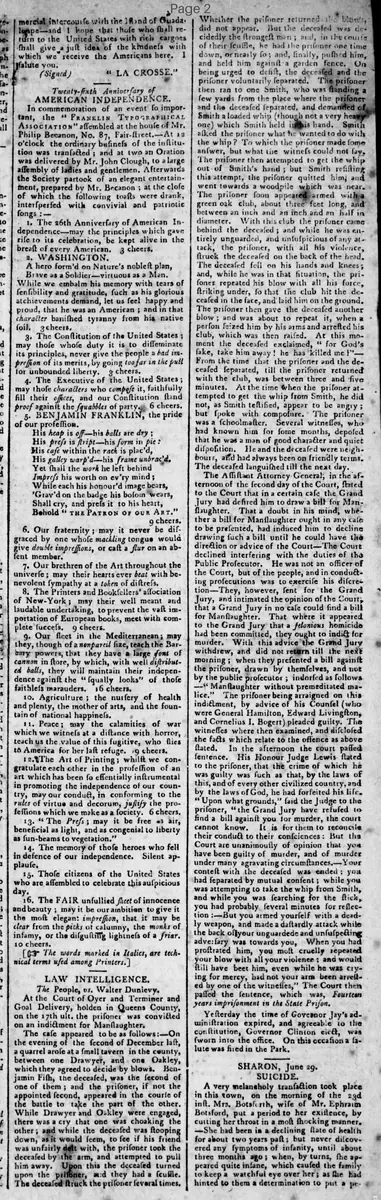
The People, vs. Walter Dunlevy.
At the Court of Oyer and Terminer and Goal Delivery, holden in Queens County, on the 17th ult. the prisoner was convicted on an indictment for Manslaughter.
The case appeared to be as follows;--On the evening of the second of December last, a quarrel arose at a small tavern in the county, between one Drawyer, and one Oakley, which they agreed to decide by blows. Benjamin Fish, the deceased, was the second of one of them; and the prisoner, if not the appointed second, appeared in the course of the battle to take the part of the other. While Drawyer and Oakley were engaged, there was a cry that one was choking the other; and while the deceased was stooping down, as it would seem, to see if his friend was unfairly dealt with, the prisoner took the deceased by the arm, and attempted to pull him away. Upon this the deceased turned upon the prisoner, and they had a scuffle. The deceased struck the prisoner several times. Whether the prisoner returned blows, did not appear. But the deceased was decidedly the strongest man; and, in the course of their scuffle, he had the prisoner one time down, or nearly so; and, finally, pushed him, and held him against a garden fence. On being urged to desist, the deceased and the prisoner voluntarily separated. The prisoner then ran to one Smith, who was standing a few yards from the place where the prisoner and the deceased separated, and demanded of Smith a loaded whip (though not a very heavy one) which Smith held in his hand. Smith asked the prisoner what he wanted to do with the whip? To which the prisoner made some answer, but what the witness could not say. The prisoner then attempted to get the whip out of Smith's hand; but Smith resisting this attempt, the prisoner quitted him; and went towards a woodpile which was near. The prisoner soon appeared armed with a green oak club, about three feet long, and between an inch and an inch and a half in diameter. With this club the prisoner came behind the deceased; and while he was entirely unguarded, and unsuspicious of any attack, the prisoner, with all his violence, struck the deceased on the back of the head. The deceased fell on his hands and knees; and, while he was in that situation, the prisoner repeated his blow with all his force, striking under, so that the club hit the deceased in the face, and laid him on the ground. The prisoner then gave the deceased another blow; and was about to repeat it, when a person seized him by his arms and arrested his club, which was then raised. At this moment the deceased exclaimed, "for God's sake, take him away! he has killed me!" From the time that the prisoner and the deceased separated, till the prisoner returned with the club, was between three and five minutes. At the time when the prisoner attempted to get the whip from Smith, he did not, as Smith testified, appear to be angry; but spoke with composure. The prisoner was a schoolmaster. Several witnesses, who had known him for some months, deposed that he was a man of good character and quiet disposition. He and the deceased were neighbours, and had always been on friendly terms. The deceased languished till the next day.
The Assistant Attorney General; in the afternoon of the second day of the Court, Stated to the Court that in a certain case the Grand Jury had desired him to draw a bill for Manslaughter. That a doubt in his mind, whether a bill for Manslaughter ought in any case to be presented, had induced him to decline drawing such a bill until he could have the direction or advice of the Court--The Court declined interfering with the duties of the Public Prosecutor. He was not an officer of the Court, but of the people, and in conducting prosecutions was to exercise his discretion--They, however, sent for the Grand Jury, and intimated the opinion of the Court, that a Grand Jury in no case could find a bill for Manslaughter. That where it appeared to the Grand Jury that a felonious homicide had been committed, they ought to indict for murder. With this advice the Grand Jury withdrew, and did not return till the next morning; when they presented a bill against the prisoner, drawn by themselves, and not by the public prosecutor; indorsed as follows "Manslaughter without premeditated malice." The prisoner being arraigned on this indictment, by advice of his Counsel (who were General Hamilton, Edward Livingston, and Cornelius I. Bogert) pleaded guilty. The witnesses were then examined, and disclosed the facts which relate to the offence as above stated. In the afternoon the court passed sentence. His Honour Judge Lewis Stated to the prisoner, that the crime of which he was guilty was such as that, by the laws of this, and of every other civilized country, and by the laws of God, he had forfeited his life. "Upon what grounds," said the Judge to the prisoner, "the Grand Jury have refused to find a bill against you for murder, the court cannot know. It is for them to reconcile their conduct to their consciences: But the Court are unanimously of opinion that you have been guilty of murder, and of murder under many aggravating circumstances.--Your contest with the deceased was ended; you had separated by mutual consent; while you was attempting to take the whip from Smith, and while you was searching for the stick, you had probably several minutes for reflection:--But you armed yourself with a deadly weapon, and made a dastardly attack while the back of your unguarded and unsuspicious adversary was towards you. When you had prostrated him, you most cruelly repeated your blow with all your violence; and would still have beat him, even while he was crying for mercy, had not your arm been arrested by one of the witnesses," The Court then passed the sentence, which was, Fourteen years imprisonment in the State Prison.
What sub-type of article is it?
What keywords are associated?
What entities or persons were involved?
Where did it happen?
Domestic News Details
Primary Location
Queens County
Event Date
17th Ult.
Key Persons
Outcome
benjamin fish died the next day after being struck with a club; walter dunlevy sentenced to fourteen years imprisonment in the state prison.
Event Details
Walter Dunlevy, a schoolmaster, intervened in a fight at a tavern between Drawyer and Oakley on the evening of December 2 last, leading to a scuffle with Benjamin Fish, who was stronger and pinned him against a fence. After separating, Dunlevy armed himself with a club and struck Fish from behind on the head, repeating blows until stopped, causing Fish's death. At trial on the 17th ult., despite Grand Jury's manslaughter bill, the court deemed it murder and sentenced him accordingly.