Thank you for visiting SNEWPapers!
Sign up free
Jenks's Portland Gazette
Portland, Cumberland County, Maine
What is this article about?
Excerpt from Burke's posthumous works offering advice to Louis XVIII on restoring order in France post-revolution: advocate measured justice against regicides and Jacobins, indemnity for the masses and certain offenses, emphasizing mercy and legal trials to ensure peace.
Clipping
OCR Quality
Full Text
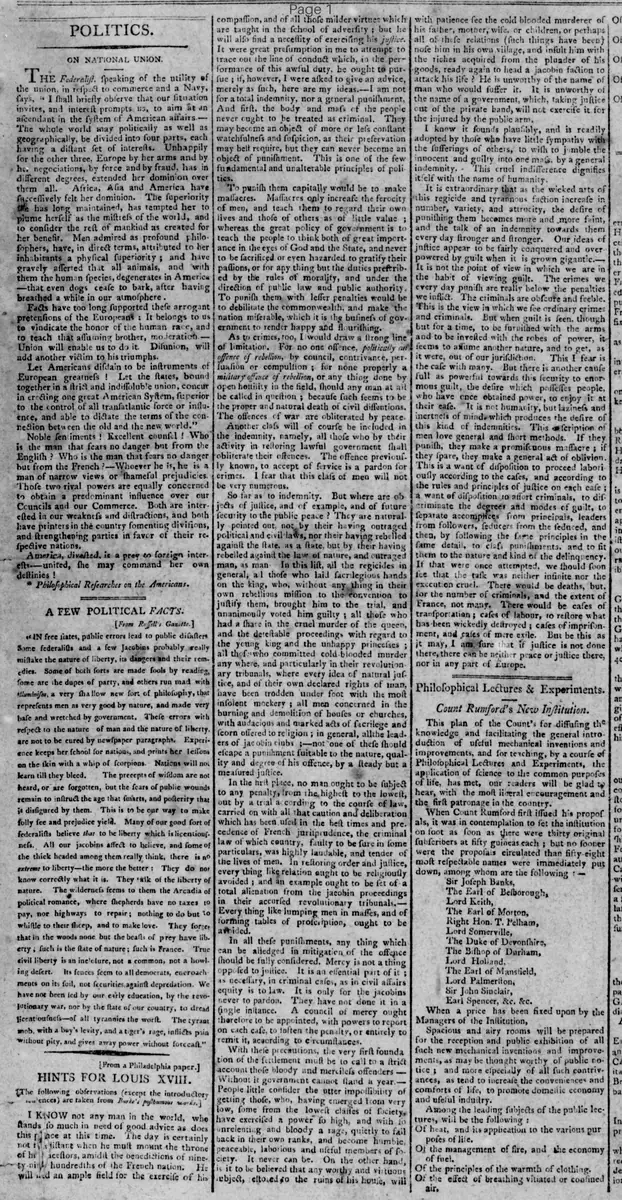
HINTS FOR LOUIS XVIII.
The following observations (except the introductory sentences) are taken from Burke's posthumous works.
I know not any man in the world, who stands so much in need of good advice as does this Prince at this time. The day is certainly not distant when he must mount the throne of his ancestors, amidst the benedictions of ninety-nine hundredths of the French nation. He will need an ample field for the exercise of his compassion, and of all those milder virtues which are taught in the school of adversity: but he will also find a necessity of exercising his justice. It were great presumption in me to attempt to trace out the line of conduct which, in the performance of this awful duty, he ought to pursue; if, however, I were asked to give an advice, merely as such, here are my ideas.--I am not for a total indemnity, nor a general punishment. And first, the body and mass of the people never ought to be treated as criminal. They may become an object of more or less constant watchfulness and suspicion, as their preservation may best require, but they can never become an object of punishment. This is one of the few fundamental and unalterable principles of politics. To punish them capitally would be to make massacres. Massacres only increase the ferocity of men, and teach them to regard their own lives and those of others as of little value; whereas the great policy of government is to teach the people to think both of great importance in the eyes of God and the State, and never to be sacrificed or even hazarded to gratify their passions, or for any thing but the duties prescribed by the rules of morality, and under the direction of public law and public authority. To punish them with lesser penalties would be to debilitate the commonwealth, and make the nation miserable, which it is the business of government to render happy and flourishing. As to crimes, too, I would draw a strong line of limitation. For no one offence, politically an offence of rebellion, by counsel, contrivance, persuasion or compulsion; for none properly a military offence of rebellion, or any thing done by open hostility in the field, should any man at all be called in question: because such seems to be the proper and natural death of civil dissensions. The offences of war are obliterated by peace. Another class will of course be included in the indemnity, namely, all those who by their activity in restoring lawful government shall obliterate their offences. The offence previously known, to accept of service is a pardon for crimes. I fear that this class of men will not be very numerous. So far as to indemnity. But where are objects of justice, and of example, and of future security to the public peace? They are naturally pointed out, not by their having outraged political and civil laws, nor their having rebelled against the state, as a state, but by their having rebelled against the law of nature, and outraged man, as man. In this list, all the regicides in general; all those who laid sacrilegious hands on the king, who, without any thing in their own rebellious mission to the convention to justify them, brought him to the trial, and unanimously voted him guilty; all those who had a share in the cruel murder of the queen, and the detestable proceedings with regard to the young king and the unhappy princesses; all those who committed cold-blooded murder any where, and particularly in their revolutionary tribunals, where every idea of natural justice, and of their own declared rights of man, have been trodden under foot with the most insolent mockery; all men concerned in the burning and demolition of houses or churches, with audacious and marked acts of sacrilege and contumelies offered to religion; in general, all the leaders of jacobins clubs;--not one of these should escape a punishment suitable to the nature, quality and degree of his offence, by a steady but a measured justice. In the first place, no man ought to be subject to any penalty, from the highest to the lowest, but by a trial according to the course of law, carried on with all that caution and deliberation which has been used in the best times and precedents of French jurisprudence, the criminal law of which country, faulty to be sure in some particulars, was highly laudable, and tender of the lives of men. In restoring order and justice, every thing like retaliation ought to be religiously avoided; and an example ought to be set of a total alienation from the jacobins proceedings in their accursed revolutionary tribunals.--Every thing like lumping men in masses, and of forming tables of proscription, ought to be avoided. In all these punishments, any thing which can be alleged in mitigation of the offence should be fully considered. Mercy is not a thing opposed to justice. It is an essential part of it; as necessary, in criminal cases, as in civil affairs equity is to law. It is only for the jacobins never to pardon. They have not done it in a single instance. A council of mercy ought therefore to be appointed, with powers to report on each case, to lessen the penalty, or entirely to remit it, according to circumstances. With these precautions, the very first foundation of the settlement must be to call to a strict account those bloody and merciless offenders--Without it government cannot stand a year.--People little consider the utter impossibility of getting those, who, having emerged from very low, some from the lowest classes of society, have exercised a power so high, and with so unrelenting and bloody a rage, quietly to fall back in their own ranks, and become humble, peaceable, laborious and useful members of society. It never can be. On the other hand, is it to be believed that any worthy and virtuous subject, exiled to the ruins of his house, will with patience see the cold blooded murderer of his father, mother, wife, or children, or perhaps all of these relations (such things have been) move him in his own village, and insult him with the riches acquired from the plunder of his goods, ready again to head a jacobins faction to attack his life? He is unworthy of the name of man who would suffer it. It is unworthy of the name of a government, which, taking justice out of the private hand, will not exercise it for the injured by the public arm. I know it sounds plausibly, and is readily adopted by those who have little sympathy with the sufferings of others, to wish to jumble the innocent and guilty into one mass, by a general indemnity. --This cruel indifference dignifies itself with the name of humanity. It is extraordinary that as the wicked arts of this regicide and tyrannous faction increase in number, variety, and atrocity, the desire of punishing them becomes more and more faint, and the talk of an indemnity towards them every day stronger and stronger. Our ideas of justice appear to be fairly conquered and over-powered by guilt when it is grown gigantic.--It is not the point of view in which we are in the habit of viewing guilt. The crimes we every day punish are really below the penalties we inflict. The criminals are obscure and feeble. This is the view in which we see ordinary crimes and criminals. But when guilt is seen, though but for a time, to be furnished with the arms and to be invested with the robes of power, it seems to assume another nature, and to get, as it were, out of our jurisdiction. This I fear is the case with many. But there is another cause full as powerful towards this security to enormous guilt, the desire which possesses people, who have once obtained power, to enjoy it at their ease. It is not humanity, but laziness and inertness of mind, which produces the desire of this kind of indemnities. This description of men love general and short methods. If they punish, they make a promiscuous massacre; if they spare, they make a general act of oblivion. This is a want of disposition to proceed laboriously according to the cases, and according to the rules and principles of justice on each case; a want of disposition to assort criminals, to discriminate the degrees and modes of guilt, to separate accomplices from principals, leaders from followers, seducers from the seduced, and then, by following the same principles in the same detail, to class punishments, and to fit them to the nature and kind of the delinquency. If that were once attempted, we should soon see that the task was neither infinite nor the execution cruel. There would be deaths, but, for the number of criminals, and the extent of France, not many. There would be cases of transportation; cases of labour, to restore what has been wickedly destroyed; cases of imprisonment, and cases of mere exile. But be this as it may, I am sure that if justice is not done there, there can be neither peace nor justice there, nor in any part of Europe.
What sub-type of article is it?
What keywords are associated?
What entities or persons were involved?
Where did it happen?
Foreign News Details
Primary Location
France
Key Persons
Event Details
Edmund Burke's posthumous advice to Louis XVIII on governing post-revolution France: grant indemnity to the masses and those involved in civil dissensions or restoring the monarchy, but strictly punish regicides, Jacobin leaders, and perpetrators of atrocities against humanity through measured legal justice, trials, and a council of mercy to ensure lasting peace and security.