Thank you for visiting SNEWPapers!
Sign up free
Constitutional Whig
Richmond, Virginia
What is this article about?
A clerk criticizes a Virginia General Assembly bill regulating court clerks' fees as unjust, particularly oppressive to Superior Court clerks due to unequal compensation for greater workload compared to County Court clerks. He urges fellow clerks to protest and petition for redress.
Clipping
OCR Quality
Full Text
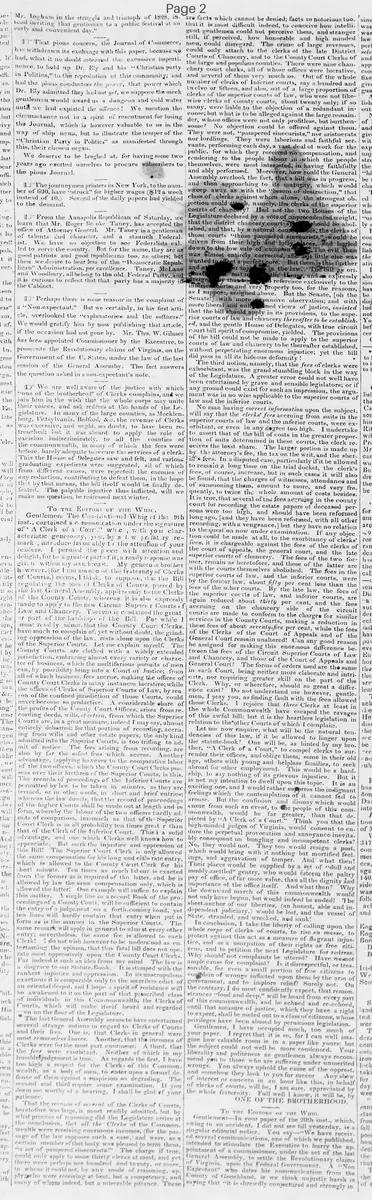
Gentlemen: The Constitutional Whig of the 9th inst., contained a communication under the signature of "A Clerk of a Court," which, with your characteristic generosity, you, by a few prefatory remarks, introduce favorably to the attention of your readers. I perused the piece with attention and delight, for to a greater part of it, a ready response was given within my own breast. My generous brother however, (for I too am one of the fraternity of Clerks of Courts,) seems, I think, to suppose, that the Bill regulating the fees of Clerks of Courts, passed by the last General Assembly, applies only to the Clerks of the County Courts, whereas it is also expressly made to apply to the new Circuit Superior Courts of Law and Chancery. Therein is contained the great "rub" of the Bill. For while I most roundly admit, that the County Court Clerks, have much to complain of, yet without doubt, the grinding oppression of the law, rests alone upon the Clerks of the Superior Courts. Let me explain myself. The County Courts are clothed with a widely extended jurisdiction, embracing almost every variety or character of business, which the multifarious pursuits of men can, by possibility bring into a Court of Justice; from all of which business, fees accrue, making the offices of County Court Clerks in many instances lucrative; while the offices of Clerks of Superior Courts of Law, by reason of the confined jurisdiction of those Courts, could never become so productive. A considerable share of the profits of the County Court Offices, arises from recording deeds, wills, et cetera, from which the Superior Courts are, in a great measure, indeed I may say, almost entirely debarred: for that portion of recording, accruing from wills and other estate papers, the only kind admitted into the Superior Courts, is too trifling to admit of notice. The fees arising from recording, are also by far the safest fees which accrue. Another advantage, (applying however to the comparative labor of the two offices,) which the County Court Clerks possess over their brethren of the Superior Courts, is this. The records of proceedings of the Inferior Courts are permitted by law to be taken in minutes, as they are termed, or in other words, in short and brief entries; whereas the law directs, that the record of proceedings of the higher Courts shall be made out at length and in form, whereby the labour of the two officers hardly admits of comparison, inasmuch as that of the Superior Court Clerk is in all probability ten times greater than that of the Clerk of the Inferior Court. This is a solid advantage, and one which Clerks well know how to appreciate. But mark the injustice and oppression of this Bill! The Superior Court Clerk is only allowed the same compensation for his long and elaborate entry, which is allowed to the County Court Clerk for his short minute. Ten times as much labour is exacted from the former as is required of the latter, and he is allowed by law the same compensation only, which is allowed the latter! One example will suffice to explain this matter. A single line in a record Book of the proceedings of a County Court, will be sufficient to contain the entry of a judgment on a forthcoming bond, yet ten lines will hardly contain that entry when put in form as is the manner in the Superior Courts. The same remark will apply in general to almost every other entry; nevertheless, the same fee is allowed to each Clerk! I do not wish however to be understood as entertaining the opinion, that this fatal bill does not operate most oppressively upon the County Court Clerks. Far indeed is such an idea from my mind. The law is a disgrace to our Statute Book. It is stamped with the rankest injustice and oppression. In its unscrupulous exactions it is comparable only to the merciless edict of an oriental despot, and I hope a spirit of resistance will be awakened to it on the part of that proscribed class of individuals in this Commonwealth, the Clerks of Courts, which will make itself heard and regarded on the floor of the Legislature.
The last General Assembly seems to have entertained several strange notions in regard to Clerks of Courts and their fees. One is, that Clerks in general were most remorseless knaves. Another, that the incomes of Clerks were for the most part enormous: A third, that the fees were exorbitant. Neither of which in my humble judgement is true. As regards the first, I have too high a respect for the Clerks of this Commonwealth, as a body of men, to enter upon a formal defence of them against a suspicion so degrading. The second and third require some examination. If you deem me worthy of a hearing, I shall be glad of your patience.
That the revenue of several of the Clerks of Courts, heretofore was large, is most readily admitted, but by what process of reasoning did the Legislature arrive at the conclusion, that all the Clerks of the Commonwealth were receiving enormous incomes, (for the passage of the law supposes such a case, and were, as a certain member of that body was pleased to term them, "a set of pampered sinecurists?" The charge if true, could only apply to some thirty clerks at most, and yet there were perhaps one hundred and twenty, or more, to whom it could not, by any mode of reasoning, apply: who were receiving at least, but a competency, and many of whom indeed, but a miserable pittance. These are facts which cannot be denied: facts so notorious too, that it is most difficult indeed, to conceive how intelligent gentlemen could not perceive them, and stranger still, if perceived, how honorable and high minded men, could disregard. The crime of large revenues, could only attach to the clerks of the late District Courts of Chancery, and to the County Court Clerks of the large and populous counties. There were nine chancery court clerks, all of whose offices were lucrative, and several of them very much so. Out of the whole number of clerks of Inferior courts, say a hundred and twelve or fifteen, and also, out of a large proportion of clerks of the superior courts of law, who were not like- wise clerks of county courts, about twenty only; if so many. were liable to the objection of a redundant income; but what is to be alleged against the large remainder, whose offices were not only profitless, but burthensome? No objection could be offered against them. They were not, "pampered sinecurists," nor aristocrats nor lordlings. They were laborious and faithful servants, performing each day, a vast deal of work for the public, for which they received no compensation, and rendering to the people labour in which the people themselves, were most interested, in having faithfully and ably performed. Moreover, how could the General Assembly overlook the fact, that a bill was in progress, and then approaching to its maturity, which would sweep away as with the "besom of destruction," that class of clerks against whom alone, the strongest objection could attach, namely, the clerks of the superior courts of chancery? Had not the two Houses of the Legislature declared by a vote of unprecedented weight, that the district chancery court system should be abolished, and that, by a natural consequence, the clerks of those courts "those pampered sinecurists," would be driven from their high and lofty places, and hurled down to the low vale of common? The evil then was almost entirely corrected, and but little else was wanted to effect a perfect cure. But there is this further and serious error in the law. The bill as originally introduced into the House, and as expressly designed by that body, had reference exclusively to the inferior courts: and very properly too, for the reasons, as I suppose, assigned above. But the Senate, [oh the Senate! with more expansive observation; and with more liberal and enlightened views of justice, insisted that the bill should apply in its provisions, to the superior courts of law and chancery thereafter to be established, and the gentle House of Delegates, with true circuit court bill spirit of compromise, yielded. The provisions of the bill could not be made to apply to the superior courts of law and chancery to be thereafter established, without perpetrating enormous injustice; yet the bill did pass in all its hideous deformity!
The third notion, namely, that the fees of clerks were exhorbitant, was the grand stumbling block in the way of the Legislature. A greater error could not well have been entertained by grave and sensible legislators; or if any ground could exist for such an impression, the argument was in no wise applicable to the superior courts of law and the inferior courts.
No man having correct information upon the subject, will say that the clerks' fees accruing from suits in the superior courts of law and the inferior courts, were exorbitant, or even in any degree too high. I undertake to assert that of the bill of costs in the greater proportion of suits determined in these courts, the clerk receives the least share. The larger portion is made up by the attorney's fee, the tax on the writ, and the sheriff's fees. In a disputed case, particularly if it be allowed to remain a long time on the trial docket, the clerk's fees, of course, increase, but in such cases it will also be found, that the charges of witnesses, attendance and of summoning them, amount to more, and very frequently, to twice the whole amount of costs besides. It is true, that several of the fees accruing in the county court for recording the estate papers of deceased persons were too high, and should have been reformed long ago. [and they have been reformed, with all other recording, with a vengeance,] but they have no relation to the question now under examination. If any objection could be made at all, to the exorbitancy of clerks' fees, it is chargeable against the fees of the clerks of the court of appeals, the general court, and the late superior courts of chancery. The fees of the two former, remain as heretofore, and those of the latter are with the courts themselves abolished. The fees in the superior courts of law, and the inferior courts, were by the former law, about fifty per cent less than the fees of the other courts. By the late law, the fees of the superior courts of law, and inferior courts, are again reduced about thirty per cent, and the fees accruing on the chancery side of the circuit courts are made to conform to the charges for similar services in the County Courts, making a reduction in these fees of about seventy-five per cent, while the fees of the Clerks of the Court of Appeals and of the General Court remain unaltered! Can any good reason be assigned for making this enormous difference between the fees of the Circuit Superior Courts of Law and Chancery, and those of the Court of Appeals and General Court? The forms of orders used are the same in each Court, being neither more elaborate and intricate, nor requiring greater skill on the part of the Clerk. Why, or wherefore, should so great a difference exist? Do not understand me however, gentlemen, I pray you, as finding fault with the fees allowed those Clerks. I rejoice that three Clerks at least in the whole Commonwealth have escaped the ravages of this awful bill: but it is the heartless legislation in relation to the other Courts of which I complain.
Let me now enquire, what will be the natural tendencies of this law, if it be allowed to linger upon the statute-book? One will be, as hinted by my brother, "A Clerk of a Court," to compel clerks to surrender their offices, and oblige them, some in their old age, others with young and helpless families, to seek abroad for other employment. This would be a hardship, to say nothing of its grievous injustice. But it is not my intention to dwell upon this topic. It is an exciting one, and I would rather suppress the indignant feelings which the contemplation of it cannot fail to arouse. But the confusion and dismay which would ensue from such an event, to the people of this commonwealth, would be far greater, than that depicted by "A Clerk of a Court." Think you that the high-minded judges of Virginia, would consent to endure the perpetual provocation and annoyance inevitably consequent on bungling and incompetent clerks? No, they would not. They too would resign a post, which would bring with it nothing but mortified feelings, and aggravation of temper. And what then? Their places would be supplied by a set of "dull and muddy-mettled" gentry, who would esteem the paltry pay of office, of far more value, than all the dignity and importance of the office itself. And what then? Why the downward march of this commonwealth would not only have begun, but would indeed be ended! The sheet-anchor of our liberties, (an honest, able and independent judiciary,) would be lost, and the vessel of State, stranded, and wrecked, and sunk!
In conclusion, I take the liberty of calling upon the whole corps of clerks of courts, to rise en masse, to protest against this act as a measure of flagrant injustice, and as a usurpation of their rights as free citizens, and to petition the next Legislature for redress. Why should not complaints be uttered? Have we not ample cause for complaint? Is it disrespectful, or treasonable, for even a small portion of free citizens to complain of wrongs inflicted upon them by the arm of government, and to implore relief? Surely not. On the contrary, I do most confidently expect, that remonstrances "loud and deep," will be heard from every part of this commonwealth, and be echoed and re-echoed, until that measure of justice, which they have a right to expect, shall be meted out to a class of citizens, whose privileges have been abused by pernicious legislation.
Gentlemen, I have occupied much, too much of your paper. I regret that it is so, for I can well imagine how valuable room is in a paper like yours: but the subject could not well be more condensed. Your liberality and politeness as gentlemen always recommend you to those who are suffering under unmerited wrongs. You always uphold the cause of the oppressed, and somehow they look to you for succor. Any show of interest or concern in an hour like this, in behalf of clerks of courts, will be, I am sure, appreciated by the whole fraternity. Full well I know, it will be, by ONE OF THE BROTHERHOOD.
What sub-type of article is it?
What themes does it cover?
What keywords are associated?
What entities or persons were involved?
Letter to Editor Details
Author
One Of The Brotherhood
Recipient
The Editors Of The Whig
Main Argument
the bill passed by the last general assembly regulating clerks of courts' fees is unjust and oppressive, especially to superior court clerks who face greater labor for the same compensation as county court clerks, and it rests on false assumptions about clerks' incomes and fees; clerks should protest and petition for repeal.
Notable Details