Thank you for visiting SNEWPapers!
Sign up free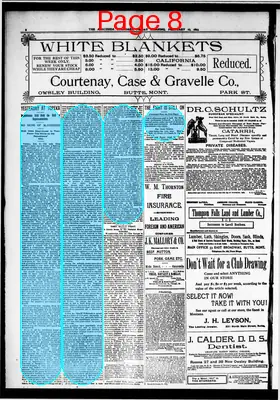
Story
February 17, 1893
The Anaconda Standard
Anaconda, Deer Lodge County, Montana
What is this article about?
In Topeka, Kansas, on Feb. 16, Republicans hold the House amid tensions with Populists and Governor Lewelling. Militia disobeys orders to eject them, sheriff arms posse for Republicans, leading to armed truce and compromise proposals. No violence occurs despite threats.
Clipping
OCR Quality
95%
Excellent
Full Text
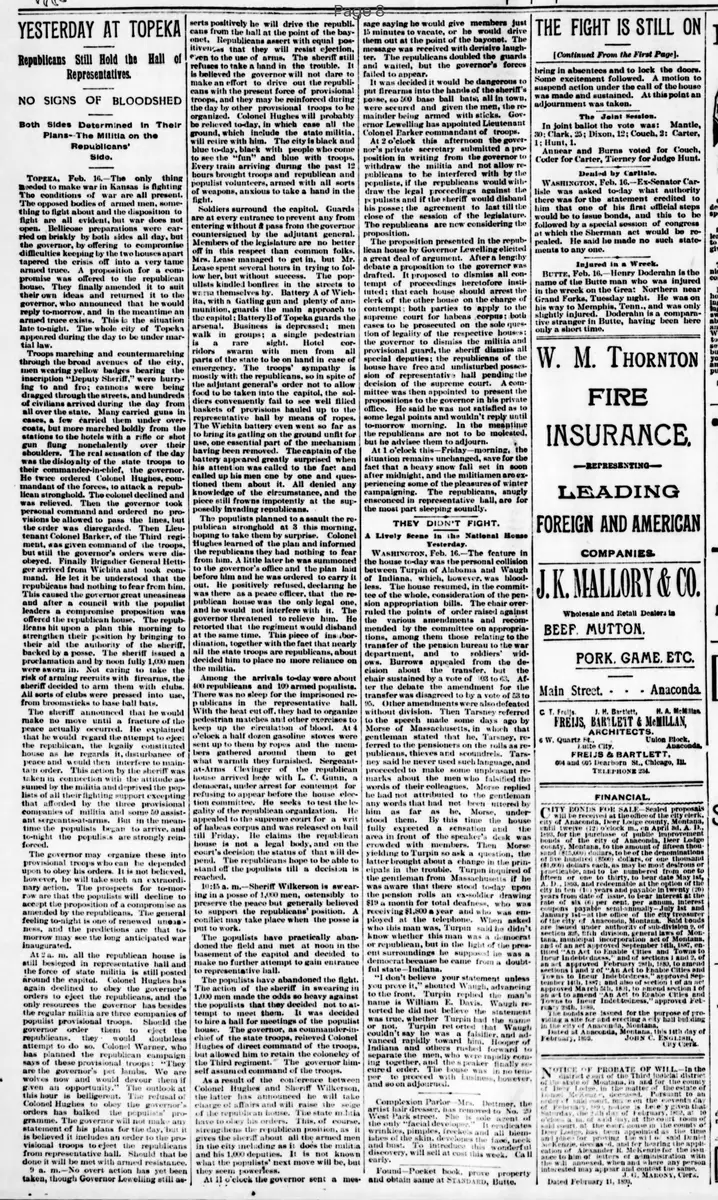
YESTERDAY AT TOPEKA
Republicans Still Hold the Hall of Representatives.
NO SIGNS OF BLOODSHED
Both Sides Determined In Their Plans--The Militia on the Republicans' Side.
Topeka, Feb. 16.--The only thing needed to make war in Kansas is fighting. The conditions of war are all present. The opposed bodies of armed men, something to fight about and the disposition to fight are all evident, but war does not open. Bellicose preparations were carried on briskly by both sides all day, but the governor, by offering to compromise difficulties keeping by the two houses apart tapered the crisis off into a very tame armed truce. A proposition for a compromise was offered to the republican house. They finally amended it to suit their own ideas and returned it to the governor, who announced that he would reply to-morrow, and in the meantime an armed truce exists. This is the situation late to-night. The whole city of Topeka appeared during the day to be under martial law. Troops marching and countermarching through the broad avenues of the city, men wearing yellow badges bearing the inscription "Deputy Sheriff," were hurrying to and fro; cannons were being dragged through the streets, and hundreds of civilians arrived during the day from all over the state. Many carried guns in cases, a few carried them under overcoats, but more marched boldly from the stations to the hotels with a rifle or shot gun flung nonchalently over their shoulders. The real sensation of the day was the disloyalty of the state troops to their commander-in-chief, the governor. He twice ordered Colonel Hughes, commandant of the forces, to attack a republican stronghold. The colonel declined and was relieved. Then the governor took personal command and ordered no provisions be allowed to pass the lines, but the order was disregarded. Then Lieutenant Colonel Barker, of the Third regiment, was given command of the troops, but still the governor's orders were disobeyed. Finally Brigadier General Hettinger arrived from Wichita and took command. He let it be understood that the republicans had nothing to fear from him. This caused the governor great uneasiness and after a council with the populist leaders a compromise proposition was offered the republican house. The republicans hit upon a plan this morning to strengthen their position by bringing to their aid the authority of the sheriff, backed by a posse. The sheriff issued a proclamation and by noon fully 1,000 men were sworn in. Not caring to take the risk of arming recruits with firearms, the sheriff decided to arm them with clubs. All sorts of clubs were pressed into use, from broomsticks to base ball bats. The sheriff announced that he would make no move until a fracture of the peace actually occurred. He explained that he would regard the attempt to eject the republican, the legally constituted house as he regards it, disturbance of peace and would then interfere to maintain order. This action by the sheriff was taken in connection with the attitude assumed by the militia and deprived the populists of all their fighting support excepting that afforded by the three provisional companies of militia and some 50 assistant sergeants-at-arms. But in the meantime the populists began to arrive, and to-night the populists are strongly reinforced. The governor may organize these into provisional troops who can be depended upon to obey his orders. It is not believed, however, he will take such an extraordinary action. The prospects for to-morrow are that the populists will decline to accept the proposition of a compromise as amended by the republicans. The general feeling to-night is one of renewed uneasiness, and the predictions are that to-morrow may see the long anticipated war inaugurated.
At 2 a. m. all the republican house is still besieged in representative hall and the force of state militia is still posted around the capitol. Colonel Hughes has again declined to obey the governor's orders to eject the republicans, and the only resources the governor has besides the regular militia are three companies of populist provisional troops. Should the governor order them to eject the republicans, they would doubtless attempt to do so. Colonel Warner, who has planned the republican campaign says of these provisional troops: "They are the governor's pet lambs. We are wolves now and would devour them if given an opportunity."
The outlook at this hour is belligerent. The refusal of Colonel Hughes to obey the governor's orders has balked the populists' programme. The governor will not make a statement of his plans for the day, but it is believed it includes an order to the provisional troops to eject the republicans from representative hall. Should that be done it will be met with armed resistance.
9 a. m.--No overt action has yet been taken, though Governor Lewelling still asserts positively he will drive the republicans from the hall at the point of the bayonet. Republicans assert with equal positiveness that they will resist ejection, even to the use of arms. The sheriff still refuses to take a hand in the trouble. It is believed the governor will not dare to make an effort to drive out the republicans with the present force of provisional troops, and they may be reinforced during the day by other provisional troops to be organized. Colonel Hughes will probably be relieved to-day, in which case all the ground, which include the state militia, will retire with him. The city is black and blue to-day, black with people who come to see the "fun" and blue with troops. Every train arriving during the past 12 hours brought troops and republican and populist volunteers, armed with all sorts of weapons, anxious to take a hand in the fight. Soldiers surround the capitol. Guards are at every entrance to prevent any from entering without a pass from the governor countersigned by the adjutant general. Members of the legislature are no better off in this respect than common folks. Mrs. Lease managed to get in, but Mr. Lease spent several hours in trying to follow her, but without success. The populists kindled bonfires in the streets to warm themselves by. Battery A of Wichita, with a Gatling gun and plenty of ammunition, guards the main approach to the capitol; Battery B of Topeka guards the arsenal. Business is depressed; men walk in groups; a single pedestrian is a rare sight. Hotel corridors swarm with men from all parts of the state to be on hand in case of emergency. The troops' sympathy is mostly with the republicans, so in spite of the adjutant general's order not to allow food to be taken into the capitol, the soldiers conveniently fail to see well-filled baskets of provisions hauled up to the representative hall by means of ropes. The Wichita battery even went so far as to bring its gatling on the ground unfit for use, one essential part of the mechanism having been removed. The captain of the battery appeared greatly surprised when his attention was called to the fact and called up his men one by one and questioned them about it. All denied any knowledge of the circumstance, and the piece still frowns impotently at the supposedly invading republicans. The populists planned to assault the republican stronghold at 3 this morning, hoping to take them by surprise. Colonel Hughes learned of the plan and informed the republicans they had nothing to fear from him. A little later he was summoned to the governor's office and the plan laid before him and he was ordered to carry it out. He positively refused, declaring he was there as a peace officer, that the republican house was the only legal one, and he would not interfere with it. The governor threatened to relieve him. He retorted that the regiment would disband at the same time. This piece of insubordination, together with the fact that nearly all the state troops are republicans, about decided him to place no more reliance on the militia. Among the arrivals to-day were about 400 republicans and 100 armed populists. There was no sleep for the imprisoned republicans in the representative hall. With the heat cut off, they had to organize pedestrian matches and other exercises to keep up the circulation of blood. At 4 o'clock a half dozen gasoline stoves were sent up to them by ropes and the members gathered around them to get what warmth they furnished. Sergeant-at-Arms Clevinger of the republican house arrived here with L. C. Gunn, a democrat, under arrest for contempt for refusing to appear before the house election committee. He seeks to test the legality of the republican organization. He appealed to the supreme court for a writ of habeas corpus and was released on bail till Friday. He claims the republican house is not a legal body, and on the court's decision the status of that will depend. The republicans hope to be able to stand off the populists till a decision is reached.
10:15 a. m.--Sheriff Wilkerson is swearing in a posse of 1,000 men, ostensibly to preserve the peace but generally believed to support the republicans' position. A conflict may take place when the posse is put to work. The populists have practically abandoned the field and met at noon in the basement of the capitol and decided to make no further attempt to gain entrance to representative hall. The populists have abandoned the fight. The action of the sheriff in swearing in 1,000 men made the odds so heavy against the populists that they decided not to attempt to meet them. It was decided to hire a hall for meetings of the populist house. The governor, as commander-in-chief of the state troops, relieved Colonel Hughes of direct command of the troops, but allowed him to retain the colonelcy of the Third regiment. The governor himself assumed command of the troops. As a result of the conference between Colonel Hughes and Sheriff Wilkerson, the latter has announced he will take charge of affairs and will raise the siege of the republican house. The state militia have to obey his orders. This, of course, strengthens the republican position, as it gives the sheriff about all the armed men in the city including as it does the militia and his 1,000 deputies. It is not known what the populists' next move will be, but they seem powerless.
At 11 o'clock the governor sent a message saying he would give members just 15 minutes to vacate, or he would drive them out at the point of the bayonet. The message was received with derisive laughter. The republicans doubled the guards and waited, but the governor's forces failed to appear. It was decided it would be dangerous to put firearms into the hands of the sheriff's posse, so 500 base ball bats, all in town, were secured and given the men, the remainder being armed with sticks. Governor Lewelling has appointed Lieutenant Colonel Barker commandant of troops.
At 2 o'clock this afternoon the governor's private secretary submitted a proposition in writing from the governor to withdraw the militia and not allow republicans to be interfered with by the populists, if the republicans would withdraw the legal proceedings against the populists and if the sheriff would disband his posse; the agreement to last till the close of the session of the legislature. The republicans are now considering the proposition. The proposition presented in the republican house by Governor Lewelling elicited a great deal of argument. After a lengthy debate a proposition to the governor was drafted. It proposed to dismiss all contempt proceedings heretofore instituted; that each house should arrest the clerk of the other house on the charge of contempt; both parties to apply to the supreme court for habeas corpus; both cases to be prosecuted on the sole question of legality of the respective houses; the governor to dismiss the militia and provisional guard, the sheriff dismiss all special deputies; the republicans of the house have free and undisturbed possession of representative hall pending the decision of the supreme court. A committee was then appointed to present the propositions to the governor in his private office. He said he was not satisfied as to some legal points and wouldn't reply until to-morrow morning. In the meantime the republicans are not to be molested, but he advises them to adjourn.
At 1 o'clock this--Friday--morning, the situation remains unchanged, save for the fact that a heavy snow fall set in soon after midnight, and the militiamen are experiencing some of the pleasures of winter campaigning. The republicans, snugly ensconced in representative hall, are for the most part sleeping soundly.
THE FIGHT IS STILL ON
[Continued From the First Page]
bring in absentees and to lock the doors. Some excitement followed. A motion to suspend action under the call of the house was made and sustained. At this point an adjournment was taken.
The Joint Session.
In joint ballot the vote was: Mantle, 30; Clark, 25; Dixon, 12; Couch, 2; Carter, 1; Hunt, 1. Annear and Burns voted for Couch, Coder for Carter, Tierney for Judge Hunt.
Republicans Still Hold the Hall of Representatives.
NO SIGNS OF BLOODSHED
Both Sides Determined In Their Plans--The Militia on the Republicans' Side.
Topeka, Feb. 16.--The only thing needed to make war in Kansas is fighting. The conditions of war are all present. The opposed bodies of armed men, something to fight about and the disposition to fight are all evident, but war does not open. Bellicose preparations were carried on briskly by both sides all day, but the governor, by offering to compromise difficulties keeping by the two houses apart tapered the crisis off into a very tame armed truce. A proposition for a compromise was offered to the republican house. They finally amended it to suit their own ideas and returned it to the governor, who announced that he would reply to-morrow, and in the meantime an armed truce exists. This is the situation late to-night. The whole city of Topeka appeared during the day to be under martial law. Troops marching and countermarching through the broad avenues of the city, men wearing yellow badges bearing the inscription "Deputy Sheriff," were hurrying to and fro; cannons were being dragged through the streets, and hundreds of civilians arrived during the day from all over the state. Many carried guns in cases, a few carried them under overcoats, but more marched boldly from the stations to the hotels with a rifle or shot gun flung nonchalently over their shoulders. The real sensation of the day was the disloyalty of the state troops to their commander-in-chief, the governor. He twice ordered Colonel Hughes, commandant of the forces, to attack a republican stronghold. The colonel declined and was relieved. Then the governor took personal command and ordered no provisions be allowed to pass the lines, but the order was disregarded. Then Lieutenant Colonel Barker, of the Third regiment, was given command of the troops, but still the governor's orders were disobeyed. Finally Brigadier General Hettinger arrived from Wichita and took command. He let it be understood that the republicans had nothing to fear from him. This caused the governor great uneasiness and after a council with the populist leaders a compromise proposition was offered the republican house. The republicans hit upon a plan this morning to strengthen their position by bringing to their aid the authority of the sheriff, backed by a posse. The sheriff issued a proclamation and by noon fully 1,000 men were sworn in. Not caring to take the risk of arming recruits with firearms, the sheriff decided to arm them with clubs. All sorts of clubs were pressed into use, from broomsticks to base ball bats. The sheriff announced that he would make no move until a fracture of the peace actually occurred. He explained that he would regard the attempt to eject the republican, the legally constituted house as he regards it, disturbance of peace and would then interfere to maintain order. This action by the sheriff was taken in connection with the attitude assumed by the militia and deprived the populists of all their fighting support excepting that afforded by the three provisional companies of militia and some 50 assistant sergeants-at-arms. But in the meantime the populists began to arrive, and to-night the populists are strongly reinforced. The governor may organize these into provisional troops who can be depended upon to obey his orders. It is not believed, however, he will take such an extraordinary action. The prospects for to-morrow are that the populists will decline to accept the proposition of a compromise as amended by the republicans. The general feeling to-night is one of renewed uneasiness, and the predictions are that to-morrow may see the long anticipated war inaugurated.
At 2 a. m. all the republican house is still besieged in representative hall and the force of state militia is still posted around the capitol. Colonel Hughes has again declined to obey the governor's orders to eject the republicans, and the only resources the governor has besides the regular militia are three companies of populist provisional troops. Should the governor order them to eject the republicans, they would doubtless attempt to do so. Colonel Warner, who has planned the republican campaign says of these provisional troops: "They are the governor's pet lambs. We are wolves now and would devour them if given an opportunity."
The outlook at this hour is belligerent. The refusal of Colonel Hughes to obey the governor's orders has balked the populists' programme. The governor will not make a statement of his plans for the day, but it is believed it includes an order to the provisional troops to eject the republicans from representative hall. Should that be done it will be met with armed resistance.
9 a. m.--No overt action has yet been taken, though Governor Lewelling still asserts positively he will drive the republicans from the hall at the point of the bayonet. Republicans assert with equal positiveness that they will resist ejection, even to the use of arms. The sheriff still refuses to take a hand in the trouble. It is believed the governor will not dare to make an effort to drive out the republicans with the present force of provisional troops, and they may be reinforced during the day by other provisional troops to be organized. Colonel Hughes will probably be relieved to-day, in which case all the ground, which include the state militia, will retire with him. The city is black and blue to-day, black with people who come to see the "fun" and blue with troops. Every train arriving during the past 12 hours brought troops and republican and populist volunteers, armed with all sorts of weapons, anxious to take a hand in the fight. Soldiers surround the capitol. Guards are at every entrance to prevent any from entering without a pass from the governor countersigned by the adjutant general. Members of the legislature are no better off in this respect than common folks. Mrs. Lease managed to get in, but Mr. Lease spent several hours in trying to follow her, but without success. The populists kindled bonfires in the streets to warm themselves by. Battery A of Wichita, with a Gatling gun and plenty of ammunition, guards the main approach to the capitol; Battery B of Topeka guards the arsenal. Business is depressed; men walk in groups; a single pedestrian is a rare sight. Hotel corridors swarm with men from all parts of the state to be on hand in case of emergency. The troops' sympathy is mostly with the republicans, so in spite of the adjutant general's order not to allow food to be taken into the capitol, the soldiers conveniently fail to see well-filled baskets of provisions hauled up to the representative hall by means of ropes. The Wichita battery even went so far as to bring its gatling on the ground unfit for use, one essential part of the mechanism having been removed. The captain of the battery appeared greatly surprised when his attention was called to the fact and called up his men one by one and questioned them about it. All denied any knowledge of the circumstance, and the piece still frowns impotently at the supposedly invading republicans. The populists planned to assault the republican stronghold at 3 this morning, hoping to take them by surprise. Colonel Hughes learned of the plan and informed the republicans they had nothing to fear from him. A little later he was summoned to the governor's office and the plan laid before him and he was ordered to carry it out. He positively refused, declaring he was there as a peace officer, that the republican house was the only legal one, and he would not interfere with it. The governor threatened to relieve him. He retorted that the regiment would disband at the same time. This piece of insubordination, together with the fact that nearly all the state troops are republicans, about decided him to place no more reliance on the militia. Among the arrivals to-day were about 400 republicans and 100 armed populists. There was no sleep for the imprisoned republicans in the representative hall. With the heat cut off, they had to organize pedestrian matches and other exercises to keep up the circulation of blood. At 4 o'clock a half dozen gasoline stoves were sent up to them by ropes and the members gathered around them to get what warmth they furnished. Sergeant-at-Arms Clevinger of the republican house arrived here with L. C. Gunn, a democrat, under arrest for contempt for refusing to appear before the house election committee. He seeks to test the legality of the republican organization. He appealed to the supreme court for a writ of habeas corpus and was released on bail till Friday. He claims the republican house is not a legal body, and on the court's decision the status of that will depend. The republicans hope to be able to stand off the populists till a decision is reached.
10:15 a. m.--Sheriff Wilkerson is swearing in a posse of 1,000 men, ostensibly to preserve the peace but generally believed to support the republicans' position. A conflict may take place when the posse is put to work. The populists have practically abandoned the field and met at noon in the basement of the capitol and decided to make no further attempt to gain entrance to representative hall. The populists have abandoned the fight. The action of the sheriff in swearing in 1,000 men made the odds so heavy against the populists that they decided not to attempt to meet them. It was decided to hire a hall for meetings of the populist house. The governor, as commander-in-chief of the state troops, relieved Colonel Hughes of direct command of the troops, but allowed him to retain the colonelcy of the Third regiment. The governor himself assumed command of the troops. As a result of the conference between Colonel Hughes and Sheriff Wilkerson, the latter has announced he will take charge of affairs and will raise the siege of the republican house. The state militia have to obey his orders. This, of course, strengthens the republican position, as it gives the sheriff about all the armed men in the city including as it does the militia and his 1,000 deputies. It is not known what the populists' next move will be, but they seem powerless.
At 11 o'clock the governor sent a message saying he would give members just 15 minutes to vacate, or he would drive them out at the point of the bayonet. The message was received with derisive laughter. The republicans doubled the guards and waited, but the governor's forces failed to appear. It was decided it would be dangerous to put firearms into the hands of the sheriff's posse, so 500 base ball bats, all in town, were secured and given the men, the remainder being armed with sticks. Governor Lewelling has appointed Lieutenant Colonel Barker commandant of troops.
At 2 o'clock this afternoon the governor's private secretary submitted a proposition in writing from the governor to withdraw the militia and not allow republicans to be interfered with by the populists, if the republicans would withdraw the legal proceedings against the populists and if the sheriff would disband his posse; the agreement to last till the close of the session of the legislature. The republicans are now considering the proposition. The proposition presented in the republican house by Governor Lewelling elicited a great deal of argument. After a lengthy debate a proposition to the governor was drafted. It proposed to dismiss all contempt proceedings heretofore instituted; that each house should arrest the clerk of the other house on the charge of contempt; both parties to apply to the supreme court for habeas corpus; both cases to be prosecuted on the sole question of legality of the respective houses; the governor to dismiss the militia and provisional guard, the sheriff dismiss all special deputies; the republicans of the house have free and undisturbed possession of representative hall pending the decision of the supreme court. A committee was then appointed to present the propositions to the governor in his private office. He said he was not satisfied as to some legal points and wouldn't reply until to-morrow morning. In the meantime the republicans are not to be molested, but he advises them to adjourn.
At 1 o'clock this--Friday--morning, the situation remains unchanged, save for the fact that a heavy snow fall set in soon after midnight, and the militiamen are experiencing some of the pleasures of winter campaigning. The republicans, snugly ensconced in representative hall, are for the most part sleeping soundly.
THE FIGHT IS STILL ON
[Continued From the First Page]
bring in absentees and to lock the doors. Some excitement followed. A motion to suspend action under the call of the house was made and sustained. At this point an adjournment was taken.
The Joint Session.
In joint ballot the vote was: Mantle, 30; Clark, 25; Dixon, 12; Couch, 2; Carter, 1; Hunt, 1. Annear and Burns voted for Couch, Coder for Carter, Tierney for Judge Hunt.
What sub-type of article is it?
Historical Event
What themes does it cover?
Justice
Social Manners
What keywords are associated?
Kansas Legislature
Republican Populist Conflict
Topeka Standoff
Militia Disobedience
Sheriff Posse
Political Compromise
What entities or persons were involved?
Governor Lewelling
Colonel Hughes
Sheriff Wilkerson
Brigadier General Hettinger
Lieutenant Colonel Barker
Colonel Warner
Mrs. Lease
L. C. Gunn
Where did it happen?
Topeka, Kansas
Story Details
Key Persons
Governor Lewelling
Colonel Hughes
Sheriff Wilkerson
Brigadier General Hettinger
Lieutenant Colonel Barker
Colonel Warner
Mrs. Lease
L. C. Gunn
Location
Topeka, Kansas
Event Date
Feb. 16
Story Details
Republicans maintain control of the House of Representatives in Topeka amid standoff with Populists and Governor Lewelling, who threatens ejection but faces militia disobedience and sheriff's posse support for Republicans, leading to compromise negotiations and no violence.