Thank you for visiting SNEWPapers!
Sign up free
The New Hampshire Gazette And Republican Union
Portsmouth, Rockingham County, New Hampshire
What is this article about?
Reports from Gen. Scott's army in Mexico detail the rejection of peace proposals by Nicholas Trist, renewal of hostilities on Sept. 8, 1847, a victorious skirmish at Chapultepec with heavy Mexican losses, Gen. Worth wounded, and U.S. troops advancing into Mexico City amid guerrilla threats.
Clipping
OCR Quality
Full Text
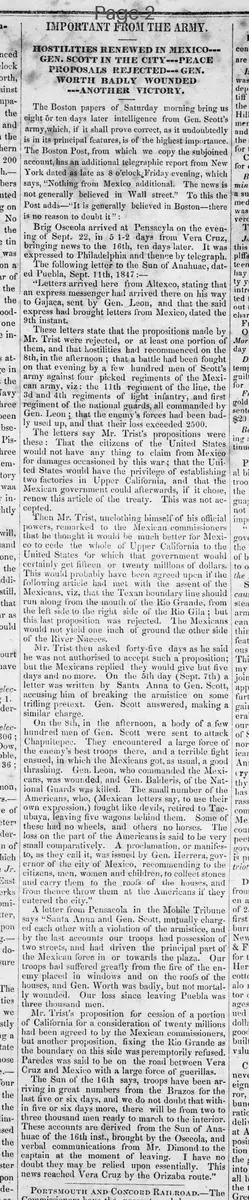
HOSTILITIES RENEWED IN MEXICO---
GEN. SCOTT IN THE CITY---PEACE
PROPOSALS REJECTED-- GEN.
WORTH BADLY WOUNDED
--ANOTHER VICTORY.
The Boston papers of Saturday morning bring us eight or ten days later intelligence from Gen. Scott's army,which, if it shall prove correct, as it undoubtedly is in its principal features, is of the highest importance. The Boston Post, from which we copy the subjoined account, has an additional telegraphic report from New York dated as late as 8 o'clock Friday evening, which says, "Nothing from Mexico additional. The news is not generally believed in Wall street." To this the Post adds-"It is generally believed in Boston-there is no reason to doubt it";
Brig Osceola arrived at Pensacola on the evening of Sept. 22, in 5 1-2 days from Vera Cruz. bringing news to the 16th, ten days later. It was expressed to Philadelphia and thence by telegraph. The following letter to the Sun of Anahuac, dated Puebla, Sept. 11th, 1847:
"Letters arrived here from Altexco, stating that an express messenger had arrived there on his way to Oajaca, sent by Gen. Leon, and that the said express had brought letters from Mexico, dated the 9th instant.
These letters state that the propositions made by Mr. Trist were rejected, or at least one portion of them, and that hostilities had recommenced on the 8th, in the afternoon ; that a battle had been fought on that evening by a few hundred men of Scott's army against four picked regiments of the Mexican army, viz: the 11th regiment of the line, the 3d and 4th regiments of light infantry, and first regiment of the national guards, all commanded by Gen. Leon; that the enemy's forces had been badly used up, and that their loss exceeded 2500.
The letters say Mr. Trist's propositions were these: That the citizens of the United States would not have any thing to claim from Mexico for damages occasioned by this war; that the United States would have the privilege of establishing two factories in Upper California, and that the Mexican government could afterwards, if it chose, renew this article of the treaty. This was not accepted.
Then Mr. Trist, unclothing himself of his official powers, remarked to the Mexican commissioners that he thought it would be much better for Mexico to cede the whole of Upper California to the United States for which that government would certainly get fifteen or twenty millions of dollars. This would probably have been agreed upon if the following article had met with the assent of the Mexicans, viz, that the Texan boundary line should run along from the mouth of the Rio Grande, from the left side to the right side of the Rio Gila; but this last proposition was rejected. The Mexicans would not yield one inch of ground the other side of the River Nueces.
Mr. Trist then asked forty-five days as he said he was not authorised to accept such a proposition; but the Mexicans replied they would give but five days and no more. On the 5th day (Sept. 7th) a letter was written by Santa Anna to Gen. Scott accusing him of breaking the armistice on some trifling pretext. Gen. Scott answered, making a similar charge.
On the 8th, in the afternoon, a body of a few hundred men of Gen. Scott were sent to attack Chapultepec. 'They encountered a large force of the enemy's best troops there, and a terrible fight ensued, in which the Mexicans got, as usual, a good thrashing. Gen. Leon, who commanded the Mexicans, was wounded, and Gen. Balderas, of the National Guards was killed. The small number of the Americans, who, (Mexican letters say, to use their own expression,) fought like devils, retired to Tacubaya, leaving five wagons behind them. Some of these had no wheels, and others no horses. The loss on the part of the Americans is said to be very small comparatively. A proclamation, or manifesto, as they call it, was issued by Gen. Herrera, governor of the city of Mexico, recommending to the citizens, men, women and children, to collect stones and carry them to the roofs of the houses, and from thence throw them at the Americans if they entered the city."
A letter from Pensacola in the Mobile Tribune says "Santa Anna and Gen. Scott, mutually charged each other with a violation of the armistice, and by the last accounts our troops had possession of two streets, and had driven the principal part of the Mexican force in or towards the plaza. Our troops had suffered greatly from the fire of the enemy placed in windows and on the roofs of the houses, and Gen. Worth was badly, but not mortally wounded. Our loss since leaving Puebla was three thousand men.
Mr. Trist's proposition for cession of a portion of California for a consideration of twenty millions had been agreed to by the Mexican commissioners, but another proposition, fixing the Rio Grande as the boundary on this side was peremptorily refused.
Paredes was said to be on the road between Vera Cruz and Mexico with a large force of guerillas.
The Sun of the 16th says, troops have been arriving in great numbers from the Brazos for the last five or six days, and we do not doubt that within five or six days more, there will be from two to three thousand men ready to march to the interior.
These accounts are derived from the Sun of Anahuac of the 16th inst., brought by the Osceola, and verbal communications from Mr. Dimond.to the captain at the moment of leaving. I have no doubt they may be relied upon essentially. This news reached Vera Cruz by the Orizaba route."
What sub-type of article is it?
What keywords are associated?
What entities or persons were involved?
Where did it happen?
Foreign News Details
Primary Location
Mexico City
Event Date
September 1847
Key Persons
Outcome
mexican loss exceeded 2500 in battle at chapultepec; gen. leon wounded, gen. balderas killed; american loss small in that engagement but 3000 since leaving puebla; gen. worth badly wounded; peace proposals rejected; u.s. troops possess two streets in mexico city.
Event Details
Peace propositions by Mr. Trist for California cession and Rio Grande boundary rejected by Mexicans; armistice broken with mutual accusations; hostilities renewed on Sept. 8 with U.S. attack on Chapultepec by few hundred men against four Mexican regiments, resulting in Mexican defeat; U.S. troops advance into Mexico City, facing house-to-house resistance; reinforcements arriving.