Thank you for visiting SNEWPapers!
Sign up free
Story
July 4, 1949
The Augusta Courier
Augusta, Richmond County, Georgia
What is this article about?
Dr. Robert A. Millikan, renowned scientist, denounces federal aid to education in a statement, emphasizing local self-government as key to American freedom. He cites philosophers like Montesquieu and a 1945 joint report warning of federalization trends threatening republican ideals.
Clipping
OCR Quality
98%
Excellent
Full Text
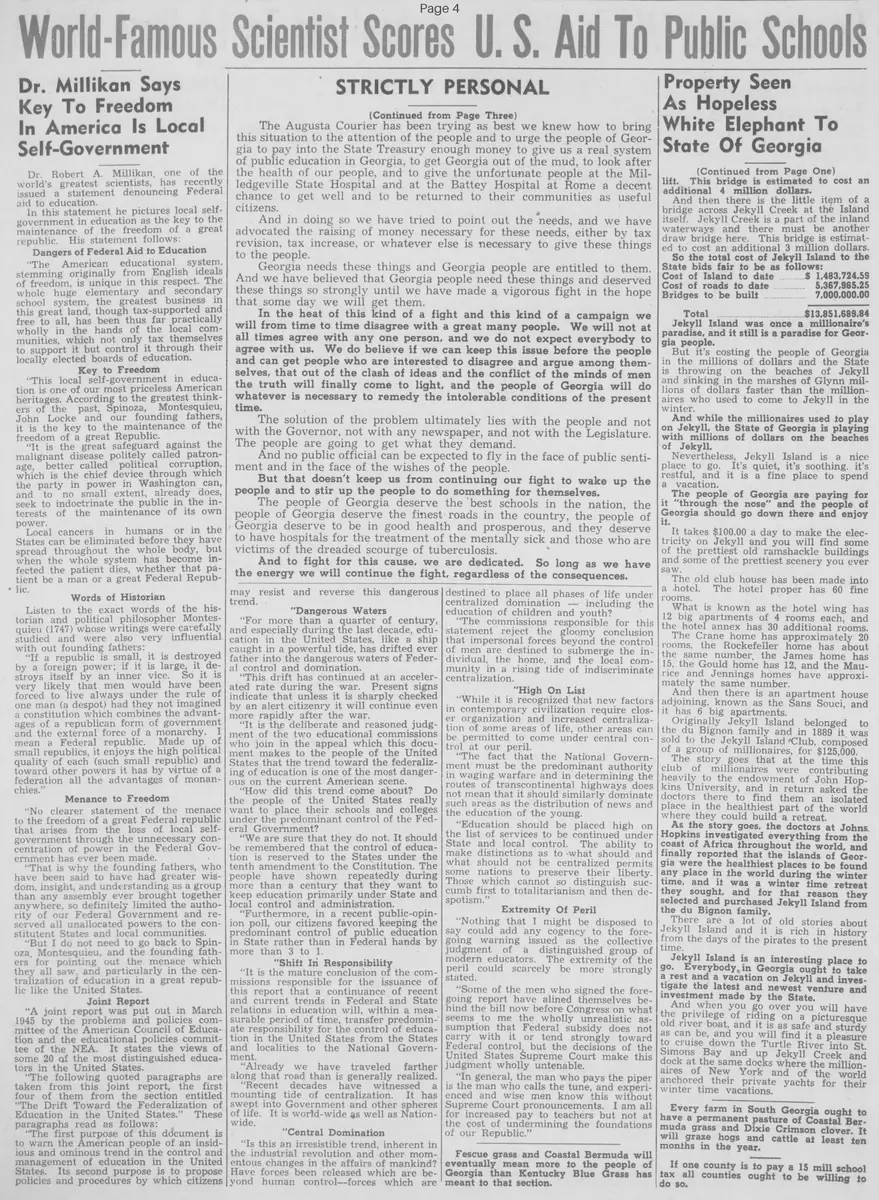
World-Famous Scientist Scores U. S. Aid To Public Schools
Dr. Millikan Says Key To Freedom In America Is Local Self-Government
Dr. Robert A. Millikan, one of the world's greatest scientists, has recently issued a statement denouncing Federal aid to education.
In this statement he pictures local self-government in education as the key to the maintenance of the freedom of a great republic. His statement follows:
Dangers of Federal Aid to Education
"The American educational system, stemming originally from English ideals of freedom, is unique in this respect. The whole huge elementary and secondary school system, the greatest business in this great land, though tax-supported and free to all, has been thus far practically wholly in the hands of the local communities, which not only tax themselves to support it but control it through their locally elected boards of education."
Key to Freedom
"This local self-government in education is one of our most priceless American heritages. According to the greatest thinkers of the past, Spinoza, Montesquieu, John Locke and our founding fathers, it is the key to the maintenance of the freedom of a great Republic."
"It is the great safeguard against the malignant disease politely called patronage, better called political corruption, which is the chief device through which the party in power in Washington can, and to no small extent, already does, seek to indoctrinate the public in the interests of the maintenance of its own power."
Local cancers in humans or in the States can be eliminated before they have spread throughout the whole body, but when the whole system has become infected the patient dies, whether that patient be a man or a great Federal Republic.
Words of Historian
Listen to the exact words of the historian and political philosopher Montesquieu (1747) whose writings were carefully studied and were also very influential with our founding fathers:
"If a republic is small, it is destroyed by a foreign power; if it is large, it destroys itself by an inner vice. So it is very likely that men would have been forced to live always under the rule of one man (a despot) had they not imagined a constitution which combines the advantages of a republican form of government and the external force of a monarchy. I mean a Federal republic. Made up of small republics, it enjoys the high political quality of each (such small republic) and toward other powers it has by virtue of a federation all the advantages of monarchies."
Menace to Freedom
"No clearer statement of the menace to the freedom of a great Federal republic that arises from the loss of local self-government through the unnecessary concentration of power in the Federal Government has ever been made."
"That is why the founding fathers, who have been said to have had greater wisdom, insight, and understanding as a group than any assembly ever brought together anywhere, so definitely limited the authority of our Federal Government and reserved all unallocated powers to the constituent States and local communities."
"But I do not need to go back to Spinoza, Montesquieu, and the founding fathers for pointing out the menace which they all saw, and particularly in the centralization of education in a great republic like the United States."
Joint Report
"A joint report was put out in March 1945 by the problems and policies committee of the American Council of Education and the educational policies committee of the NEA. It states the views of some 20 of the most distinguished educators in the United States."
"The following quoted paragraphs are taken from this joint report, the first four of them from the section entitled "The Drift Toward the Federalization of Education in the United States." These paragraphs read as follows:"
"The first purpose of this document is to warn the American people of an insidious and ominous trend in the control and management of education in the United States. Its second purpose is to propose policies and procedures by which citizens may resist and reverse this dangerous trend."
"Dangerous Waters
"For more than a quarter of a century, and especially during the last decade, education in the United States, like a ship caught in a powerful tide, has drifted ever farther into the dangerous waters of Federal control and domination."
"This drift has continued at an accelerated rate during the war. Present signs indicate that unless it is sharply checked by an alert citizenry it will continue even more rapidly after the war."
"It is the deliberate and reasoned judgment of the two educational commissions who join in the appeal which this document makes to the people of the United States that the trend toward the federalizing of education is one of the most dangerous on the current American scene."
"How did this trend come about? Do the people of the United States really want to place their schools and colleges under the predominant control of the Federal Government?"
"We are sure that they do not. It should be remembered that the control of education is reserved to the States under the tenth amendment to the Constitution. The people have shown repeatedly during more than a century that they want to keep education primarily under State and local control and administration."
"Furthermore, in a recent public-opinion poll, our citizens favored keeping the predominant control of public education in State rather than in Federal hands by more than 3 to 1."
"Shift In Responsibility
"It is the mature conclusion of the commissions responsible for the issuance of this report that a continuance of recent and current trends in Federal and State relations in education will, within a measurable period of time, transfer predominant responsibility for the control of education in the United States from the States and localities to the National Government."
"Already we have traveled farther along that road than is generally realized."
"Recent decades have witnessed a mounting tide of centralization. It has swept into Government and other spheres of life. It is world-wide as well as Nation-wide."
"Central Domination
"Is this an irresistible trend, inherent in the industrial revolution and other momentous changes in the affairs of mankind? Have forces been released which are beyond human control—forces which are destined to place all phases of life under centralized domination including the education of children and youth?"
"The commissions responsible for this statement reject the gloomy conclusion that impersonal forces beyond the control of men are destined to submerge the individual, the home, and the local community in a rising tide of indiscriminate centralization."
"High On List
"While it is recognized that new factors in contemporary civilization require closer organization and increased centralization of some areas of life, other areas can be permitted to come under central control at our peril."
"The fact that the National Government must be the predominant authority in waging warfare and in determining the routes of transcontinental highways does not mean that it should similarly dominate such areas as the distribution of news and the education of the young."
"Education should be placed high on the list of services to be continued under State and local control. The ability to make distinctions as to what should and what should not be centralized permits some nations to preserve their liberty. Those which cannot so distinguish succumb first to totalitarianism and then despotism."
Extremity Of Peril
"Nothing that I might be disposed to say could add any cogency to the foregoing warning issued as the collective judgment of a distinguished group of modern educators. The extremity of the peril could scarcely be more strongly stated."
"Some of the men who signed the foregoing report have aligned themselves behind the bill now before Congress on what seems to me the wholly unrealistic assumption that Federal subsidy does not carry with it or tend strongly toward Federal control, but the decisions of the United States Supreme Court make this judgment wholly untenable."
"In general, the man who pays the piper is the man who calls the tune, and experienced and wise men know this without Supreme Court pronouncements. I am all for increased pay to teachers but not at the cost of undermining the foundations of our Republic.'"
Dr. Millikan Says Key To Freedom In America Is Local Self-Government
Dr. Robert A. Millikan, one of the world's greatest scientists, has recently issued a statement denouncing Federal aid to education.
In this statement he pictures local self-government in education as the key to the maintenance of the freedom of a great republic. His statement follows:
Dangers of Federal Aid to Education
"The American educational system, stemming originally from English ideals of freedom, is unique in this respect. The whole huge elementary and secondary school system, the greatest business in this great land, though tax-supported and free to all, has been thus far practically wholly in the hands of the local communities, which not only tax themselves to support it but control it through their locally elected boards of education."
Key to Freedom
"This local self-government in education is one of our most priceless American heritages. According to the greatest thinkers of the past, Spinoza, Montesquieu, John Locke and our founding fathers, it is the key to the maintenance of the freedom of a great Republic."
"It is the great safeguard against the malignant disease politely called patronage, better called political corruption, which is the chief device through which the party in power in Washington can, and to no small extent, already does, seek to indoctrinate the public in the interests of the maintenance of its own power."
Local cancers in humans or in the States can be eliminated before they have spread throughout the whole body, but when the whole system has become infected the patient dies, whether that patient be a man or a great Federal Republic.
Words of Historian
Listen to the exact words of the historian and political philosopher Montesquieu (1747) whose writings were carefully studied and were also very influential with our founding fathers:
"If a republic is small, it is destroyed by a foreign power; if it is large, it destroys itself by an inner vice. So it is very likely that men would have been forced to live always under the rule of one man (a despot) had they not imagined a constitution which combines the advantages of a republican form of government and the external force of a monarchy. I mean a Federal republic. Made up of small republics, it enjoys the high political quality of each (such small republic) and toward other powers it has by virtue of a federation all the advantages of monarchies."
Menace to Freedom
"No clearer statement of the menace to the freedom of a great Federal republic that arises from the loss of local self-government through the unnecessary concentration of power in the Federal Government has ever been made."
"That is why the founding fathers, who have been said to have had greater wisdom, insight, and understanding as a group than any assembly ever brought together anywhere, so definitely limited the authority of our Federal Government and reserved all unallocated powers to the constituent States and local communities."
"But I do not need to go back to Spinoza, Montesquieu, and the founding fathers for pointing out the menace which they all saw, and particularly in the centralization of education in a great republic like the United States."
Joint Report
"A joint report was put out in March 1945 by the problems and policies committee of the American Council of Education and the educational policies committee of the NEA. It states the views of some 20 of the most distinguished educators in the United States."
"The following quoted paragraphs are taken from this joint report, the first four of them from the section entitled "The Drift Toward the Federalization of Education in the United States." These paragraphs read as follows:"
"The first purpose of this document is to warn the American people of an insidious and ominous trend in the control and management of education in the United States. Its second purpose is to propose policies and procedures by which citizens may resist and reverse this dangerous trend."
"Dangerous Waters
"For more than a quarter of a century, and especially during the last decade, education in the United States, like a ship caught in a powerful tide, has drifted ever farther into the dangerous waters of Federal control and domination."
"This drift has continued at an accelerated rate during the war. Present signs indicate that unless it is sharply checked by an alert citizenry it will continue even more rapidly after the war."
"It is the deliberate and reasoned judgment of the two educational commissions who join in the appeal which this document makes to the people of the United States that the trend toward the federalizing of education is one of the most dangerous on the current American scene."
"How did this trend come about? Do the people of the United States really want to place their schools and colleges under the predominant control of the Federal Government?"
"We are sure that they do not. It should be remembered that the control of education is reserved to the States under the tenth amendment to the Constitution. The people have shown repeatedly during more than a century that they want to keep education primarily under State and local control and administration."
"Furthermore, in a recent public-opinion poll, our citizens favored keeping the predominant control of public education in State rather than in Federal hands by more than 3 to 1."
"Shift In Responsibility
"It is the mature conclusion of the commissions responsible for the issuance of this report that a continuance of recent and current trends in Federal and State relations in education will, within a measurable period of time, transfer predominant responsibility for the control of education in the United States from the States and localities to the National Government."
"Already we have traveled farther along that road than is generally realized."
"Recent decades have witnessed a mounting tide of centralization. It has swept into Government and other spheres of life. It is world-wide as well as Nation-wide."
"Central Domination
"Is this an irresistible trend, inherent in the industrial revolution and other momentous changes in the affairs of mankind? Have forces been released which are beyond human control—forces which are destined to place all phases of life under centralized domination including the education of children and youth?"
"The commissions responsible for this statement reject the gloomy conclusion that impersonal forces beyond the control of men are destined to submerge the individual, the home, and the local community in a rising tide of indiscriminate centralization."
"High On List
"While it is recognized that new factors in contemporary civilization require closer organization and increased centralization of some areas of life, other areas can be permitted to come under central control at our peril."
"The fact that the National Government must be the predominant authority in waging warfare and in determining the routes of transcontinental highways does not mean that it should similarly dominate such areas as the distribution of news and the education of the young."
"Education should be placed high on the list of services to be continued under State and local control. The ability to make distinctions as to what should and what should not be centralized permits some nations to preserve their liberty. Those which cannot so distinguish succumb first to totalitarianism and then despotism."
Extremity Of Peril
"Nothing that I might be disposed to say could add any cogency to the foregoing warning issued as the collective judgment of a distinguished group of modern educators. The extremity of the peril could scarcely be more strongly stated."
"Some of the men who signed the foregoing report have aligned themselves behind the bill now before Congress on what seems to me the wholly unrealistic assumption that Federal subsidy does not carry with it or tend strongly toward Federal control, but the decisions of the United States Supreme Court make this judgment wholly untenable."
"In general, the man who pays the piper is the man who calls the tune, and experienced and wise men know this without Supreme Court pronouncements. I am all for increased pay to teachers but not at the cost of undermining the foundations of our Republic.'"
What sub-type of article is it?
Historical Event
Biography
What themes does it cover?
Moral Virtue
Justice
What keywords are associated?
Federal Aid Education
Local Self Government
American Freedom
Robert Millikan
Education Policy
Federal Republic
What entities or persons were involved?
Dr. Robert A. Millikan
Spinoza
Montesquieu
John Locke
Founding Fathers
Where did it happen?
United States
Story Details
Key Persons
Dr. Robert A. Millikan
Spinoza
Montesquieu
John Locke
Founding Fathers
Location
United States
Event Date
March 1945
Story Details
Dr. Millikan issues a statement against federal aid to education, arguing it endangers local self-government essential for republican freedom, quoting historical philosophers and a 1945 joint report on the dangers of federalization.