Thank you for visiting SNEWPapers!
Sign up free
Alexandria Daily Advertiser
Alexandria, Virginia
What is this article about?
London court decision in August 1805 limits neutral (American) trade with French/Spanish West Indies colonies, requiring cargo reshipment in new vessels to break voyage continuity. Includes 1801 US protest by Rufus King against similar British seizures, leading to corrective instructions.
Clipping
OCR Quality
Full Text
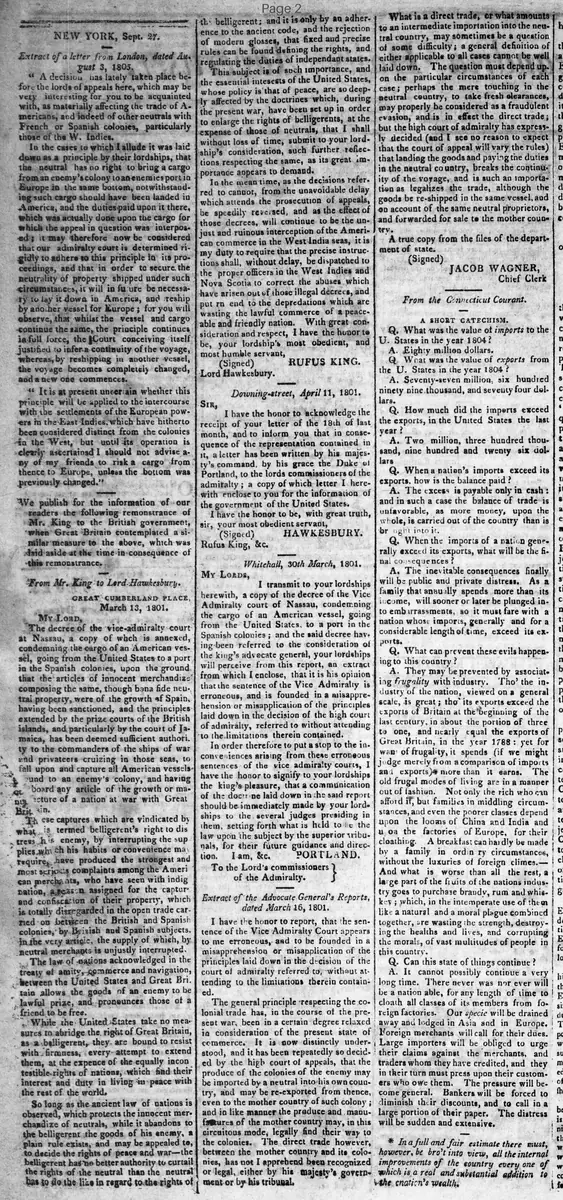
Extract of a letter from London, dated August 3, 1805.
"A decision has lately taken place before the lords of appeals here, which may be very interesting for you to be acquainted with, as materially affecting the trade of Americans, and indeed of other neutrals with French or Spanish colonies, particularly those of the W. Indies.
In the cases to which I allude it was laid down as a principle by their lordships, that the neutral has no right to bring a cargo from an enemy's colony to an enemy's port in Europe in the same bottom, notwithstanding such cargo should have been landed in America, and the duties paid upon it there, which was actually done upon the cargo for which the appeal in question was interposed; it may therefore now be considered that our admiralty court is determined rigorously to adhere to this principle in its proceedings, and that in order to secure the neutrality of property shipped under such circumstances, it will in future be necessary to lay it down in America, and reship by another vessel for Europe; for you will observe, that whilst the vessel and cargo continue the same, the principle continues in full force, the Court conceiving itself justified to infer a continuity of the voyage, whereas, by reshipping in another vessel, the voyage becomes completely changed, and a new one commences.
It is at present uncertain whether this principle will be applied to the intercourse with the settlements of the European powers in the East Indies, which have hitherto been considered distinct from the colonies in the West, but until its operation is clearly ascertained I should not advise any of my friends to risk a cargo from thence to Europe, unless the bottom was previously changed."
We publish for the information of our readers the following remonstrance of Mr. King to the British government, when Great Britain contemplated a similar measure to the above, which was laid aside at the time in consequence of this remonstrance.
From Mr. King to Lord Hawkesbury.
GREAT CUMBERLAND PLACE,
March 13, 1801.
My Lord,
The decree of the vice-admiralty-court at Nassau, a copy of which is annexed, condemning the cargo of an American vessel, going from the United States to a port in the Spanish colonies, upon the ground that the articles of innocent merchandise composing the same, though bona fide neutral property, were of the growth of Spain, having been sanctioned, and the principles extended by the prize courts of the British islands, and particularly by the court of Jamaica, has been deemed sufficient authority to the commanders of the ships of war and privateers cruising in those seas, to fall upon and capture all American vessels bound to an enemy's colony, and having on board any article of the growth or manufacture of a nation at war with Great Britain.
These captures which are vindicated by what is termed belligerent's right to distress his enemy, by interrupting the supplies which his habits or convenience may require, have produced the strongest and most serious complaints among the American merchants, who have seen with indignation, a reason assigned for the capture and confiscation of their property, which is totally disregarded in the open trade carried on between the British and Spanish colonies, by British and Spanish subjects, in the very article, the supply of which, by neutral merchants is unjustly interrupted.
The law of nations acknowledged in the treaty of amity, commerce and navigation, between the United States and Great Britain allows the goods of an enemy to be lawful prize, and pronounces those of a friend to be free.
While the United States take no measures to abridge the right of Great Britain, as a belligerent, they are bound to resist with firmness, every attempt to extend them, at the expense of the equally incontestable rights of nations, which find their interest and duty in living in peace with the rest of the world.
So long as the ancient law of nations is observed, which protects the innocent merchandise of neutrals, while it abandons to the belligerent the goods of his enemy, a plain rule exists, and may be appealed to, to decide the rights of peace and war—the belligerent has no better authority to curtail the rights of the neutral than the neutral has to do the like in regard to the rights of the belligerent: and it is only by an adherence to the ancient code, and the rejection of modern glosses, that fixed and precise rules can be found defining the rights, and regulating the duties of independent states.
This subject is of such importance, and the essential interests of the United States, whose policy is that of peace, are so deeply affected by the doctrines which, during the present war, have been set up in order to enlarge the rights of belligerents, at the expense of those of neutrals, that I shall without loss of time, submit to your lordship's consideration, such further reflections respecting the same, as its great importance appears to demand.
In the mean time, as the decisions referred to cannot, from the unavoidable delay which attends the prosecution of appeals, be speedily reversed, and as the effect of those decrees, will continue to be the unjust and ruinous interception of the American commerce in the West India seas, it is my duty to require that the precise instructions shall, without delay, be dispatched to the proper officers in the West Indies and Nova Scotia to correct the abuses which have arisen out of those illegal decrees, and put an end to the depredations which are wasting the lawful commerce of a peaceable and friendly nation. With great consideration and respect, I have the honor to be, your lordship's most obedient, and most humble servant,
(Signed) RUFUS KING.
Lord Hawkesbury.
Downing-street, April 11, 1801.
SIR,
I have the honor to acknowledge the receipt of your letter of the 13th of last month, and to inform you that in consequence of the representation contained in it, a letter has been written by his majesty's command, by his grace the Duke of Portland, to the lords commissioners of the admiralty; a copy of which letter I herewith enclose to you for the information of the government of the United States.
I have the honor to be, with great truth, sir, your most obedient servant,
(Signed) HAWKESBURY.
Rufus King, &c.
Whitehall, 30th March, 1801.
My Lords,
I transmit to your lordships herewith, a copy of the decree of the Vice Admiralty court of Nassau, condemning the cargo of an American vessel, going from the United States, to a port in the Spanish colonies; and the said decree having been referred to the consideration of the king's advocate general, your lordships will perceive from this report, an extract from which I enclose, that it is his opinion that the sentence of the Vice Admiralty is erroneous, and is founded in a misapprehension or misapplication of the principles laid down in the decision of the high court of admiralty, referred to without attending to the limitations therein contained.
In order therefore to put a stop to the inconveniences arising from these erroneous sentences of the vice admiralty courts, I have the honor to signify to your lordships the king's pleasure, that a communication of the doctrine laid down in the said report should be immediately made by your lordships to the several judges presiding in them, setting forth what is held to be the law upon the subject by the superior tribunals, for their future guidance and direction. I am, &c.
PORTLAND.
To the Lords commissioners of the Admiralty.
Extract of the Advocate General's Reports, dated March 16, 1801.
I have the honor to report, that the sentence of the Vice Admiralty Court appears to me erroneous, and to be founded in a misapprehension or misapplication of the principles laid down in the decision of the court of admiralty referred to, without attending to the limitations therein contained.
The general principle respecting the colonial trade has, in the course of the present war, been in a certain degree relaxed in consideration of the present state of commerce. It is now distinctly understood, and it has been repeatedly so decided by the high court of appeals, that the produce of the colonies of the enemy may be imported by a neutral into his own country, and may be re-exported from thence, even to the mother country of such colony; and in like manner the produce and manufactures of the mother country may, in this circuitous mode, legally find their way to the colonies. The direct trade however, between the mother country and its colonies, has not I apprehend been recognized or legal, either by his majesty's government or by his tribunal.
to an intermediate importation into the neutral country, may sometimes be a question of some difficulty; a general definition of either applicable to all cases cannot be well laid down. The question must depend upon the particular circumstances of each case; perhaps the mere touching in the neutral country, to take fresh clearances, may properly be considered as a fraudulent evasion, and is in effect the direct trade; but the high court of admiralty has expressly decided (and I see no reason to expect that the court of appeal will vary the rules) that landing the goods and paying the duties in the neutral country, breaks the continuity of the voyage, and is such an importation as legalizes the trade, although the goods be re-shipped in the same vessel, and on account of the same neutral proprietors, and forwarded for sale to the mother country.
A true copy from the files of the department of state.
(Signed) JACOB WAGNER,
Chief Clerk
What sub-type of article is it?
What keywords are associated?
What entities or persons were involved?
Where did it happen?
Foreign News Details
Primary Location
London
Event Date
August 3, 1805
Key Persons
Outcome
british lords of appeals rule that neutrals cannot transport cargo from enemy colonies to enemy european ports in the same vessel, even after landing and paying duties in america; reshipment in another vessel required to break voyage continuity. 1801 remonstrance by rufus king led to british instructions correcting erroneous vice-admiralty seizures of american vessels.
Event Details
Extract from London letter reports recent appeals court decision affecting neutral trade with French/Spanish West Indies colonies, establishing principle against continuity of voyage in same vessel. Publication includes 1801 diplomatic correspondence: Rufus King's protest to Lord Hawkesbury against seizures of American ships carrying Spanish goods to Spanish colonies; Hawkesbury's acknowledgment and enclosure of Duke of Portland's letter to Admiralty directing correction of erroneous vice-admiralty practices based on Advocate General's report affirming that landing and paying duties in neutral country legalizes re-export even in same vessel.