Thank you for visiting SNEWPapers!
Sign up free
Richmond Palladium
Richmond, Wayne County, Indiana
What is this article about?
The first US public demonstration of the Evangelical Alliance, formed in London in August 1846 by Protestant delegates to promote unity and break sectarian barriers, occurred last evening at Green Street Methodist Church in New York. Speakers from various denominations explained its principles and goals to overthrow Romanism and spread Protestantism.
Clipping
OCR Quality
Full Text
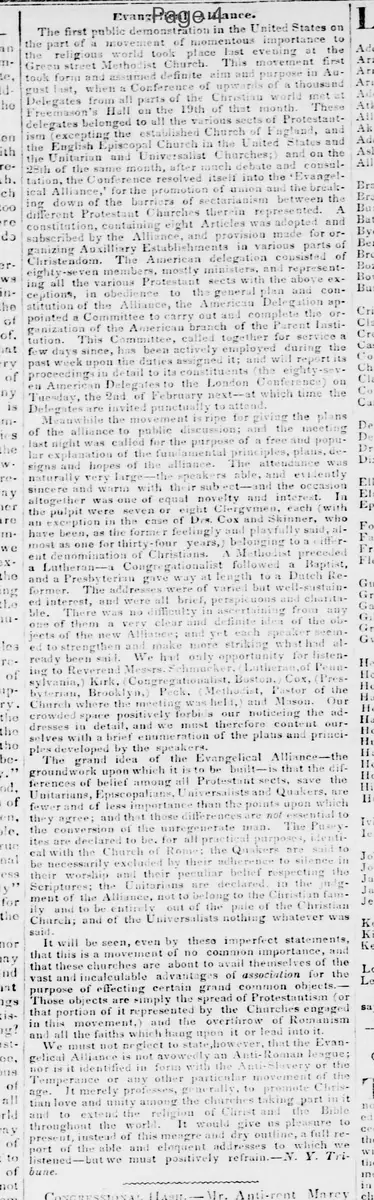
Meanwhile the movement is ripe for giving the plans of the alliance to public discussion; and the meeting last night was called for the purpose of a free and popular explanation of the fundamental principles, plans, designs and hopes of the alliance. The attendance was naturally very large--the speakers able, and evidently sincere and warm with their subject--and the occasion altogether was one of equal novelty and interest. In the pulpit were seven or eight Clergymen, each (with an exception in the case of Drs. Cox and Skinner, who have been, as the former feelingly and playfully said, almost as one for thirty-four years,) belonging to a different denomination of Christians. A Methodist preceded a Lutheran--a Congregationalist followed a Baptist, and a Presbyterian gave way at length to a Dutch Reformer. The addresses were of varied but well-sustained interest, and were all brief, perspicuous and charitable. There was no difficulty in ascertaining from any one of them a very clear and definite idea of the objects of the new Alliance; and yet each speaker seemed to strengthen and make more striking what had already been said. We had only opportunity for listening to Reverend Messrs. Schmucke (Lutheran, of Pennsylvania,) Kirk, (Congregationalist, Boston,) Cox, (Presbyterian, Brooklyn,) Peck, Methodist, Pastor of the Church where the meeting was held,) and Mason. Our crowded space positively forbids our noticing the addresses in detail, and we must therefore content ourselves with a brief enumeration of the plans and principles developed by the speakers.
The grand idea of the Evangelical Alliance--the groundwork upon which it is to be built--is that the differences of belief among all Protestant sects, save the Unitarians, Episcopalians, Universalists and Quakers, are fewer and of less importance than the points upon which they agree; and that those differences are not essential to the conversion of the unregenerate man. The Puseyites are declared to be, for all practical purposes, identical with the Church of Rome; the Quakers are said to be necessarily excluded by their adherence to silence in their worship and their peculiar belief respecting the Scriptures; the Unitarians are declared, in the judgment of the Alliance, not to belong to the Christian family and to be entirely out of the pale of the Christian Church; and of the Universalists nothing whatever was said.
It will be seen, even by these imperfect statements, that this is a movement of no common importance, and that these churches are about to avail themselves of the vast and incalculable advantages of association for the purpose of effecting certain grand common objects.-- Those objects are simply the spread of Protestantism (or that portion of it represented by the Churches engaged in this movement.) and the overthrow of Romanism and all the faiths which hang upon it or lead into it.
We must not neglect to state, however, that the Evangelical Alliance is not avowedly an Anti-Roman league; nor is it identified in form with the Anti-Slavery or the Temperance or any other particular movement of the age. It merely professes, generally, to promote Christian love and unity among the churches taking part in it and to extend the religion of Christ and the Bible throughout the world. It would give us pleasure to present, instead of this meagre and dry outline, a full report of the able and eloquent addresses to which we listened--but we must positively refrain.--N. Y. Tribune.
What sub-type of article is it?
What themes does it cover?
What keywords are associated?
What entities or persons were involved?
Where did it happen?
Story Details
Key Persons
Location
Green Street Methodist Church, New York
Event Date
August Last; Last Evening; 2nd Of February Next
Story Details
Protestant delegates from various sects formed the Evangelical Alliance in London in August to promote union among churches, excluding certain groups. The American branch organized, holding its first public meeting last evening with speakers from different denominations outlining principles of unity, agreement on essentials, and aims to spread Protestantism and counter Romanism.