Thank you for visiting SNEWPapers!
Sign up free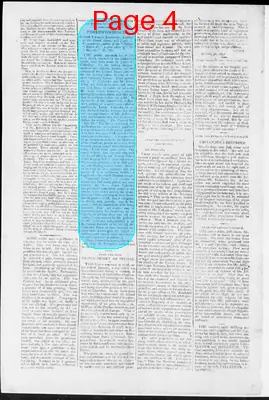
Editorial
November 17, 1802
The Recorder
Richmond, Virginia
What is this article about?
Editorial from The Balance reprints and discusses correspondence between President Thomas Jefferson and James T. Callender, exposing a scandal where Jefferson allegedly paid Callender $100 for his anti-Federalist work 'The Prospect Before Us.' It details the public quarrel between Callender and M. Jones that revealed this, and criticizes Democratic denials.
Clipping
OCR Quality
95%
Excellent
Full Text
FROM THE BALANCE, A PAPER PRINTED AT HUDSON IN THE STATE OF NEW-YORK.
CORRESPONDENCE
Between Thomas Jefferson president of the United States, and James T. Callender, author of the "Prospect Before Us." present editor of "The Recorder." &c. &c.
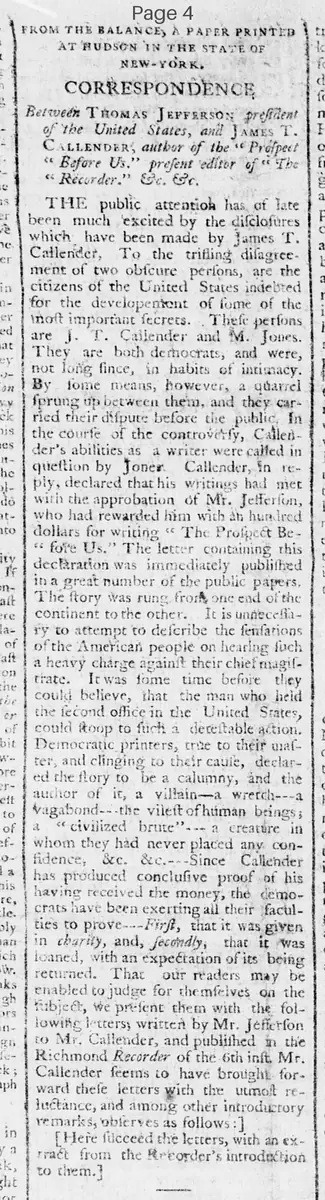
THE public attention has of late been much excited by the disclosures which have been made by James T. Callender. To the trifling disagreement of two obscure persons, are the citizens of the United States indebted for the development of some of the most important secrets. These persons are J. T. Callender and M. Jones. They are both democrats, and were, not long since, in habits of intimacy. By some means, however, a quarrel sprung up between them, and they carried their dispute before the public. In the course of the controversy, Callender's abilities as a writer were called in question by Jones. Callender, in reply, declared that his writings had met with the approbation of Mr. Jefferson, who had rewarded him with an hundred dollars for writing "The Prospect Before Us." The letter containing this declaration was immediately published in a great number of the public papers. The story was rung from one end of the continent to the other. It is unnecessary to attempt to describe the sensations of the American people on hearing such a heavy charge against their chief magistrate. It was some time before they could believe, that the man who held the second office in the United States, could stoop to such a detestable action. Democratic printers, true to their master, and clinging to their cause, declared the story to be a calumny, and the author of it, a villain--a wretch---a vagabond---the vilest of human beings; a "civilized brute"---a creature in whom they had never placed any confidence. &c. &c.---Since Callender has produced conclusive proof of his having received the money, the democrats have been exerting all their faculties to prove---First, that it was given in charity, and, secondly, that it was loaned, with an expectation of its being returned. That our readers may be enabled to judge for themselves on the subject, we present them with the following letters: written by Mr. Jefferson to Mr. Callender, and published in the Richmond Recorder of the 6th inst. Mr. Callender seems to have brought forward these letters with the utmost reluctance, and among other introductory remarks, observes as follows:
[Here succeed the letters, with an extract from the Recorder's introduction to them.]
CORRESPONDENCE
Between Thomas Jefferson president of the United States, and James T. Callender, author of the "Prospect Before Us." present editor of "The Recorder." &c. &c.
THE public attention has of late been much excited by the disclosures which have been made by James T. Callender. To the trifling disagreement of two obscure persons, are the citizens of the United States indebted for the development of some of the most important secrets. These persons are J. T. Callender and M. Jones. They are both democrats, and were, not long since, in habits of intimacy. By some means, however, a quarrel sprung up between them, and they carried their dispute before the public. In the course of the controversy, Callender's abilities as a writer were called in question by Jones. Callender, in reply, declared that his writings had met with the approbation of Mr. Jefferson, who had rewarded him with an hundred dollars for writing "The Prospect Before Us." The letter containing this declaration was immediately published in a great number of the public papers. The story was rung from one end of the continent to the other. It is unnecessary to attempt to describe the sensations of the American people on hearing such a heavy charge against their chief magistrate. It was some time before they could believe, that the man who held the second office in the United States, could stoop to such a detestable action. Democratic printers, true to their master, and clinging to their cause, declared the story to be a calumny, and the author of it, a villain--a wretch---a vagabond---the vilest of human beings; a "civilized brute"---a creature in whom they had never placed any confidence. &c. &c.---Since Callender has produced conclusive proof of his having received the money, the democrats have been exerting all their faculties to prove---First, that it was given in charity, and, secondly, that it was loaned, with an expectation of its being returned. That our readers may be enabled to judge for themselves on the subject, we present them with the following letters: written by Mr. Jefferson to Mr. Callender, and published in the Richmond Recorder of the 6th inst. Mr. Callender seems to have brought forward these letters with the utmost reluctance, and among other introductory remarks, observes as follows:
[Here succeed the letters, with an extract from the Recorder's introduction to them.]
What sub-type of article is it?
Partisan Politics
Press Freedom
What keywords are associated?
Jefferson Scandal
Callender Correspondence
Political Patronage
Democratic Denial
Public Disclosure
What entities or persons were involved?
Thomas Jefferson
James T. Callender
M. Jones
Democratic Printers
Richmond Recorder
Editorial Details
Primary Topic
Jefferson Callender Payment Scandal
Stance / Tone
Critical Of Jefferson And Democrats
Key Figures
Thomas Jefferson
James T. Callender
M. Jones
Democratic Printers
Richmond Recorder
Key Arguments
Callender Received $100 From Jefferson For 'The Prospect Before Us'
Quarrel With Jones Led To Public Disclosure
Democrats Initially Called It Calumny, Now Claim Charity Or Loan
Letters Provide Proof Of Payment