Thank you for visiting SNEWPapers!
Sign up free
Editorial
August 18, 1872
The Morning Star And Catholic Messenger
New Orleans, Orleans County, Louisiana
What is this article about?
The editorial criticizes the practice of running up debts through long credit from retail merchants, which leads to moral contempt, family strife, and financial ruin for both customers and traders, advocating for prompt payment to avoid extravagance.
Clipping
OCR Quality
95%
Excellent
Full Text
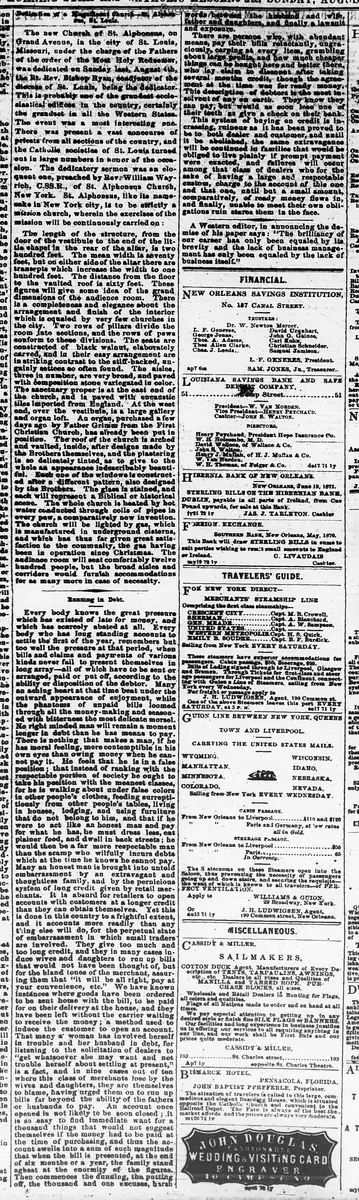
RUNNING IN DEBT.
Everybody knows the great pressure which has existed of late for money, and which has scarcely abated at all. Everybody who has long standing accounts to settle the first of the year, remembers but too well the pressure at that period, when bills and claims and payments of various kinds never fail to present themselves in long array--all of which have to be sent or arranged, paid or put off, according to the ability or disposition of the debtor. Many an aching heart at that time beat under the outward appearance of enjoyment, while the phantoms of unpaid bills loomed through all the money-making and seasoned with bitterness the most delicate morsel. No right minded man will remain a moment longer in debt than he has means to pay. There is nothing that makes a man, if he has moral feeling, more contemptible in his own eyes than owing money when he cannot pay it. He feels that he is in a false position; that instead of ranking with the respectable portion of society he ought to take his position with the meanest classes, for he is walking about under false colors in other people's clothes, feeding surreptitiously from other people's tables, living in houses, lodging, and using furniture that do not belong to him, and that if he were to act like an honest man and pay for what he has, he must dress less, eat plainer food, and dwell in back streets; he would then be a far more respectable man than the scamp who wilfully incurs debts which at the time he knows he cannot pay. Many an honest man is brought into untold embarrassment by an extravagant and thoughtless family, and by the pernicious system of long credit given by retail merchants. It is absurd for retailers to open accounts with customers at a longer credit than they can obtain themselves. Yet this is done in this country to a frightful extent, and it accounts more readily than anything else will do, for the perpetual state of embarrassment in which small traders are involved. They give too much and too long credit, and they in many cases induce wives and daughters to run up bills that would not have been thought of, but for the bland tones of the merchant, assuring them that 'it will be all right, pay at your convenience, etc.' We have known instances where goods have been ordered to be sent home with the bill, to be paid for on their delivery at the house, and they have been left without the carrier waiting to receive the money; a method used to induce the customer to open an account. That many a woman has involved herself in trouble and her husband in debt, for listening to the solicitation of dealers to 'get whatsoever she may want and not trouble herself about settling at present,' is a fact, and in nine cases out of ten where this class of merchants lose by the wives and daughters, they are themselves to blame, having urged them on to run up bills far beyond the ability of the fathers or husbands to pay. An account once opened is not likely to be soon closed; it is so easy to find immediate want for a thousand things that would not suggest themselves if the money had to be paid at the time of purchasing, and thus the account swells into a sum of such magnitude that when the bill is presented, at the end of six months or a year, the family stand aghast at the enormity of the figures. Then commences the dunning, the putting off, the thousand and one excuses, harsh words between the husband and wife, father and daughter, and finally a lawsuit under exposure. There are perhaps those, with abundant means, pay their bills reluctantly, ungraciously, carping at every item, grumbling about large profits and how much cheaper things can be bought here and better there, who lay claim to discount after taking several months credit--though the agreement at the time was for ready money. This description of debtors is the most insolvent of any on earth. They know they can pay, but would as soon lose one of their teeth as give a check on their bank. This system of buying on credit is increasing, ruinous as it has been proved to be to both dealer and customer, and until it be abolished the same extravagance will be continued in families that would be obliged to live plainly if prompt payment were exacted, and failures will occur among that class of dealers who for the sake of having a large & respectable custom, charge to the account of this one and that one, until but a small amount, comparatively, of ready money flows in, and finally, unable to meet their own obligations ruin stares them in the face.
Everybody knows the great pressure which has existed of late for money, and which has scarcely abated at all. Everybody who has long standing accounts to settle the first of the year, remembers but too well the pressure at that period, when bills and claims and payments of various kinds never fail to present themselves in long array--all of which have to be sent or arranged, paid or put off, according to the ability or disposition of the debtor. Many an aching heart at that time beat under the outward appearance of enjoyment, while the phantoms of unpaid bills loomed through all the money-making and seasoned with bitterness the most delicate morsel. No right minded man will remain a moment longer in debt than he has means to pay. There is nothing that makes a man, if he has moral feeling, more contemptible in his own eyes than owing money when he cannot pay it. He feels that he is in a false position; that instead of ranking with the respectable portion of society he ought to take his position with the meanest classes, for he is walking about under false colors in other people's clothes, feeding surreptitiously from other people's tables, living in houses, lodging, and using furniture that do not belong to him, and that if he were to act like an honest man and pay for what he has, he must dress less, eat plainer food, and dwell in back streets; he would then be a far more respectable man than the scamp who wilfully incurs debts which at the time he knows he cannot pay. Many an honest man is brought into untold embarrassment by an extravagant and thoughtless family, and by the pernicious system of long credit given by retail merchants. It is absurd for retailers to open accounts with customers at a longer credit than they can obtain themselves. Yet this is done in this country to a frightful extent, and it accounts more readily than anything else will do, for the perpetual state of embarrassment in which small traders are involved. They give too much and too long credit, and they in many cases induce wives and daughters to run up bills that would not have been thought of, but for the bland tones of the merchant, assuring them that 'it will be all right, pay at your convenience, etc.' We have known instances where goods have been ordered to be sent home with the bill, to be paid for on their delivery at the house, and they have been left without the carrier waiting to receive the money; a method used to induce the customer to open an account. That many a woman has involved herself in trouble and her husband in debt, for listening to the solicitation of dealers to 'get whatsoever she may want and not trouble herself about settling at present,' is a fact, and in nine cases out of ten where this class of merchants lose by the wives and daughters, they are themselves to blame, having urged them on to run up bills far beyond the ability of the fathers or husbands to pay. An account once opened is not likely to be soon closed; it is so easy to find immediate want for a thousand things that would not suggest themselves if the money had to be paid at the time of purchasing, and thus the account swells into a sum of such magnitude that when the bill is presented, at the end of six months or a year, the family stand aghast at the enormity of the figures. Then commences the dunning, the putting off, the thousand and one excuses, harsh words between the husband and wife, father and daughter, and finally a lawsuit under exposure. There are perhaps those, with abundant means, pay their bills reluctantly, ungraciously, carping at every item, grumbling about large profits and how much cheaper things can be bought here and better there, who lay claim to discount after taking several months credit--though the agreement at the time was for ready money. This description of debtors is the most insolvent of any on earth. They know they can pay, but would as soon lose one of their teeth as give a check on their bank. This system of buying on credit is increasing, ruinous as it has been proved to be to both dealer and customer, and until it be abolished the same extravagance will be continued in families that would be obliged to live plainly if prompt payment were exacted, and failures will occur among that class of dealers who for the sake of having a large & respectable custom, charge to the account of this one and that one, until but a small amount, comparatively, of ready money flows in, and finally, unable to meet their own obligations ruin stares them in the face.
What sub-type of article is it?
Moral Or Religious
Social Reform
Economic Policy
What keywords are associated?
Debt
Credit System
Retail Credit
Family Extravagance
Moral Debt
Merchant Practices
Financial Embarrassment
What entities or persons were involved?
Retail Merchants
Debtors
Families
Editorial Details
Primary Topic
Critique Of Debt And Long Credit Practices
Stance / Tone
Moral Warning Against Running Debts And Excessive Credit
Key Figures
Retail Merchants
Debtors
Families
Key Arguments
No Right Minded Man Should Remain In Debt Longer Than He Can Pay
Debt Makes One Contemptible And In A False Position
Extravagant Families And Long Credit From Merchants Cause Embarrassment
Retailers Should Not Give Longer Credit Than They Receive
Merchants Induce Women To Run Up Bills Beyond Means
Once Opened, Accounts Swell Due To Easy Purchasing
Prompt Payment Would Prevent Extravagance And Failures