Thank you for visiting SNEWPapers!
Sign up free
The Freeman's Journal, Or, New Hampshire Gazette
Portsmouth, Rockingham County, New Hampshire
What is this article about?
A letter supporting the 1777 price regulating act in New Hampshire during the Revolutionary War, urging traders and farmers to comply to preserve paper currency and aid the war effort, while condemning non-compliers as avaricious enemies worse than Tories.
Merged-components note: Continuation of the same letter to the editor signed A.Z., split across two components on page 4 with sequential reading order and direct text flow.
Clipping
OCR Quality
Full Text
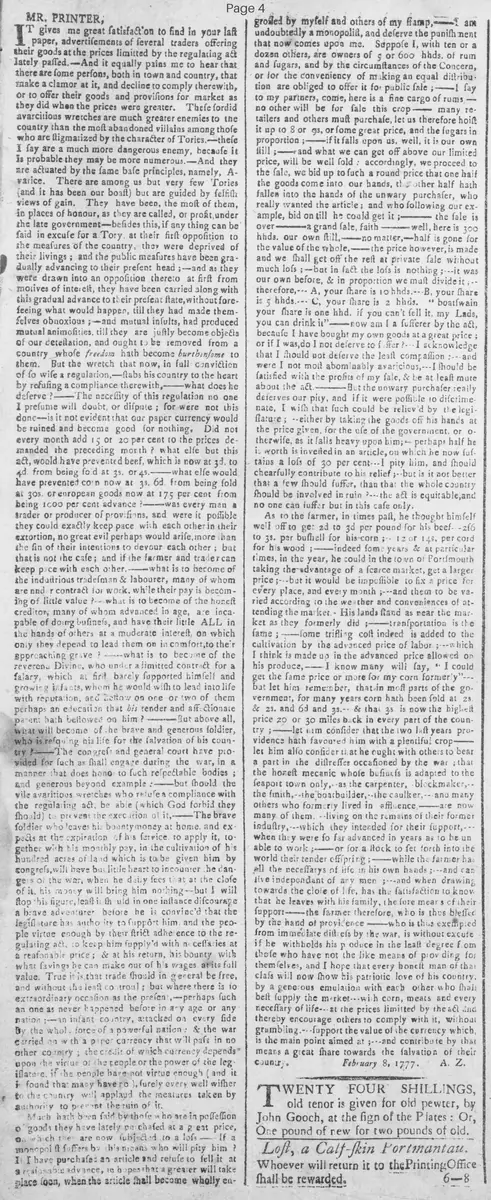
It gives me great satisfaction to find in your last paper, advertisements of several traders offering their goods at the prices limited by the regulating act lately passed.--And it equally pains me to hear that there are some persons, both in town and country, that make a clamour at it, and decline to comply therewith, or to offer their goods and provisions for market as they did when the prices were greater. These sordid avaricious wretches are much greater enemies to the country than the most abandoned villains among those who are stigmatized by the character of Tories.--these I say are a much more dangerous enemy, because it is probable they may be more numerous.--And they are actuated by the same base principles, namely, Avarice. There are among us but very few Tories (and it has been our boast) but are guided by selfish views of gain. They have been, the most of them, in places of honour, as they are called, or profit, under the late government--besides this, if any thing can be said in excuse for a Tory, at their first opposition to the measures of the country, they were deprived of their livings ; and the public measures have been gradually advancing to their present head ;--and as they were drawn into an opposition thereto at first from motives of interest, they have been carried along with this gradual advance to their present state, without foreseeing what would happen, till they had made themselves obnoxious ;and mutual insults, had produced mutual animosities, till they are justly become objects of our detestation, and ought to be removed from a country whose freedom hath become burthensome to them. But the wretch that now, in full conviction of so wise a regulation,--stabs his country to the heart by refusing a compliance therewith,---what does he deserve ?--The necessity of this regulation no one I presume will doubt, or dispute ; for were not this done--is it not evident that our paper currency would be ruined and become good for nothing. Did not every month add 15 or 20 per cent to the prices demanded the preceding month ? what else but this act, would have prevented beef, which is now at 3d. to 4d. from being sold at 3s. or 4s.---what else would have prevented corn now at 3s. 6d. from being sold at 30s. or European goods now at 175 per cent from being 1000 per cent advance nwas every man a grader or producer of provisions, and were it possible they could exactly keep pace with each other in their extortion, no great evil perhaps would arise, more than the sin of their intentions to devour each other ; but that is not the case; and if the farmer and trader can keep pace with each other,--what is to become of the industrious trademan & labourer, many of whom are under contract for work, while their pay is becoming of little value ?-- what is to become of the honest creditor. many of whom advanced in age. are incapable of doing business, and have their little ALL in the hands of others at a moderate interest, on which only they depend to lead them on in comfort,to their approaching grave ? --what is to become of the reverend. Divine, who under a limited contract for a salary, which at first barely supported himself and growing infants, whom he would wish to lead into life with reputation, and bestow on one or two of them perhaps an education that his tender and affectionate parent hath bestowed on him ? -But above all, what will become of the brave and generous soldier. who is risking his life for the salvation of his country Pe-The congress and general court have provided for such as shall engage during the war, in a manner that does honour to such respectable bodies ; and generous beyond example :-but should the vile avaricious wretches who refuse a compliance with the regulating act. be able (which God forbid they should) to prevent the execution of it,--The brave soldier who leaves his bounty money at home. and expects at the expiration of his service. to apply it, to- gether with his monthly pay, in the cultivation of his hundred acres of land which is to be given him by congress, will have but little heart to encounter the dangers of the war, when he duly sees that at the close of it, his money will bring him nothing--but I will stop his figure, lest it should in one instance discourage a brave adventurer before he is convinced that the legislature has authority to support him. and the people virtue enough by their strict adherence to the re- gulating act, to keep him supplied with necessaries at a reasonable price; & at his return, his bounty with what savings he can make out of his wages at its full value. True it is that trade should in general be free. and without the least controul ; but where there is so extraordinary occasion as the present,-perhaps such an one as never happened before in any age or any nation ;-an infant country, attacked on every side By the whole. force of a powerful nation : & the war carried on with a paper currency that will pass in no other country : the credit of which currency depends upon the virtue of the people or the power of the leg- islature. if the people have not virtue enough (and it is found that many have not ), surely every well wisher to the country will applaud the measures taken by authority to prevent the ruin of it.
Much hath been said by those who are in possession of goods they have lately purchased at a great price, on which they are now subjected to a loss If a monopolist suffers by his means who will pity him ? It I have purchased an article and refuse to sell it at a reasonable advance, in hopes that a greater will take place soon, when the article shall become wholly en-
grossed by myself and others of my stamp, am undoubtedly a monopolist, and deserve the punishment that now comes upon me. Suppose I, with ten or a dozen others, are owners of 500 or 600 hhds. of rum and sugars, and by the circumstances of the Concern, or for the conveniency of making an equal distribution are obliged to offer it for public sale ;--I say to my partners, come, here is a fine cargo of rums -- no other will be for sale this crop-season- many re- tailers and others must purchase, let us therefore hoist it up to 8 or 9s, or some great price, and the sugars in proportion ;-and if it falls upon us, well, it is our own still ;--and what we can get off above our limited price, will be well sold : accordingly, we proceed to the sale, we bid up to such a round price that one half the goods come into our hands, the other half hath fallen into the hands of the unwary purchaser, who really wanted the article; and who following Our ex- ample, bid on till he could get it ;--- the sale is over a grand sale, faith--well, here is 300 hhds. our own still,-no matter,-half is gone for the value of the whole,--the price however, is made and we shall get off the rest at private sale without much loss ;-but in fact the loss is nothing ;---it was our own before. & in proportion we must divide it,. therefore,--- A, your share is 10 hhds.--.B, your share is 2 hhds.--. C. your share is 2 hhds. " boatswain your share is one hhd. if you can't sell it, my Lads you can drink it"--now am I a sufferer by the act. because I have bought my own goods at a great price ; or if I was,do I not deserve to suffer ?-..I acknowledge that I should not deserve the least compassion :---and were I not most abominably avaricious, ---I should be satisfied with the profits of my sale, & be at least mute about the act.-But the unwary purchaser really deserves our pity. and if it were possible to discriminate, I wish that such could be relieved by the legi- slature; --either by taking the goods off his hands at the price given, or the use of the government, or o- therwise, as it falls heavy upon him;-- perhaps half he it worth is invested in an article. on which he now suf- tains a loss of 20 per cent-.-I pity him, and should cheerfully contribute to his relief ;--but is it not better that a few should suffer, than that the whole country should be involved in ruin ?---the act is equitable,and no one can suffer but in this case only.
As to the farmer, in times past, he thought himself well off to get 2d to 3d per pound for his beef. -2s 6 to 3s. per bushell for his-corn ;-- 12 or 14s. per cord for his wood ;--indeed some years & at particular times, in the year. he could in the town of Portsmouth taking the advantage of a scarce market, get a larger price;---but it would be impossible to fix a price for every place, and every month ;---and them to be va- ried according to the weather and conveniences of at- tending the market. - His lands stand as near the mar- ket as they formerly did ;----transportation is the same ; --some trifling cost indeed is added to the cultivation by the advanced price of labor ;---which I think is made up in the advanced price allowed on his produce,-I know many will say, " I could get the same price or more for my corn formerly"--. but let him remember, that in most parts of the go- vernment, for many years corn hath been sold at 2s. & 2s. and 6d and 3s.-- & that 3s is now the highest price 20 or 30 miles back in every part of the coun- try ;--let him consider that the two last years pro- vidence hath favoured him with a plentiful crop let him also consider that he ought with others to bear a part in the distress occasioned by the war ; that the honest mechanic whose business is adapted to the seaport town only.- as the carpenter, blockmaker,-- the smith.--the boatbuilder,--the caulker,-- and many others who formerly lived in affluence --are now many of them. --living on the remains of their former industry,---which they intended for their support,--- when they were so far advanced in years as to be un- able to work ;--or for.a stock to set forth into the world their tender offspring ;--while the farmer has all the necessaries of life in his own hands ;---and can live independent of any men ;--and when drawing towards the close of life, has the satisfaction to know that he leaves with his family, the sure means of their support--the farmer therefore, who is thus blessed by the hand of providence -who is thus exempted from immediate distress by the war, is without excuse if he withholds his produce in the least degree from those who have not the like means of providing for themselves, and I hope that every honest man of that class will now show his patriotic love of his country. by a generous emulation with each other who shall best supply the market-with corn, meats and every necessary of life--at the prices limited by the act and thereby encourage others to comply with it, without grumbling.--support the value of the currency which, is the main point aimed at ;---and contribute by that means a great share towards the salvation of their country.
February 8, 1777.
A. Z.
What sub-type of article is it?
What themes does it cover?
What keywords are associated?
What entities or persons were involved?
Letter to Editor Details
Author
A. Z.
Recipient
Mr. Printer;
Main Argument
the regulating act on prices is essential to prevent the ruin of the paper currency during the war; compliance is a patriotic duty, and resisters driven by avarice are greater enemies to the country than tories, deserving no pity while the vulnerable like soldiers and laborers suffer otherwise.
Notable Details