Thank you for visiting SNEWPapers!
Sign up free
Mower County Transcript
Austin, Lansing, Mower County, Minnesota
What is this article about?
Summary of late-session U.S. Congressional activities from Feb. 28 to March 4, covering Senate and House debates, bill passages (appropriations, pensions, river/harbor, Indian affairs), conferees, and final adjournment with Gen. Grant's retirement nomination confirmed.
Clipping
OCR Quality
Full Text
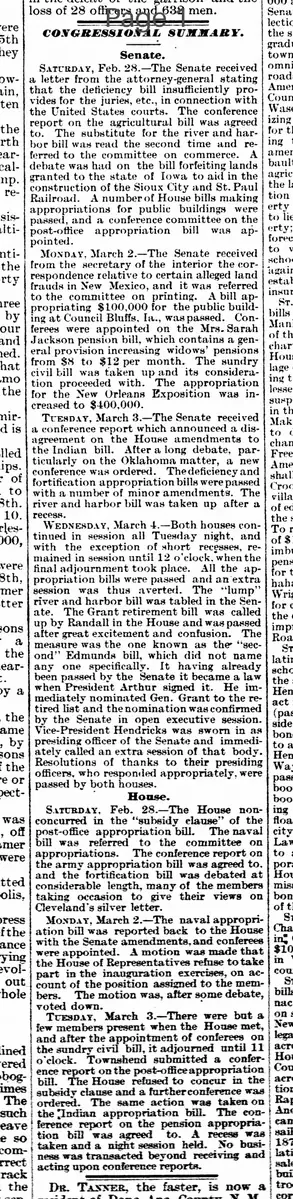
Senate.
Saturday, Feb. 28.—The Senate received a letter from the attorney-general stating that the deficiency bill insufficiently provides for the juries, etc., in connection with the United States courts. The conference report on the agricultural bill was agreed to. The substitute for the river and harbor bill was read the second time and referred to the committee on commerce. A debate was had on the bill forfeiting lands granted to the state of Iowa to aid in the construction of the Sioux City and St. Paul Railroad. A number of House bills making appropriations for public buildings were passed, and a conference committee on the post-office appropriation bill was appointed.
Monday, March 2.—The Senate received from the secretary of the interior the correspondence relative to certain alleged land frauds in New Mexico, and it was referred to the committee on printing. A bill appropriating $100,000 for the public building at Council Bluffs, Ia., was passed. Conferees were appointed on the Mrs. Sarah Jackson pension bill, which contains a general provision increasing widows' pensions from $8 to $12 per month. The sundry civil bill was taken up and its consideration proceeded with. The appropriation for the New Orleans Exposition was increased to $400,000.
Tuesday, March 3.—The Senate received a conference report which announced a disagreement on the House amendments to the Indian bill. After a long debate, particularly on the Oklahoma matter, a new conference was ordered. The deficiency and fortification appropriation bills were passed with a number of minor amendments. The river and harbor bill was taken up after a recess.
Wednesday, March 4.—Both houses continued in session all Tuesday night, and with the exception of short recesses, remained in session until 12 o'clock, when the final adjournment took place. All the appropriation bills were passed and an extra session was thus averted. The "lump" river and harbor bill was tabled in the Senate. The Grant retirement bill was called up by Randall in the House and was passed after great excitement and confusion. The measure was the one known as the "second" Edmunds bill, which did not name any one specifically. It having already been passed by the Senate it became a law when President Arthur signed it. He immediately nominated Gen. Grant to the retired list and the nomination was confirmed by the Senate in open executive session. Vice-President Hendricks was sworn in as presiding officer of the Senate and immediately called an extra session of that body. Resolutions of thanks to their presiding officers, who responded appropriately, were passed by both houses.
House.
Saturday, Feb. 28.—The House non-concurred in the "subsidy clause" of the post-office appropriation bill. The naval bill was referred to the committee on appropriations. The conference report on the army appropriation bill was agreed to, and the fortification bill was debated at considerable length, many of the members taking occasion to give their views on Cleveland's silver letter.
Monday, March 2.—The naval appropriation bill was reported back to the House with the Senate amendments, and conferees were appointed. A motion was made that the House of Representatives refuse to take part in the inauguration exercises, on account of the position assigned to the members. The motion was, after some debate, voted down.
Tuesday, March 3.—There were but a few members present when the House met, and after the appointment of conferees on the sundry civil bill, it adjourned until 11 o'clock. Townshend submitted a conference report on the post-office appropriation bill. The House refused to concur in the subsidy clause and a further conference was ordered. The same action was taken on the Indian appropriation bill. The conference report on the pension appropriation bill was agreed to. A recess was taken and a night session held. No business was transacted beyond receiving and acting upon conference reports.
What sub-type of article is it?
What keywords are associated?
What entities or persons were involved?
Domestic News Details
Event Date
February 28 To March 4
Key Persons
Outcome
all appropriation bills passed; extra session averted; grant retirement bill passed and signed into law; gen. grant nominated and confirmed to retired list; final adjournment at 12 o'clock on march 4; vice-president hendricks sworn in; extra session called.
Event Details
Congressional proceedings in Senate and House from Saturday, Feb. 28, to Wednesday, March 4, including receipt of letters and correspondence on deficiencies, land frauds; debates and passages of bills on agriculture, river and harbor, public buildings, post-office appropriations, naval, army, fortification, sundry civil, Indian, pension, deficiency bills; appointments of conferees; increase in widows' pensions; New Orleans Exposition appropriation increased to $400,000; disagreement on subsidy clause and House amendments; motion on inauguration exercises voted down; night sessions; final adjournment after passing all bills.