Thank you for visiting SNEWPapers!
Sign up free
The North Carolina Standard
Raleigh, Wake County, North Carolina
What is this article about?
In a detailed rebuttal to critics in the Register, an anonymous writer from Chapel Hill defends their prior article advocating immediate U.S. occupation of Oregon territory up to 54°40' N latitude. They assert American prior discovery and rights, criticize Henry Clay's compromise with Britain, refute charges of partisanship and plagiarism, and highlight historical U.S.-British hostilities.
Clipping
OCR Quality
Full Text
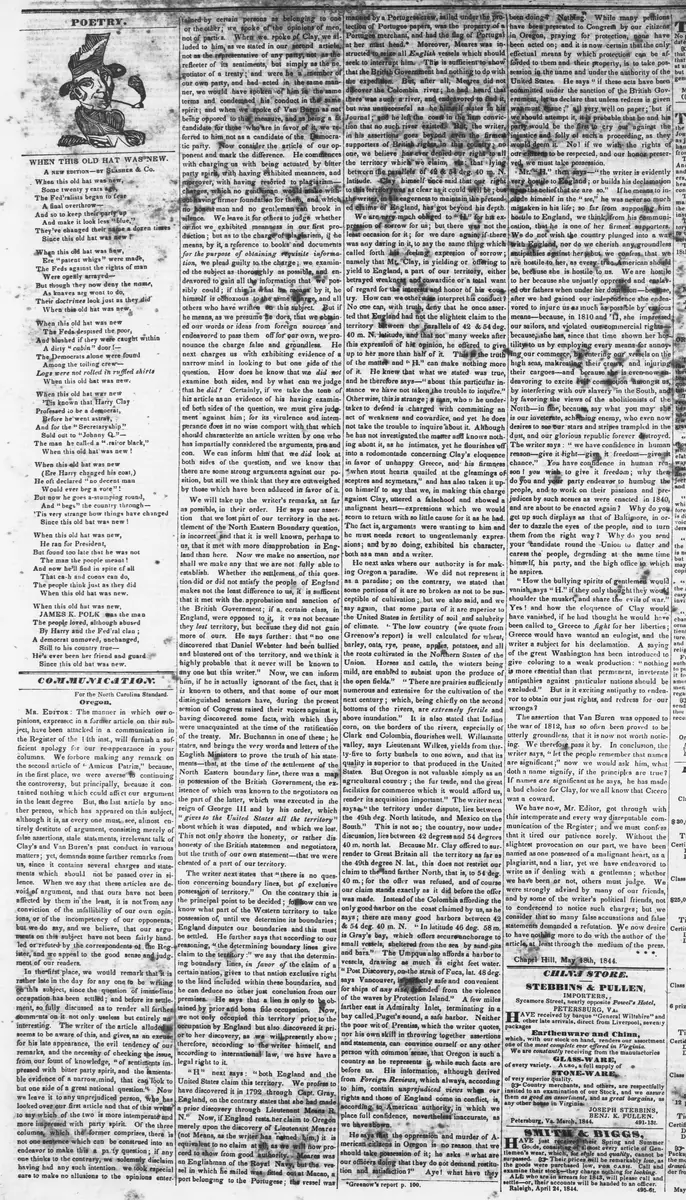
For the North Carolina Standard.
Oregon.
Mr. Editor: The manner in which our opinions, expressed in a former article on this subject, have been attacked in a communication in the Register of the 14th inst., will furnish a sufficient apology for our re-appearance in your columns.
We forbore making any remark on the second article of 'Amicus Patriæ,' because, in the first place, we were averse to continuing the controversy, but principally, because it contained nothing which could affect our argument in the least degree. But, the last article by another person, which has appeared on this subject, although it is, as every one must see, almost entirely destitute of argument, consisting merely of false assertions, stale statements, irrelevant talk of Clay's and Van Buren's past conduct in various matters; yet, demands some further remarks from us, since it contains several charges and statements which should not be passed over in silence.
When we say that these articles are devoid of argument, and that ours have not been affected by them in the least, it is not from any conviction of the infallibility of our own opinions, or of the incompetency of our opponents; but we do say, and we believe, that our arguments on this subject have not been fairly handled or refuted by the correspondents of the Register, and we appeal to the good sense and judgment of our readers.
In the first place, we would remark that it is rather late in the day for any one to be writing on this subject, since the question of immediate occupation has been settled; and before its settlement, so fully discussed as to render all farther comments on it not only useless but entirely uninteresting. The writer of the article alluded to seems to be aware of this, and gives, as an excuse for his late appearance, the evil tendency of our remarks, and the necessity of checking the issue, from our fount of knowledge, 'of sentiments impressed with bitter party spirit, and the lamentable evidence of a narrow mind, that can look to but one side of a great national question.' Now we leave it to any unprejudiced person, who has looked over our first article and that of this writer to say which of the two is more intemperate and more impressed with party spirit. Of the three columns, which the former comprises, there is not one sentence which can be construed into an endeavor to make this a party question; if any one thinks to the contrary, we solemnly disclaim having had any such intention we took especial care to make no allusions to the opinions entertained by certain persons as belonging to one or the other; we spoke of the opinions of men, not of parties. When we spoke of Clay, we alluded to him, as we stated in our second article not as the representative of any party, not as the reflector of its sentiments, but simply as the negotiator of a treaty; and were he a member of our own party, and had acted in the same manner, we would have spoken of him in the same terms and condemned his conduct in the same spirit; and when we spoke of Van Buren as not being opposed to this measure, and as being a fit candidate for those who are in favor of it, we referred to him not as a candidate of the Democratic party. Now consider the article of our opponent and mark the difference. He commences with charging us with being actuated by bitter party spirit, with having exhibited meanness, and moreover, with having resorted to plagiarism—charges, which no gentleman would make without having firmer foundation for them, and which no honest man and no gentleman can brook in silence. We leave it for others to judge whether or not we exhibited meanness in our first production; but as to the charge of plagiarism, if he means, by it, a reference to books and documents for the purpose of obtaining requisite information, we plead guilty to the charge; we examined the subject as thoroughly as possible, and endeavored to gain all the information that we possibly could; if this is what he means by it, he himself is obnoxious to the same charge, and all others who have written on this subject. But if he means, as we presume he does, that we obtained our words or ideas from foreign sources and endeavored to pass them off for our own, we pronounce the charge false and groundless. He next charges us with exhibiting evidence of a narrow mind in looking to but one side of the question. How does he know that we did not examine both sides, and by what can we judge that he did? Certainly, if we take the tone of his article as an evidence of his having examined both sides of the question, we must give judgment against him; for its virulence and intemperance does in no wise comport with that which should characterize an article written by one who has impartially considered the arguments, pro and con. We can inform him that we did look at both sides of the question, and we know that there are some strong arguments against our position, but still we think that they are outweighed by those which have been adduced in favor of it.
We will take up the writer's remarks, as far as possible, in their order. He says our assertion that we lost part of our territory in the settlement of the North Eastern Boundary question, is incorrect and that it is well known, perhaps to us, that it met with more disapprobation in England than here. Now we make no assertion, nor shall we make any that we are not fully able to establish. Whether the settlement of this question did or did not satisfy the people of England makes not the least difference to us, it is sufficient that it met with the approbation and sanction of the British Government; if a certain class, in England, were opposed to it, it was not because they lost territory, but because they did not gain more of ours. He says further: that 'no one discovered that Daniel Webster had been bullied and blustered out of the territory, and we think it highly probable that it never will be known to any one but this writer.' Now, we can inform him, if he is actually ignorant of the fact, that it is known to others, and that some of our most distinguished senators have, during the present session of Congress raised their voices against it, having discovered some facts, with which they were unacquainted at the time of the ratification of the treaty. Mr. Buchanan in one of these; he states, and brings the very words and letters of the English Ministers to prove the truth of his statements—that, at the time of the settlement of the North Eastern boundary line, there was a map in possession of the British Government, the existence of which was known to the negotiators on the part of the latter, which was executed in the reign of George III and by his order, which 'gives to the United States all the territory' about which it was disputed, and which we lost. This not only shows the honesty, or rather dishonesty of the British statesmen and negotiators, but the truth of our own statement—that we were cheated of a part of our territory.
The writer next states that 'there is no question concerning boundary lines, but of exclusive possession of territory.' On the contrary this is the principal point to be decided; for how can we know what part of the Western territory to take possession of, until we determine its boundaries; England disputes our boundaries and this must be settled. He further says that according to our reasoning, 'the determining boundary lines give claim to the territory:' we say that the determining boundary lines, in favor of the claim of a certain nation, gives to that nation exclusive right to the land included within these boundaries, and he can deduce no other just conclusion from our premises. He says that a lien is only to be obtained by prior and bona fide occupation. Now, we not only occupied this territory prior to the occupation by England but also discovered it prior to her discovery, as we will presently show; therefore, according to the writer himself, and according to international law, we have a legal right to it.
'H' next says: 'both England and the United States claim this territory. We profess to have discovered it in 1792 through Capt. Gray. England, on the contrary states that she had made a prior discovery through Lieutenant Meares R. N.' Now, if England rests her claim to Oregon merely upon the discovery of Lieutenant Meares (not Means, as the writer has named him,) it is equivalent to no claim at all, as we will now proceed to show from good authority. Meares was an Englishman of the Royal Navy, but the vessel in which he sailed was fitted out at Macao, a port belonging to the Portuguese; the vessel was manned by a Portuguese crew, sailed under the protection of Portuguese papers, was the property of a Portuguese merchant, and had the flag of Portugal at her mast head. Moreover, Meares was instructed to seize all English vessels which should seek to interrupt him. This is sufficient to show that the British Government had nothing to do with the expedition. But, after all, Meares did not discover the Columbia river; he had heard that there was such a river, and endeavored to find it, but was unsuccessful as he himself states in his Journal; and he left the coast in the firm conviction that no such river existed. But, the writer, in his assertions goes beyond even the firmest supporters of British rights, in this country; no one, we believe has ever denied our right to all the territory which we claim, viz: that lying between the parallels of 42 & 54 deg. 40 m. N. latitude. Clay himself once said that our right to this territory was as clear as it could well be; but the writer, in his eagerness to maintain the pretended claims of England, has got beyond his depth.
We are very much obliged to 'H.' for his expression of sorrow for us; but there was not the least occasion for it; for we dare again, if there was any daring in it, to say the same thing which called forth his feeling expression of sorrow; namely that Mr Clay, in yielding or offering to yield to England, a part of our territory, either betrayed weakness and cowardice or a total want of regard for the interests and honor of his country. How can we otherwise interpret his conduct? No one can, with truth, deny that he once asserted that England had not the slightest claim to the territory between the parallels of 42 & 54 deg. 40 m. N. latitude, and that not many weeks after this expression of his opinion, he offered to give up to her more than half of it. This is the truth of the matter and 'H.' can make nothing more of it. He knew that what we stated was true, and he therefore says—'about this particular instance we have not taken the trouble to inquire.' Otherwise, this is strange; a man, who he undertakes to defend is charged with committing an act of weakness and cowardice, and yet he does not take the trouble to inquire about it. Although he has not investigated the matter and knows nothing about it, as he intimates, yet he flourishes off into a rodomontade concerning Clay's eloquence in favor of unhappy Greece, and 'when stout hearts quailed at the gleamings of sceptres and scymetars,' and has also taken it upon himself to say that we, in making this charge against Clay, uttered a falsehood and showed a malignant heart—expressions which we would scorn to return with so little cause for it as he had. The fact is, arguments were wanting to him and he must needs resort to ungentlemanly expressions; and by so doing, exhibited his character, both as a man and writer.
He next asks where our authority is for making Oregon a paradise. We did not represent it as a paradise; on the contrary, we stated that some portions of it are so broken as not to be susceptible of cultivation; but we also said, and we say again, that some parts of it are superior to the United States in fertility of soil and salubrity of climate. The low country (we quote from Greenhow's report) is well calculated for wheat; barley, oats, rye, pease, apples, potatoes, and all the roots cultivated in the Northern States of the Union. Horses and cattle, the winters being mild, are enabled to subsist upon the produce of the open fields. 'There are prairies sufficiently numerous and extensive for the cultivation of the next century; which, being chiefly on the second bottoms of the rivers, are extremely fertile and above inundation.' It is also stated that Indian corn, on the borders of the rivers, especially of Clark and Columbia, flourishes well. Willamette valley, says Lieutenant Wilkes, yields from thirty-five to forty bushels to one sown, and that its quality is superior to that produced in the United States. But Oregon is not valuable simply as an agricultural country; the fur trade, and the great facilities for commerce which it would afford us, render its acquisition important. The writer next says 'the territory under dispute, lies between the 49th deg. North latitude, and Mexico on the South.' This is not so; the country, now under discussion, lies between 42 degrees and 54 degrees 40 m. north lat. Because Mr. Clay offered to surrender to Great Britain all the territory as far as the 49th degree N. lat., this does not restrict our claim to the land farther North, that is, to 54 deg. 40 m.; for the offer was refused, and of course our claim stands exactly as it did before the offer was made. Instead of the Columbia affording the only good harbor on the coast claimed by us, as he says; there are many good harbors between 42 & 54 deg. 40 m. N. 'In latitude 46 deg. 58 m. is Gray's bay, which offers secure anchorage to small vessels, sheltered from the sea by sand-pits and bars.' The Umpqua also affords a harbor to vessels, drawing as much as eight feet water. 'Port Discovery, on the strait of Fuca, lat. 48 deg. says Vancouver, is perfectly safe and convenient for ships of any size, defended from the violence of the waves by Protection Island.' A few miles farther east is Admiralty Inlet, terminating in a bay called Puget's sound, a safe harbor. Neither the poor wit of Prentiss, which the writer quotes, nor his own skill in throwing together assertions and statements, can convince ourself or any other person with common sense, that Oregon is such a country as he represents it, while such facts are before us. His information, although derived from Foreign Reviews, which always, according to him, contain unprejudiced views when our rights and those of England come in conflict, is, according to American authority, in which we place full confidence, nevertheless inaccurate, as we have shown.
He says that the oppression and murder of American citizens in Oregon is no reason that we should take possession of it; he asks 'what are our officers doing that they do not demand restitution and satisfaction?' Aye! what have they been doing? Nothing. While many petitions have been presented to Congress by our citizens in Oregon, praying for protection, none have been acted on; and it is now certain that the only effectual means by which protection can be afforded to them and their property, is to take possession in the name and under the authority of the United States. He says 'if these acts have been committed under the sanction of the British Government, let us declare that unless redress is given war must ensue;' all very well on paper; 'but if we should attempt it, it is probable that he and his party would be the first to cry out against the injustice and folly of such a proceeding, as they would deem it.' No! if we wish the rights of our citizens to be respected, and our honor preserved, we must take possession.
Mr. 'H.' then says—'the writer is evidently very hostile to England; or builds his declamation upon the belief that we are so.' If he means to include himself in the 'we,' he was never so much mistaken in his life; so far from supposing him hostile to England, we think, from his communication, that he is one of her firmest supporters. We do not wish the country plunged into a war with England, nor do we cherish any groundless antipathies against her; but we confess that we are hostile to her, as every true American should be, because she is hostile to us. We are hostile to her because she unjustly oppressed and enslaved our fathers when under her dominion—because, after we had gained our independence she endeavored to injure us as much as possible by various means—because, in 1812 and '13, she impressed our sailors, and violated our commercial rights—because, she has, since that time shown her hostility to us by employing every means for annoying our commerce, by entering our vessels on the high seas, maltreating their crews, and injuring their cargoes—and because she is even now endeavoring to excite evil commotion amongst us, by interfering with our slavery in the South, and by favoring the views of the abolitionists of the North—in fine, because, say what you may, she is our inveterate, scheming enemy, who even now desires to see our stars and stripes trampled in the dust, and our glorious republic forever destroyed.
The writer says: 'we have confidence in human reason—give it light—give it freedom—give it chance.' You have confidence in human reason! you wish to give it freedom; why then do you and your party endeavor to humbug the people, and to work on their passions and prejudices by such scenes as were enacted in 1840, and are about to be enacted again? Why do you get up such displays as that of Baltimore, in order to dazzle the eyes of the people, and to turn them from the right way? Why do you send your candidate round the Union to flatter and caress the people, degrading at the same time himself, his party, and the high office to which he aspires?
'How the bullying spirits of gentlemen would vanish, says 'H.' if they only thought they would shoulder the musket, and share the evils of war.' Yes! and how the eloquence of Clay would have vanished, if he had thought he would have been called to Greece to fight for her liberties; Greece would have wanted an eulogist, and the writer a subject for his declamation. A saying of the great Washington has been introduced to give coloring to a weak production: 'nothing is more essential than that permanent, inveterate antipathies against particular nations should be excluded.' But is it exciting antipathy to endeavor to obtain our just rights, and redress for our wrongs?
The assertion that Van Buren was opposed to the war of 1812, has so often been proved to be utterly groundless, that it is now not worth noticing. We therefore pass it by. In conclusion, the writer says, 'let the people remember that names are significant;' now we would ask him, what doth a name signify, if the principles are true? If names are significant as he says, he has made a bad choice for Clay, for we all know that Cicero was a coward.
We have now, Mr. Editor, got through with this intemperate and every way disreputable communication of the Register; and we must confess that it tired our patience sorely. Without the slightest provocation on our part, we have been named as one possessed of a malignant heart, as a plagiarist, and a liar, yet we have endeavored to write as if dealing with a gentleman; whether we have been or not, others must judge. We were strongly advised by many of our friends, and by some of the writer's political friends, not to condescend to notice such charges; but we consider that so many false accusations and false statements demanded a refutation. We now desire to have nothing more to do with the author of the article, at least through the medium of the press.
Chapel Hill, May 18th, 1844.
What sub-type of article is it?
What themes does it cover?
What keywords are associated?
What entities or persons were involved?
Letter to Editor Details
Recipient
Mr. Editor
Main Argument
the writer defends their advocacy for immediate u.s. occupation of oregon, refutes critics' personal attacks and false claims, asserts u.s. prior discovery and territorial rights against britain, and criticizes henry clay's compromising stance while supporting van buren's position.
Notable Details