Thank you for visiting SNEWPapers!
Sign up free
The Detroit Times
Detroit, Wayne County, Michigan
What is this article about?
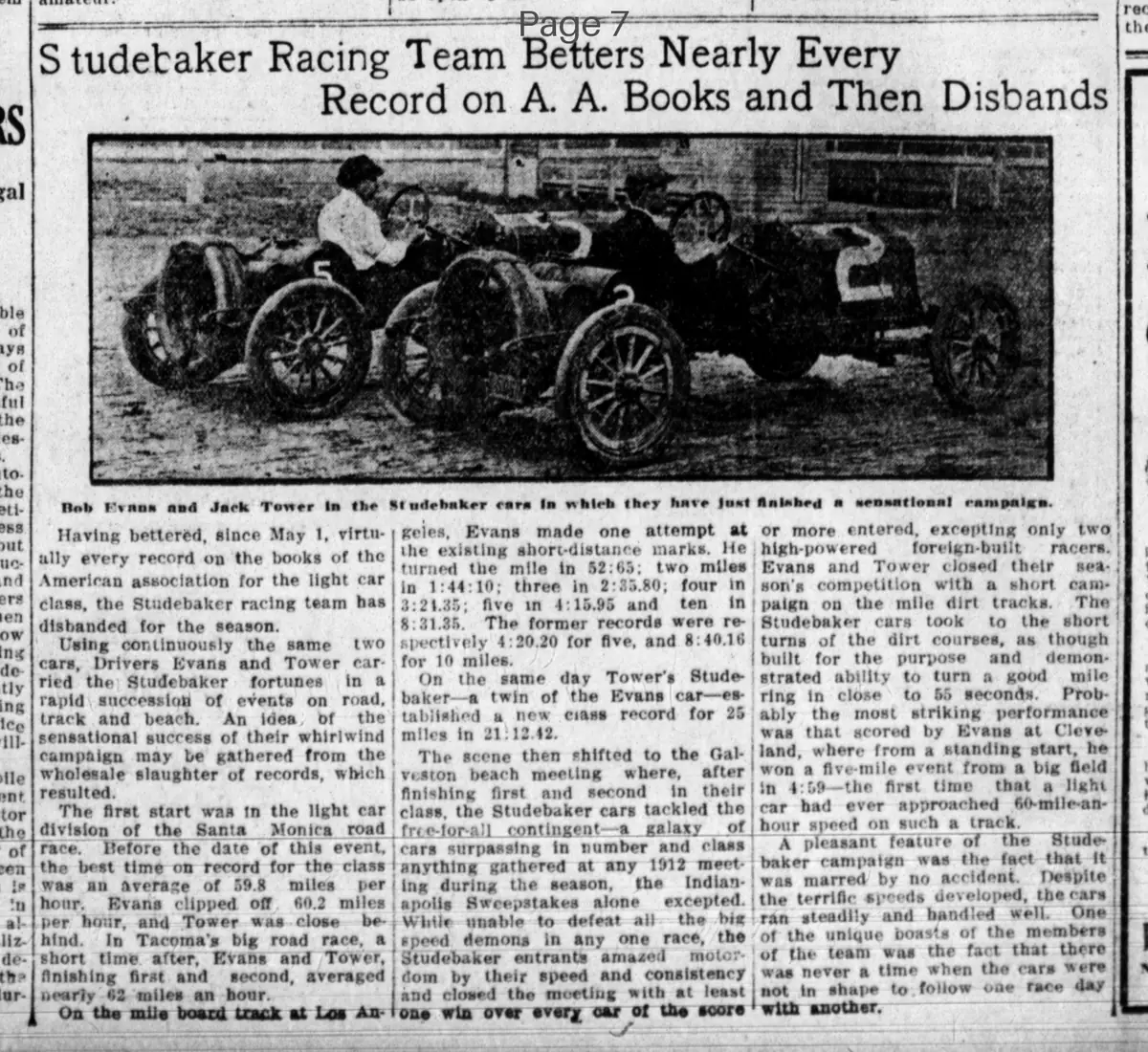
The Studebaker racing team, with drivers Evans and Tower using two identical cars, broke nearly every American Automobile Association record for the light car class since May 1, 1912, in various road, track, and beach races across the US, including Santa Monica, Tacoma, Los Angeles, Galveston, and Cleveland, before disbanding for the season without accidents.
Clipping
OCR Quality
Full Text
Having bettered, since May 1, virtually every record on the books of the American association for the light car class, the Studebaker racing team has disbanded for the season.
Using continuously the same two cars, Drivers Evans and Tower carried the Studebaker fortunes in a rapid succession of events on road, track and beach. An idea of the sensational success of their whirlwind campaign may be gathered from the wholesale slaughter of records, which resulted.
The first start was in the light car division of the Santa Monica road race. Before the date of this event, the best time on record for the class was an average of 59.8 miles per hour. Evans clipped off 60.2 miles per hour, and Tower was close behind. In Tacoma's big road race, a short time after, Evans and Tower, finishing first and second, averaged nearly 62 miles an hour.
In Los Angeles, Evans made one attempt at the existing short-distance marks. He turned the mile in 52:65; two miles in 1:44:10; three in 2:35.80; four in 3:21.35; five in 4:15.95 and ten in 8:31.35. The former records were respectively 4:20.20 for five, and 8:40.16 for 10 miles.
On the same day Tower's Studebaker-a twin of the Evans car-established a new class record for 25 miles in 21:12.42.
The scene then shifted to the Galveston beach meeting where, after finishing first and second in their class, the Studebaker cars tackled the free-for-all contingent--a galaxy of cars surpassing in number and class anything gathered at any 1912 meeting during the season, the Indianapolis Sweepstakes alone excepted.
While unable to defeat all the big speed demons in any one race, the Studebaker entrants amazed motordom by their speed and consistency and closed the meeting with at least one new record in every event in which two or more entered, excepting only two high-powered foreign-built racers.
Evans and Tower closed their season's competition with a short campaign on the mile dirt tracks. The Studebaker cars took to the short turns of the dirt courses, as though built for the purpose and demonstrated ability to turn a good mile ring in close to 55 seconds. Probably the most striking performance was that scored by Evans at Cleveland, where from a standing start, he won a five-mile event from a big field in 4:59 the first time that a light car had ever approached 60-mile-an-hour speed on such a track.
A pleasant feature of the Studebaker campaign was the fact that it was marred by no accident. Despite the terrific speeds developed, the cars ran steadily and handled well. One of the unique boasts of the members of the team was the fact that there was never a time when the cars were not in shape to follow one race day with another.
What sub-type of article is it?
What themes does it cover?
What keywords are associated?
What entities or persons were involved?
Where did it happen?
Story Details
Key Persons
Location
Santa Monica, Tacoma, Los Angeles, Galveston Beach, Cleveland
Event Date
Since May 1, 1912
Story Details
Studebaker racing team with drivers Evans and Tower broke numerous light car class records in road races, track events, and beach meetings across US locations, achieving speeds up to nearly 62 mph and short-distance marks, then disbanded without accidents.