Thank you for visiting SNEWPapers!
Sign up free
Literary
December 8, 1829
The New Hampshire Gazette
Portsmouth, Rockingham County, New Hampshire
What is this article about?
A moral tale contrasting the downfall of Samuel Ledyard, son of a wealthy judge who relies on privilege and squanders his inheritance, with the rise of Stephen Le Forest, a poor joiner's son who succeeds through hard work and study, becoming a judge while Samuel ends in prison.
Clipping
OCR Quality
98%
Excellent
Full Text
From the Christian Intelligencer.
WHEEL OF FORTUNE.
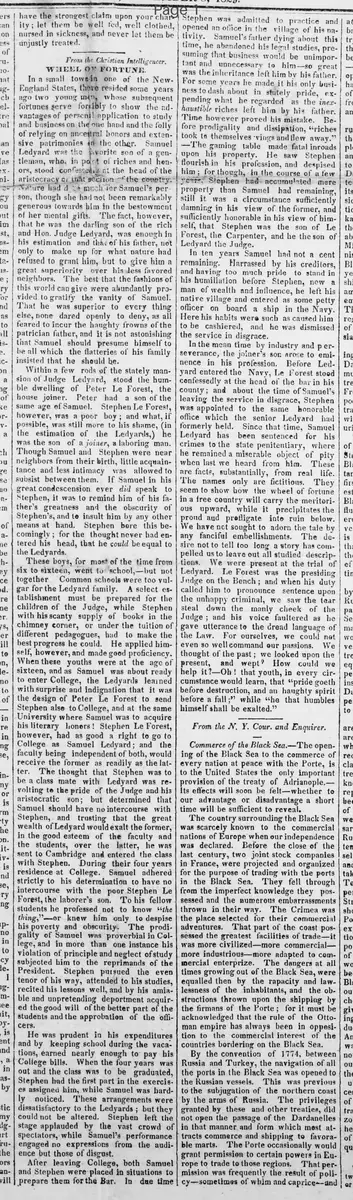
In a small town in one of the New-England States, there resided some years ago two young men, whose subsequent fortunes serve forcibly to show the advantages of personal application to study and business on the one hand and the folly of relying on ancestral honors and extensive patrimonies on the other. Samuel Ledyard was the favorite son of a gentleman, who, in point of riches and honors, stood confessedly at the head of the aristocracy of that section of the country. Nature had done but little for Samuel's person, though she had not been remarkably generous towards him in the bestowment of her mental gifts. The fact, however, that he was the darling son of the rich and Hon. Judge Ledyard, was enough in his estimation and that of his father, not only to make up for what nature had refused to grant him, but to give him a great superiority over his less favored neighbors. The best that the fashions of this world can give were abundantly provided to gratify the vanity of Samuel. That he was superior to every thing else, none dared openly to deny, as all feared to incur the haughty frowns of the patrician father, and it is not astonishing that Samuel should presume himself to be all which the flatteries of his family insisted that he should be.
Within a few rods of the stately mansion of Judge Ledyard, stood the humble dwelling of Peter Le Forest, the house joiner. Peter had a son of the same age of Samuel. Stephen Le Forest, however, was a poor boy; and what, if possible, was still more to his shame, (in the estimation of the Ledyards,) he was the son of a joiner, a laboring man. Though Samuel and Stephen were near neighbors from their birth, little acquaintance and less intimacy was allowed to subsist between them. If Samuel in his great condescension ever did speak to Stephen, it was to remind him of his father's greatness and the obscurity of Stephen's, and to insult him by any other means at hand. Stephen bore this becomingly; for the thought never had entered his head, that he could be equal to the Ledyards.
These boys, for most of the time from six to sixteen, went to school,-but not together Common schools were too vulgar for the Ledyard family. A select establishment must be prepared for the children of the Judge, while Stephen with his scanty supply of books in the chimney corner, or under the tuition of different pedagogues, had to make the best progress he could. He applied himself, however, and made good proficiency.
When these youths were at the age of sixteen, and as Samuel was about ready to enter College, the Ledyards learned with surprise and indignation that it was the design of Peter Le Forest to send Stephen also to College, and at the same University where Samuel was to acquire his literary honors! Stephen Le Forest, however, had as good a right to go to College as Samuel Ledyard; and the faculty being independent of both, would receive the former as readily as the latter. The thought that Stephen was to be a class mate with Ledyard was revolting to the pride of the Judge and his aristocratic son; but determined that Samuel should have no intercourse with Stephen, and trusting that the great wealth of Ledyard would exalt the former, in the good esteem of the faculty and the students, over the latter, he was sent to Cambridge and entered the class with Stephen. During their four years residence at College, Samuel adhered strictly to his determination to have no intercourse with the poor Stephen Le Forest, the laborer's son. To his fellow students he professed not to know "the thing," or knew him only to despise his poverty and obscurity. The prodigality of Samuel was proverbial in College, and in more than one instance his violation of principle and neglect of study subjected him to the reprimands of the President. Stephen pursued the even tenor of his way, attended to his studies, recited his lessons well, and by his amiable and unpretending deportment acquired the good will of the better part of the students and the approbation of the officers.
He was prudent in his expenditures and by keeping school during the vacations, earned nearly enough to pay his College bills. When the four years was out and the class was to be graduated, Stephen had the first part in the exercises assigned him, while Samuel was hardly noticed. These arrangements were dissatisfactory to the Ledyards; but they could not be altered. Stephen left the stage applauded by the vast crowd of spectators, while Samuel's performance engaged no expressions from the audience but those of disgust.
After leaving College, both Samuel and Stephen were placed in situations to prepare them for the Bar. In due time Stephen was admitted to practice and opened an office in the village of his nativity. Samuel's father dying about this time, he abandoned his legal studies, presuming that business would be unimportant and unnecessary to him-so great was the inheritance left him by his father. For some years he made it his only business to dash about in stately pride, expending what he regarded as the inexhaustible riches left him by his father. Time however proved his mistake. Before prodigality and dissipation, "riches took to themselves wings and flew away." -The gaming table made fatal inroads upon his property. He saw Stephen flourish in his profession, and despised him; for though, in the course of a few years, Stephen had accumulated more property than Samuel had remaining, still it was a circumstance sufficiently damning in his view of the former, and sufficiently honorable in his view of himself, that Stephen was the son of Le Forest, the Carpenter, and he the son of Ledyard the Judge.
In ten years Samuel had not a cent remaining. Harassed by his creditors, and having too much pride to stand in his humiliation before Stephen, now a man of wealth and influence, he left his native village and entered as some petty officer on board a ship in the Navy Here his habits were such as caused him to be cashiered, and he was dismissed the service in disgrace.
In the mean time by industry and perseverance, the joiner's son arose to eminence in his profession. Before Ledyard entered the Navy, Le Forest stood confessedly at the head of the bar in his county; and about the time of Samuel's leaving the service in disgrace, Stephen was appointed to the same honorable office which the senior Ledyard had formerly held. Since that time, Samuel Ledyard has been sentenced for his crimes to the state penitentiary, where he remained a miserable object of pity when last we heard from him. These are facts, substantially, from real life. The names only are fictitious. They seem to show how the wheel of fortune in a free country will carry the meritorious upward, while it precipitates the proud and profligate into ruin below.
We have not sought to adorn the tale by any fanciful embellishments. The desire not to tell too long a story has compelled us to leave out all studied descriptions. We were present at the trial of Ledyard. Le Forest was the presiding Judge on the Bench; and when his duty called him to pronounce sentence upon the unhappy criminal, we saw the tear steal down the manly cheek of the Judge; and his voice faltered as he gave utterance to the dread language of the Law. For ourselves, we could not even so well command our passions. We thought of the past; we looked upon the present, and wept? How could we help it? Oh! that youth, in every circumstance would learn, that "pride goeth before destruction, and an haughty spirit before a fall;" while "he that humbles himself shall be exalted."
WHEEL OF FORTUNE.
In a small town in one of the New-England States, there resided some years ago two young men, whose subsequent fortunes serve forcibly to show the advantages of personal application to study and business on the one hand and the folly of relying on ancestral honors and extensive patrimonies on the other. Samuel Ledyard was the favorite son of a gentleman, who, in point of riches and honors, stood confessedly at the head of the aristocracy of that section of the country. Nature had done but little for Samuel's person, though she had not been remarkably generous towards him in the bestowment of her mental gifts. The fact, however, that he was the darling son of the rich and Hon. Judge Ledyard, was enough in his estimation and that of his father, not only to make up for what nature had refused to grant him, but to give him a great superiority over his less favored neighbors. The best that the fashions of this world can give were abundantly provided to gratify the vanity of Samuel. That he was superior to every thing else, none dared openly to deny, as all feared to incur the haughty frowns of the patrician father, and it is not astonishing that Samuel should presume himself to be all which the flatteries of his family insisted that he should be.
Within a few rods of the stately mansion of Judge Ledyard, stood the humble dwelling of Peter Le Forest, the house joiner. Peter had a son of the same age of Samuel. Stephen Le Forest, however, was a poor boy; and what, if possible, was still more to his shame, (in the estimation of the Ledyards,) he was the son of a joiner, a laboring man. Though Samuel and Stephen were near neighbors from their birth, little acquaintance and less intimacy was allowed to subsist between them. If Samuel in his great condescension ever did speak to Stephen, it was to remind him of his father's greatness and the obscurity of Stephen's, and to insult him by any other means at hand. Stephen bore this becomingly; for the thought never had entered his head, that he could be equal to the Ledyards.
These boys, for most of the time from six to sixteen, went to school,-but not together Common schools were too vulgar for the Ledyard family. A select establishment must be prepared for the children of the Judge, while Stephen with his scanty supply of books in the chimney corner, or under the tuition of different pedagogues, had to make the best progress he could. He applied himself, however, and made good proficiency.
When these youths were at the age of sixteen, and as Samuel was about ready to enter College, the Ledyards learned with surprise and indignation that it was the design of Peter Le Forest to send Stephen also to College, and at the same University where Samuel was to acquire his literary honors! Stephen Le Forest, however, had as good a right to go to College as Samuel Ledyard; and the faculty being independent of both, would receive the former as readily as the latter. The thought that Stephen was to be a class mate with Ledyard was revolting to the pride of the Judge and his aristocratic son; but determined that Samuel should have no intercourse with Stephen, and trusting that the great wealth of Ledyard would exalt the former, in the good esteem of the faculty and the students, over the latter, he was sent to Cambridge and entered the class with Stephen. During their four years residence at College, Samuel adhered strictly to his determination to have no intercourse with the poor Stephen Le Forest, the laborer's son. To his fellow students he professed not to know "the thing," or knew him only to despise his poverty and obscurity. The prodigality of Samuel was proverbial in College, and in more than one instance his violation of principle and neglect of study subjected him to the reprimands of the President. Stephen pursued the even tenor of his way, attended to his studies, recited his lessons well, and by his amiable and unpretending deportment acquired the good will of the better part of the students and the approbation of the officers.
He was prudent in his expenditures and by keeping school during the vacations, earned nearly enough to pay his College bills. When the four years was out and the class was to be graduated, Stephen had the first part in the exercises assigned him, while Samuel was hardly noticed. These arrangements were dissatisfactory to the Ledyards; but they could not be altered. Stephen left the stage applauded by the vast crowd of spectators, while Samuel's performance engaged no expressions from the audience but those of disgust.
After leaving College, both Samuel and Stephen were placed in situations to prepare them for the Bar. In due time Stephen was admitted to practice and opened an office in the village of his nativity. Samuel's father dying about this time, he abandoned his legal studies, presuming that business would be unimportant and unnecessary to him-so great was the inheritance left him by his father. For some years he made it his only business to dash about in stately pride, expending what he regarded as the inexhaustible riches left him by his father. Time however proved his mistake. Before prodigality and dissipation, "riches took to themselves wings and flew away." -The gaming table made fatal inroads upon his property. He saw Stephen flourish in his profession, and despised him; for though, in the course of a few years, Stephen had accumulated more property than Samuel had remaining, still it was a circumstance sufficiently damning in his view of the former, and sufficiently honorable in his view of himself, that Stephen was the son of Le Forest, the Carpenter, and he the son of Ledyard the Judge.
In ten years Samuel had not a cent remaining. Harassed by his creditors, and having too much pride to stand in his humiliation before Stephen, now a man of wealth and influence, he left his native village and entered as some petty officer on board a ship in the Navy Here his habits were such as caused him to be cashiered, and he was dismissed the service in disgrace.
In the mean time by industry and perseverance, the joiner's son arose to eminence in his profession. Before Ledyard entered the Navy, Le Forest stood confessedly at the head of the bar in his county; and about the time of Samuel's leaving the service in disgrace, Stephen was appointed to the same honorable office which the senior Ledyard had formerly held. Since that time, Samuel Ledyard has been sentenced for his crimes to the state penitentiary, where he remained a miserable object of pity when last we heard from him. These are facts, substantially, from real life. The names only are fictitious. They seem to show how the wheel of fortune in a free country will carry the meritorious upward, while it precipitates the proud and profligate into ruin below.
We have not sought to adorn the tale by any fanciful embellishments. The desire not to tell too long a story has compelled us to leave out all studied descriptions. We were present at the trial of Ledyard. Le Forest was the presiding Judge on the Bench; and when his duty called him to pronounce sentence upon the unhappy criminal, we saw the tear steal down the manly cheek of the Judge; and his voice faltered as he gave utterance to the dread language of the Law. For ourselves, we could not even so well command our passions. We thought of the past; we looked upon the present, and wept? How could we help it? Oh! that youth, in every circumstance would learn, that "pride goeth before destruction, and an haughty spirit before a fall;" while "he that humbles himself shall be exalted."
What sub-type of article is it?
Prose Fiction
What themes does it cover?
Moral Virtue
Social Manners
Liberty Freedom
What keywords are associated?
Moral Tale
Pride And Fall
Social Mobility
Industry
Aristocracy
Prodigality
Meritocracy
What entities or persons were involved?
From The Christian Intelligencer.
Literary Details
Title
Wheel Of Fortune.
Author
From The Christian Intelligencer.
Key Lines
"Riches Took To Themselves Wings And Flew Away."
They Seem To Show How The Wheel Of Fortune In A Free Country Will Carry The Meritorious Upward, While It Precipitates The Proud And Profligate Into Ruin Below.
We Were Present At The Trial Of Ledyard. Le Forest Was The Presiding Judge On The Bench; And When His Duty Called Him To Pronounce Sentence Upon The Unhappy Criminal, We Saw The Tear Steal Down The Manly Cheek Of The Judge; And His Voice Faltered As He Gave Utterance To The Dread Language Of The Law.
Oh! That Youth, In Every Circumstance Would Learn, That "Pride Goeth Before Destruction, And An Haughty Spirit Before A Fall;" While "He That Humbles Himself Shall Be Exalted."