Thank you for visiting SNEWPapers!
Sign up free
The Universalist
Chicago, Cook County, Illinois
What is this article about?
Sermon by Rev. Florence E. Kollock in 1886 advocating parental primacy in children's religious education through home teaching, Sabbath school, and church, emphasizing early moral guidance's lasting impact despite external adversities.
Clipping
OCR Quality
Full Text
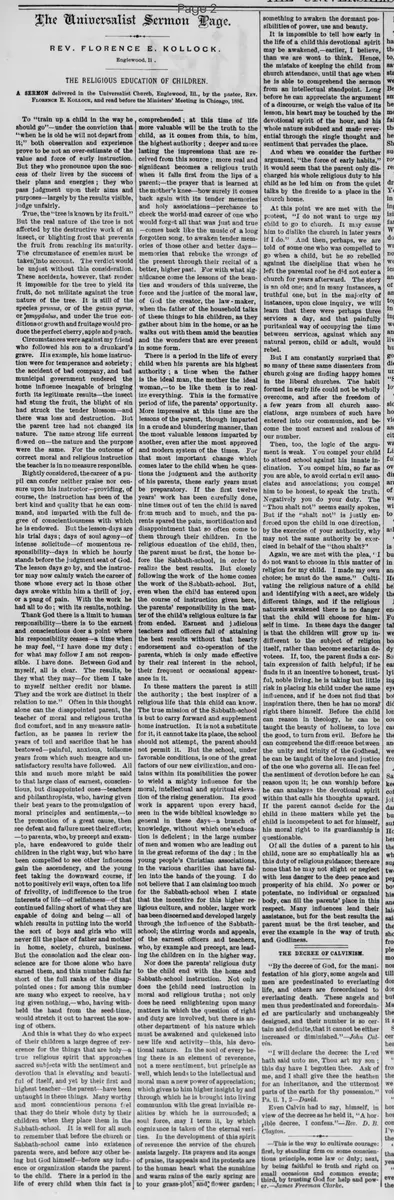
REV. FLORENCE E. KOLLOCK.
Englewood, Ill.
THE RELIGIOUS EDUCATION OF CHILDREN.
A SERMON delivered in the Universalist Church, Englewood, Ill., by the pastor, Rev. Florence E. Kollock, and read before the Ministers' Meeting in Chicago, 1886.
To "train up a child in the way he should go"-under the conviction that "when he is old he will not depart from it;" both observation and experience prove to be not an over-estimate of the value and force of early instruction. But they who pronounce upon the success of their lives by the success of their plans and energies; they who pass judgment upon their aims and purposes-largely by the results visible, judge unfairly. True, the "tree is known by its fruit." But the real nature of the tree is not affected by the destructive work of an insect, or blighting frost that prevents the fruit from reaching its maturity. The circumstance of enemies must be taken into account. The verdict would be unjust without this consideration. These accidents, however, that render it impossible for the tree to yield its fruit, do not militate against the true nature of the tree. It is still of the species prunus, or of the genus pyrus, or amygdalus, and under the true conditions of growth and fruitage would produce the perfect cherry, apple and peach. Circumstances were against my friend who followed his son to a drunkard's grave. His example, his home instruction were for temperance and sobriety: the accident of bad company, and bad municipal government rendered the home influence incapable of bringing forth its legitimate results--the insect had stung the fruit, the blight of sin had struck the tender blossom-and there was loss and destruction. But the parent tree had not changed its nature. The same strong life current flowed on-the nature and the purpose were the same. For the outcome of correct moral and religious instruction the teacher is in no measure responsible. Rightly considered, the career of a pupil can confer neither praise nor censure upon his instructor-providing, of course, the instruction has been of the best kind and quality that he can command, and imparted with the full degree of conscientiousness with which he is endowed. But the lesson-days are his trial days; days of soul agony-of intense solicitude-of momentous responsibility--days in which he hourly stands before the judgment seat of God. The lesson days go by, and the instructor may now calmly watch the career of those whose every act in those other days awoke within him a thrill of joy, or a pang of pain. With the work he had all to do; with its results, nothing. Thank God there is a limit to human responsibility-there is to the earnest and conscientious doer a point where his responsibility ceases-a time when he may feel, "I have done my duty; for what may follow I am not responsible. I have done. Between God and myself, all is clear. The results, be they what they may-for them I take to myself neither credit nor blame. They and the work are distinct in their relation to me." Often in this thought alone can the disappointed parent, the teacher of moral and religious truths find comfort, and in any measure satisfaction, as he passes in review the years of toil and sacrifice that he has bestowed--painful, anxious, toilsome years from which such meagre and unsatisfactory results have followed. All this and much more might be said to that large class of earnest, conscientious, but disappointed ones-teachers and philanthropists, who, having given their best years to the promulgation of moral principles and sentiments,-to the promotion of a great cause, then see defeat and failure meet their efforts: -to parents, who, by precept and example, have endeavored to guide their children in the right way, but who have been compelled to see other influences gain the ascendency, and the young feet taking the downward course, if not to positively evil ways, often to a life of frivolity, of indifference to the true interests of life--of selfishness-of that continued falling short of what they are capable of doing and being-all of which results in putting into the world the sort of boys and girls who will never fill the place of father and mother in home, society, church, business. But the consolation and the clear conscience are for those alone who have earned them, and this number falls far short of the full ranks of the disappointed ones; for among this number are many who expect to receive, having given nothing,-who, having withheld the hand from the seed-time, would stretch it out to harvest the sowing of others. And this is what they do who expect of their children a large degree of reverence for the things that are holy-a true religious spirit that approaches sacred subjects with the sentiment and devotion that is elevating and beautiful of itself, and yet by their first and highest teacher-the parent-have been untaught in these things. Many worthy and most conscientious persons feel that they do their whole duty by their children when they place them in the Sabbath-school. It is well for all such to remember that before the church or Sabbath-school came into existence parents were, and before any other being but God himself-before any influence or organization stands the parent to the child. There is a period in the life of every child when this fact is comprehended: at this time of life more valuable will be the truth to the child, as it comes from this, to him, the highest authority; deeper and more lasting the impressions that are received from this source; more real and significant becomes a religious truth when it falls first from the lips of a parent;-the prayer that is learned at the mother's knee-how surely it comes back again with its tender memories and holy associations-perchance to check the world-mad career of one who would forget all that was just and true -comes back like the music of a long forgotten song, to awaken tender memories of those other and better days- memories that rebuke the wrongs of the present through their recital of a better, higher past. For with what significance come the lessons of the beauties and wonders of this universe, the force and the justice of the moral law, of God the creator, the law-maker, when the father of the household talks of these things to his children, as they gather about him in the home, or as he walks out with them amid the beauties and the wonders that are ever present in some form. There is a period in the life of every child when his parents are his highest authority; a time when the father is the ideal man, the mother the ideal woman,-to be like them is to realize everything. This is the formative period of life, the parents' opportunity. More impressive at this time are the lessons of the parent, though imparted in a crude and blundering manner, than the most valuable lessons imparted by another, even after the most approved and modern system of the times. For that most important change which comes later to the child when he questions the judgment and the authority of his parents, these early years must be preparatory. If the first twelve years' work has been carefully done, nine times out of ten the child is saved from much and to much, and the parents spared the pain, mortification and disappointment that so often come to them through their children. In the religious education of the child, then, the parent must be first, the home before the Sabbath-school, in order to realize the best results. But closely following the work of the home comes the work of the Sabbath-school. But, even when the child has entered upon the course of instruction given here, the parents' responsibility in the matter of the child's religious culture is far from ended. Earnest and judicious teachers and officers fail of attaining the best results without that hearty endorsement and co-operation of the parents, which is only made effective by their real interest in the school, their frequent or occasional appearance in it. In these matters the parent is still the authority; the best inspirer of a religious life that this child can know. The true mission of the Sabbath-school is but to carry forward and supplement home instruction. It is not a substitute for it, it cannot take its place, the school should not attempt, the parent should not permit it. But the school, under favorable conditions, is one of the great factors of our new civilization, and contains within its possibilities the power to wield a mighty influence for the moral, intellectual and spiritual elevation of the rising generation. Its good work is apparent upon every hand, seen in the wide biblical knowledge so general in these days-a branch of knowledge, without which one's education is deficient; in the large number of men and women who are leading out in the great reforms of the day; in the young people's Christian associations, in the various charities that have fallen into the hands of the young. I do not believe that I am claiming too much for the Sabbath-school when I state that the incentive for this higher religious culture, and nobler, larger work has been discerned and developed largely through the influence of the Sabbath-school; the stirring words and appeals, of the earnest officers and teachers, who, by example and precept, are leading the children on in the higher way. Nor does the parents' religious duty to the child end with the home and Sabbath-school instruction. Not only does the child need instruction in moral and religious truths; not only does he need enlightening upon many matters in which the question of right and duty are involved, but there is another department of his nature which must be awakened and quickened into new life and activity-this, his devotional nature. In the soul of every being there is an element of reverence, not a mere sentiment, but principle as well, which lends to the intellectual and moral man a new power of appreciation; which gives to him higher insight by and through which he is brought into living communion with the great invisible realities by which he is surrounded; a soul force, may I term it, by which cognizance is taken of the eternal verities. In the development of this spirit of reverence the service of the church assists largely. Its prayers and its songs of praise, its appeals and its protests are to the human heart what the sunshine and warm rains of the early spring are to your grass-plot and flower garden; something to awaken the dormant possibilities of power, use and beauty. It is impossible to tell how early in the life of a child this devotional spirit may be awakened,-earlier, I believe, than we are wont to think. Hence, the mistake of keeping the child from church attendance, until that age when he is able to comprehend the sermon from an intellectual standpoint. Long before he can appreciate the argument of a discourse, or weigh the value of its lesson, his heart may be touched by the devotional spirit of the hour, and his whole nature subdued and made reverential through the single thought and sentiment that pervades the place. And when we consider the further argument, "the force of early habits," it would seem that the parent only discharged his whole religious duty to his child as he led him on from the quiet talks by the fireside to a place in the church home. At this point we are met with the protest, "I do not want to urge my child to go to church. It may cause him to dislike the church in later years if I do." And then, perhaps, we are told of some one who was compelled to go when a child, but he so rebelled against the discipline that when he left the parental roof he did not enter a church for years afterward. The story is an old one; and in many instances, a truthful one, but in the majority of instances, upon close inquiry, we will learn that there were perhaps three services a day, and that painfully puritanical way of occupying the time between services, against which any natural person, child or adult, would rebel. But I am constantly surprised that so many of these same dissenters from church going are finding happy homes in the liberal churches. The habit formed in early life could not be wholly overcome, and after the freedom of a few years from all church associations, large numbers of such have entered into our communion, and become the most earnest and zealous of our number. Then, too, the logic of the argument is weak. You compel your child to attend school against his innate inclination. You compel him, so far as you are able, to avoid certain evil associates and associations; you compel him to be honest, to speak the truth. Negatively you do your duty. The "Thou shalt not" seems easily spoken. But if the "shalt not" is justly enforced upon the child in one direction, by the exercise of your authority, why may not the same authority be exercised in behalf of the "thou shalt?" Again, we are met with the plea, 'I do not want to choose in this matter of religion for my child. I made my own choice; he must do the same." Cultivating the religious nature of a child and identifying with a sect, are widely different things, and if the religious nature is awakened there is no danger that the child will choose for himself in time. In these days the danger is that the children will grow up indifferent to the subject of religion itself, rather than become sectarian devotees. If, too, the parent finds a certain expression of faith helpful; if he finds in it an incentive to honest, trustful, noble living, he is taking but little risk in placing his child under the same influences, and if he does not find that inspiration there, then he has no moral right there himself. Before the child can reason in theology, he can be taught the beauty of holiness, to love the good, to turn from evil. Before he can comprehend the difference between the unity and trinity of the Godhead, he can be taught of the love and justice of the one who governs all. He can feel the sentiment of devotion before he can reason upon it; he can worship before he can analyze the devotional spirit within that calls his thoughts upward. If the parent cannot decide for the child in these matters while yet the child is incompetent to act for himself, his moral right to its guardianship is questionable. Of all the duties of a parent to his child, none are so emphatically his as this duty of religious guidance; there are none that he may not slight or neglect with less danger to the deep peace and prosperity of his child. No power or potentate, no individual or organized body, can fill the parents' place in this respect. Many influences lend their assistance, but for the best results the parent must be the first teacher, and ever the example in the way of truth and Godliness.
What sub-type of article is it?
What themes does it cover?
What keywords are associated?
What entities or persons were involved?
Where did it happen?
Story Details
Key Persons
Location
Englewood, Ill., Universalist Church
Event Date
1886
Story Details
The sermon stresses the paramount importance of parental responsibility in the religious and moral education of children, beginning in the home, reinforced by Sabbath school and church attendance. It argues that early instruction shapes character enduringly, despite adverse influences, and that parents must actively guide children toward reverence, devotion, and ethical living before external forces intervene.