Thank you for visiting SNEWPapers!
Sign up free
Norfolk Gazette And Publick Ledger
Norfolk, Virginia
What is this article about?
Bulletins from Napoleon's Grand Army at Finckenstein detail engagements near Weichselmunde and Danzig, including victories over Russian and Prussian forces with significant enemy casualties and captures; actions in Silesia against a surprise column; capture of an English corvette; and progress in the siege of Danzig.
Merged-components note: These two components form a single continuous foreign news bulletin about Napoleonic military events, with the text flowing directly from one to the other.
Clipping
OCR Quality
Full Text
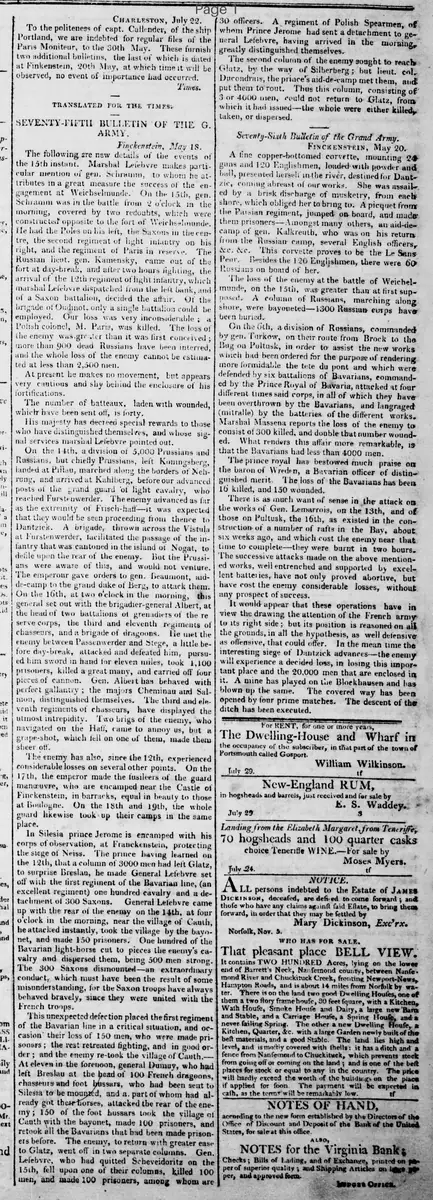
To the politeness of capt. Callender, of the ship Portland, we are indebted for regular files of the Paris Moniteur, to the 30th May. These furnish two additional bulletins, the last of which is dated at Finckenstein, 20th May, at which time it will be observed, no event of importance had occurred.
Times.
TRANSLATED FOR THE TIMES.
SEVENTY-FIFTH BULLETIN OF THE GRAND ARMY.
Finckenstein, May 18.
The following are new details of the events of the 15th instant. Marshal Lefebvre makes particular mention of gen. Schramm, to whom he attributes in a great measure the success of the engagement at Weichselmunde. On the 15th, gen. Schramm was in the battle from 2 o'clock in the morning, covered by two redoubts, which were constructed opposite to the fort of Weichselmunde. He had the Poles on his left, the Saxons in the center, the second regiment of light infantry on his right, and the regiment of Paris in reserve. The Russian lieut. gen. Kamensky, came out of the fort at day-break, and after two hours fighting, the arrival of the 12th regiment of light infantry, which marshal Lefebvre dispatched from the left bank, and of a Saxon battalion, decided the affair. Of the brigade of Oudinot, only a single battalion could be employed. Our loss was very inconsiderable; a Polish colonel, M. Paris, was killed. The loss of the enemy was greater than it was first conceived; more than 900 dead Russians have been interred. and the whole loss of the enemy cannot be estimated at less than 2,500 men.
At present he makes no movement, but appears very cautious and shy behind the enclosure of his fortifications.
The number of batteaux, laden with wounded, which have been sent off, is forty.
His majesty has decreed special rewards to those who have distinguished themselves, and whose signal services marshal Lefebvre pointed out.
On the 14th, a division of 5,000 Prussians and Russians, but chiefly Prussians, left Konigsberg, landed at Pillau, marched along the borders of Nehrung, and arrived at Kahlberg, before our advanced posts of the grand guard of light cavalry, who reached Furstenwerder. The enemy advanced as far as the extremity of Frisch-Haff--it was expected that they would be seen proceeding from thence to Dantzick. A brigade, thrown across the Vistula at Furstenwerder, facilitated the passage of the infantry that was cantoned in the island of Nogat, to defile upon the rear of the enemy. But the Prussians were aware of this, and would not venture.
The emperor gave orders to gen. Beaumont, aide-de-camp to the grand duke of Berg, to attack them.
On the 16th, at two o'clock in the morning, this general set out with the brigadier-general Albert, at the head of two battalions of grenadiers of the reserve corps, the third and eleventh regiments of chasseurs, and a brigade of dragoons. He met the enemy between Passenwerder and Stege, a little before day-break, attacked and defeated him, pursued him sword in hand for eleven miles, took 1,100 prisoners, killed a great many, and carried off four pieces of cannon. Gen. Albert has behaved with perfect gallantry; the majors Cheminau and Salmon, distinguished themselves. The third and eleventh regiments of chasseurs, have displayed the utmost intrepidity. Two brigs of the enemy, who navigated on the Haaf, came to annoy us, but a grape-shot, which fell on one of them, made them sheer off.
The enemy has also, since the 12th, experienced considerable losses on several other points. On the 17th, the emperor made the fusileers of the guard manoeuvre, who are encamped near the Castle of Finckenstein, in barracks, equal in beauty to those at Boulogne. On the 18th and 19th, the whole guard likewise took up their camps in the same place.
In Silesia prince Jerome is encamped with his corps of observation, at Frankenstein, protecting the siege of Neiss. The prince having learned on the 12th, that a column of 3000 men had left Glatz, to surprise Breslau, he made General Lefebvre set off with the first regiment of the Bavarian line, (an excellent regiment) one hundred cavalry and a detachment of 300 Saxons. General Lefebvre came up with the rear of the enemy on the 14th, at four o'clock in the morning, near the village of Cauth, he attacked instantly, took the village by the bayonet, and made 150 prisoners. One hundred of the Bavarian light-horse cut to pieces the enemy's cavalry and dispersed them, being 500 men strong.
The 300 Saxons dismounted--an extraordinary conduct, which must have been the result of some misunderstanding, for the Saxon troops have always behaved bravely, since they were united with the French troops.
This unexpected defection placed the first regiment of the Bavarian line in a critical situation, and occasioned their loss of 150 men, who were made prisoners; the rest retreated fighting, and in good order; and the enemy re-took the village of Cauth.--
At eleven in the forenoon, general Drouy, who had left Breslau at the head of 100 French dragoons, chasseurs and foot hussars, who had been sent to Silesia to be mounted, and a part of whom had already got their horses, attacked the rear of the enemy; 150 of the foot hussars took the village of Cauth with the bayonet, made 100 prisoners, and retook all the Bavarians that had been made prisoners before. The enemy, to return with greater ease to Glatz, went off in two separate columns. Gen. Lefebvre, who had quitted Scheveidoritz on the 15th, fell upon one of their columns, killed 100 men, and made 100 prisoners, among whom are 30 officers. A regiment of Polish Spearmen, of whom Prince Jerome had sent a detachment to general Lefebvre, having arrived in the morning, greatly distinguished themselves.
The second column of the enemy sought to reach Glatz, by the way of Silberberg; but lieut. col. Ducondray, the prince's aid-de-camp met them, and put them to rout. Thus this column, consisting of 3 or 4000 men, could not return to Glatz, from which it had issued--the whole were either killed-taken, or dispersed.
Seventy-Sixth Bulletin of the Grand Army
Finckenstein, May 20.
A fine copper-bottomed corvette, mounting 24 guns and 120 Englishmen, loaded with powder and ball, presented herself in the river, destined for Dantzick, coming abreast of our works. She was assailed by a brisk discharge of musketry, from each shore, which obliged her to bring to. A picquet from the Parisian regiment, jumped on board, and made them prisoners--Amongst many others, an aide-de-camp of gen. Kalkreuth, who was on his return from the Russian camp, several English officers, &c. &c. This corvette proves to be the Le Sans Peur. Besides the 120 Englishmen, there were 60 Russians on board of her.
The loss of the enemy at the battle of Weichselmunde, on the 15th, was greater than at first supposed. A column of Russians, marching along shore, were bayoneted--1300 Russian corpses have been buried.
On the 6th, a division of Russians, commanded by gen. Tormasow, on their route from Brock to the Bug on Pultusk, in order to assist the new works which had been ordered for the purpose of rendering more formidable the tete du pont and which were defended by six battalions of Bavarians, commanded by the Prince Royal of Bavaria, attacked at four different times said corps, in all of which they have been overthrown by the Bavarians, and langridged (mitraille) by the batteries of the different works.
Marshal Massena reports the loss of the enemy to consist of 300 killed, and double that number wounded. What renders this affair more remarkable, is that the Bavarians had less than 4000 men.
The prince royal has bestowed much praise on the baron of Wreden, a Bavarian officer of distinguished merit. The loss of the Bavarians has been 16 killed, and 150 wounded.
There is as much want of sense in the attack on the works of Gen. Lemarois, on the 13th, and of those on Pultusk, the 16th, as existed in the construction of a number of rafts in the Bay, about six weeks ago, and which cost the enemy near that time to complete--they were burnt in two hours.
The successive attacks made on the above mentioned works, well entrenched and supported by excellent batteries, have not only proved abortive, but have cost the enemy considerable losses, without any prospect of success.
It would appear that these operations have in view the drawing the attention of the French army to its right side; but its position is reasoned on all the grounds, in all the hypothesis, as well defensive as offensive, that could offer. In the mean time the interesting siege of Dantzick advances--the enemy will experience a decided loss, in losing this important place and the 20,000 men that are enclosed in it. A mine has played on the Blockhausen and has blown up the same. The covered way has been opened by four breaching batteries. The descent of the ditch has been executed.
What sub-type of article is it?
What keywords are associated?
What entities or persons were involved?
Where did it happen?
Foreign News Details
Primary Location
Finckenstein
Event Date
May 18 20
Key Persons
Outcome
french and allied victories: at weichselmunde, over 900 russian dead buried, total enemy loss ~2,500; 1,100 prisoners and 4 cannon taken near stege; in silesia, enemy column of 3-4,000 dispersed, killed, or captured; corvette le sans peur captured with 120 english and 60 russians; near pultusk, 300 russians killed, 600 wounded vs. 16 bavarian killed, 150 wounded; siege of dantzick advancing with mine explosion and breaching.
Event Details
The 75th Bulletin details the battle at Weichselmunde on May 15 where French and allies under gen. Schramm defeated Russians led by Kamensky, with minimal French losses and heavy Russian casualties. On May 16, gen. Beaumont defeated a Prussian-Russian force, taking prisoners and cannon. In Silesia, prince Jerome's forces under General Lefebvre engaged an enemy column from Glatz attempting to surprise Breslau, resulting in the enemy's dispersal despite a Saxon mishap. The 76th Bulletin reports capture of the English corvette Le Sans Peur destined for Dantzick; updated Weichselmunde losses to 1,300 Russian dead; Russian defeats near Pultusk by Bavarians; futile enemy attacks on French works; and progress in the siege of Dantzick including a successful mine.