Thank you for visiting SNEWPapers!
Sign up free
Editorial
July 10, 1815
Portland Gazette, And Maine Advertiser
Portland, Cumberland County, Maine
What is this article about?
Editorial denounces American republicans for admiring French tyrants like Robespierre, Danton, and Napoleon despite the mass suffering and murders in France, arguing their support was for despotism, not the people, as shown by their reaction to Napoleon's fall and return.
Clipping
OCR Quality
98%
Excellent
Full Text
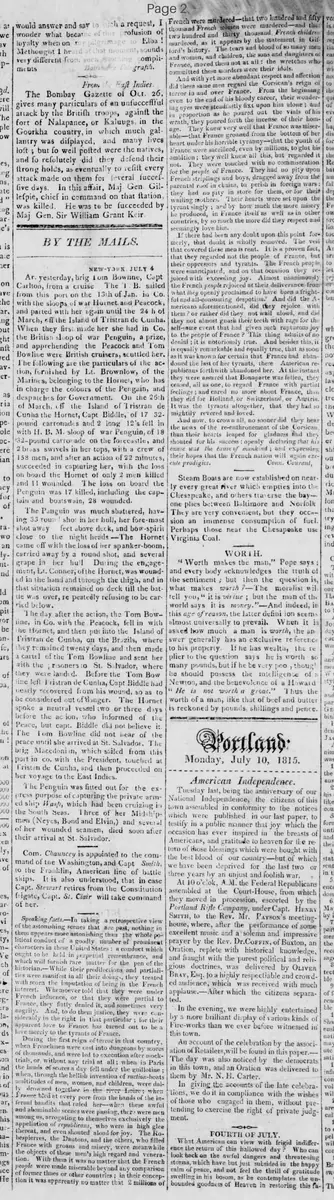
Speaking facts.--In taking a retrospective view of the astonishing scenes that are past, nothing in them appears more astonishing than the whole political conduct of a goodly number of prominent characters in these United States: a conduct which ought to be held in perpetual remembrance, and which will furnish rare matter for the pen of the historian.--While their predilections and partialities were manifest in all their doing, they treated with scorn the imputation of being in the French interest. Whensoever told that they were under French influence, or that they were partial to France, they flatly denied it, and sometimes very angrily. And, to do them justice, they were considerably in the right in that particular; for their apparent love to France has turned out to be a love merely to the tyrants of France.
During the first reign of terror in that country, when Frenchmen were cast into dungeons by scores of thousands, and were led to execution after mock-trials, or, without any trial at all: when in Paris the heads of scores a day fell under the guillotine; when, through the hellish invention of suction-boats multitudes of men, women, and children, were daily drowned together in the river Loire; when France bled at every pore from the hands of the infernal bandits that ruled her--when these awful and abominable scenes were passing, there were men among us, arrogating to themselves exclusively the appellation of republicans, who were in high glee thereat, and even shouted aloud for joy. The Robespierres, the Dantons, and the others, who filled France with groans and misery, were meanwhile the objects of these men's high regard and veneration. With them it was no matter that the French people were made miserable beyond any comparison of former times or other countries; in their conception it was apparently no matter that 2 millions of French were murdered--that two hundred and fifty thousand French women were murdered--and that two hundred and thirty thousand French children were murdered, as it appears by the statement in Girondists history. The tears and blood of so many men and women, and children, the sons and daughters of France, moved them not at all: the wretches who committed these murders were their idols.
And with yet more abundant respect and affection did these same men regard the Corsican's reign of terror in and over France. From the beginning even to the end of his bloody career, their wondering eyes were steadfastly fixt upon him alone; and in proportion as he poured out the vials of his wrath, they poured forth the incense of their homage--that France was miserable--that France groaned from the bottom of her heart under his horrible tyranny--that the youth of France were sacrificed, even by millions, to glut his ambition; they well knew all this, but regarded it not. They were touched with no commiseration for the people of France. They had no pity upon French striplings and boys, dragged away from the parental roof in chains, to perish in foreign wars: they had no pity in store for them, or for their wailing mothers. Their hearts were set upon the tyrant singly; and by how much the more misery he produced, in France itself as well as in other countries, by so much the more did they respect and seemingly love him.
If there had been any doubt upon this point formerly, that doubt is wholly removed. The veil that covered these men is rent. It is a proven fact, that they regarded not the people of France, but their oppressors and tyrants. The French people were emancipated, and on that occasion they rejoiced with exceeding joy. Almost unanimously the French people rejoiced at their deliverance from what they openly proclaimed to have been a frightful and all-consuming despotism. And did the Americans aforementioned, did they rejoice with them? or rather did they not wail aloud, and did they not almost gnash their teeth with rage for the self-same event that had given such rapturous joy to the people of France? This thing admits of no denial; it is notoriously true. And besides this, it is equally remarkable and equally true, that as soon as it was known for certain that France had abandoned the last of her tyrants, these American republicans forthwith abandoned her. At the instant they were assured that Bonaparte was fallen, they ceased, all as one, to regard France with partial feelings; and cared no more about France, than they did for Holland, or Switzerland, or Austria. It was the tyrants altogether, that they had so mightily revered and loved.
And now, to crown all, no sooner did they hear the news of the re-enthronement of the Corsican than their hearts leaped for gladness and they shouted for his success: openly declaring that his cause was the cause of mankind; and expressing their hopes that the French nation will again execute prodigies.
Conn. Courant,
During the first reign of terror in that country, when Frenchmen were cast into dungeons by scores of thousands, and were led to execution after mock-trials, or, without any trial at all: when in Paris the heads of scores a day fell under the guillotine; when, through the hellish invention of suction-boats multitudes of men, women, and children, were daily drowned together in the river Loire; when France bled at every pore from the hands of the infernal bandits that ruled her--when these awful and abominable scenes were passing, there were men among us, arrogating to themselves exclusively the appellation of republicans, who were in high glee thereat, and even shouted aloud for joy. The Robespierres, the Dantons, and the others, who filled France with groans and misery, were meanwhile the objects of these men's high regard and veneration. With them it was no matter that the French people were made miserable beyond any comparison of former times or other countries; in their conception it was apparently no matter that 2 millions of French were murdered--that two hundred and fifty thousand French women were murdered--and that two hundred and thirty thousand French children were murdered, as it appears by the statement in Girondists history. The tears and blood of so many men and women, and children, the sons and daughters of France, moved them not at all: the wretches who committed these murders were their idols.
And with yet more abundant respect and affection did these same men regard the Corsican's reign of terror in and over France. From the beginning even to the end of his bloody career, their wondering eyes were steadfastly fixt upon him alone; and in proportion as he poured out the vials of his wrath, they poured forth the incense of their homage--that France was miserable--that France groaned from the bottom of her heart under his horrible tyranny--that the youth of France were sacrificed, even by millions, to glut his ambition; they well knew all this, but regarded it not. They were touched with no commiseration for the people of France. They had no pity upon French striplings and boys, dragged away from the parental roof in chains, to perish in foreign wars: they had no pity in store for them, or for their wailing mothers. Their hearts were set upon the tyrant singly; and by how much the more misery he produced, in France itself as well as in other countries, by so much the more did they respect and seemingly love him.
If there had been any doubt upon this point formerly, that doubt is wholly removed. The veil that covered these men is rent. It is a proven fact, that they regarded not the people of France, but their oppressors and tyrants. The French people were emancipated, and on that occasion they rejoiced with exceeding joy. Almost unanimously the French people rejoiced at their deliverance from what they openly proclaimed to have been a frightful and all-consuming despotism. And did the Americans aforementioned, did they rejoice with them? or rather did they not wail aloud, and did they not almost gnash their teeth with rage for the self-same event that had given such rapturous joy to the people of France? This thing admits of no denial; it is notoriously true. And besides this, it is equally remarkable and equally true, that as soon as it was known for certain that France had abandoned the last of her tyrants, these American republicans forthwith abandoned her. At the instant they were assured that Bonaparte was fallen, they ceased, all as one, to regard France with partial feelings; and cared no more about France, than they did for Holland, or Switzerland, or Austria. It was the tyrants altogether, that they had so mightily revered and loved.
And now, to crown all, no sooner did they hear the news of the re-enthronement of the Corsican than their hearts leaped for gladness and they shouted for his success: openly declaring that his cause was the cause of mankind; and expressing their hopes that the French nation will again execute prodigies.
Conn. Courant,
What sub-type of article is it?
Partisan Politics
Foreign Affairs
What keywords are associated?
American Republicans
French Tyrants
Reign Of Terror
Napoleon
Bonaparte
French Suffering
Political Conduct
What entities or persons were involved?
American Republicans
Robespierre
Danton
Corsican (Napoleon)
Bonaparte
French People
Editorial Details
Primary Topic
Criticism Of American Republicans' Support For French Tyrants
Stance / Tone
Strongly Condemnatory And Sarcastic
Key Figures
American Republicans
Robespierre
Danton
Corsican (Napoleon)
Bonaparte
French People
Key Arguments
American Republicans Denied French Influence But Supported Tyrants Over The People
They Rejoiced At The Reign Of Terror Despite Mass Executions And Drownings
They Venerated Robespierre And Danton As Idols Despite French Misery
They Admired Napoleon's Tyranny And Wars Without Pity For French Victims
They Mourned France's Emancipation From Napoleon While The People Rejoiced
Upon Napoleon's Fall, They Abandoned Interest In France
They Now Celebrate His Return As The Cause Of Mankind