Thank you for visiting SNEWPapers!
Sign up free
The New Hampshire Gazette And Historical Chronicle
Portsmouth, Greenland, Rockingham County, New Hampshire
What is this article about?
On June 26, 1775, in Grenada, Commander in Chief William Young demanded the Assembly rescind an address to the King expressing loyalty but concern over the American conflict. The Assembly refused, defending their right to petition, and passed resolutions criticizing the demand. Young then dissolved the Assembly.
Clipping
OCR Quality
Full Text
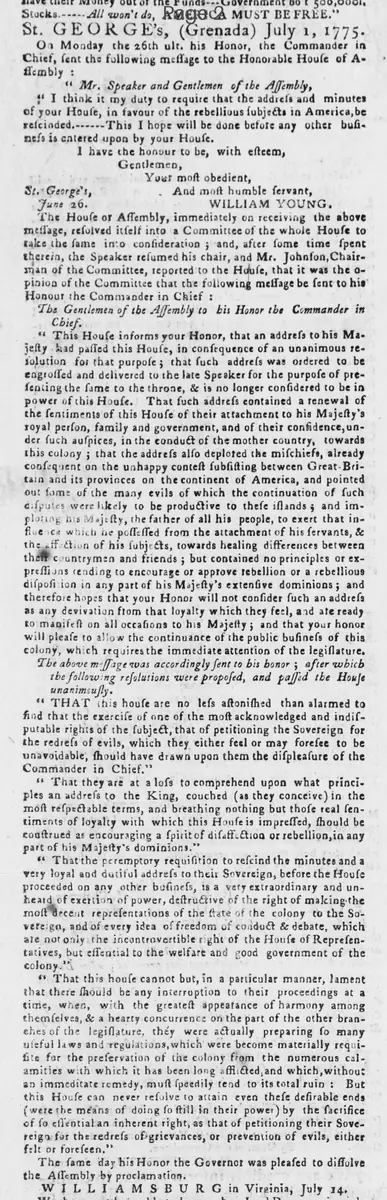
On Monday the 26th ult. his Honor, the Commander in Chief, sent the following message to the Honorable House of Assembly:
Mr. Speaker and Gentlemen of the Assembly,
I think it my duty to require that the address and minutes of your House, in favour of the rebellious subjects in America, be rescinded.----This I hope will be done before any other business is entered upon by your House.
I have the honour to be, with esteem,
Gentlemen,
Your most obedient,
And most humble servant,
WILLIAM YOUNG.
June 26.
The House or Assembly, immediately on receiving the above message, resolved itself into a Committee of the whole House to take the same into consideration; and, after some time spent therein, the Speaker resumed his chair, and Mr. Johnson, Chairman of the Committee, reported to the House, that it was the Opinion of the Committee that the following message be sent to his Honour the Commander in Chief:
The Gentlemen of the Assembly to his Honor the Commander in Chief.
This House informs your Honor, that an address to his Majesty had passed this House, in consequence of an unanimous resolution for that purpose; that such address was ordered to be engrossed and delivered to the late Speaker for the purpose of presenting the same to the throne, & is no longer considered to be in power of this House. That such address contained a renewal of the sentiments of this House of their attachment to his Majesty's royal person, family and government, and of their confidence, under such auspices, in the conduct of the mother country, towards this colony; that the address also depicted the mischiefs, already consequent on the unhappy contest subsisting between Great-Britain and its provinces on the continent of America, and pointed out some of the many evils of which the continuation of such disputes were likely to be productive to these islands; and imploring his Majesty, the father of all his people, to exert that influence which he possessed from the attachment of his servants, & the affection of his subjects, towards healing differences between their countrymen and friends; but contained no principles or expressions tending to encourage or approve rebellion or a rebellious disposition in any part of his Majesty's extensive dominions; and therefore hopes that your Honor will not consider such an address as any deviation from that loyalty which they feel, and are ready to manifest on all occasions to his Majesty; and that your honor will please to allow the continuance of the public business of this colony, which requires the immediate attention of the legislature.
The above message was accordingly sent to his honor; after which the following resolutions were proposed, and passed the House unanimously.
THAT this house are no less astonished than alarmed to find that the exercise of one of the most acknowledged and indisputable rights of the subject, that of petitioning the Sovereign for the redress of evils, which they either feel or may foresee to be unavoidable, should have drawn upon them the displeasure of the Commander in Chief.
That they are at a loss to comprehend upon what principles an address to the King, couched (as they conceive) in the most respectable terms, and breathing nothing but those real sentiments of loyalty with which this House is impressed, should be construed as encouraging a spirit of disaffection or rebellion, in any part of his Majesty's dominions.
That the peremptory requisition to rescind the minutes and a very loyal and dutiful address to their Sovereign, before the House proceeded on any other business, is a very extraordinary and unheard of exertion of power, destructive of the right of making the most decent representations of the state of the colony to the Sovereign, and of every idea of freedom of conduct & debate, which are not only the incontrovertible right of the House of Representatives, but essential to the welfare and good government of the colony.
That this house cannot but, in a particular manner, lament that there should be any interruption to their proceedings at a time, when, with the greatest appearance of harmony among themselves, & a hearty concurrence on the part of the other branches of the legislature, they were actually preparing so many useful laws and regulations, which were become materially requisite for the preservation of the colony from the numerous calamities with which it has been long afflicted, and which, without an immediate remedy, must speedily tend to its total ruin: But this House can never resolve to attain even these desirable ends (were the means of doing so still in their power) by the sacrifice of so essential an inherent right, as that of petitioning their Sovereign for the redress of grievances, or prevention of evils, either felt or foreseen.
The same day his Honor the Governor was pleased to dissolve the Assembly by proclamation.
What sub-type of article is it?
What keywords are associated?
What entities or persons were involved?
Where did it happen?
Foreign News Details
Primary Location
St. George's, Grenada
Event Date
June 26, 1775
Key Persons
Outcome
assembly dissolved by proclamation
Event Details
Commander in Chief William Young demanded the Assembly rescind an address and minutes favoring rebellious subjects in America. The Assembly responded by defending the address as loyal and petitioning the King for redress of evils from the American contest, passed unanimous resolutions criticizing the demand as an overreach, and was subsequently dissolved.