Thank you for visiting SNEWPapers!
Sign up free
Literary
November 25, 1786
Fowle's New Hampshire Gazette And General Advertiser
Portsmouth, Rockingham County, New Hampshire
What is this article about?
Medical essay critiquing antiphlogistic and evacuant treatments for putrid malignant sore throat, advocating stimulants like bark to counter putrefaction and debility. Cites authorities like Cullen, Dickinson, and Fothergill; describes absorption via pediluvium and cases in Portsmouth area.
Clipping
OCR Quality
95%
Excellent
Full Text
Observations and Remarks on the putrid malignant SORE THROAT, which has prevailed for three years past.
(Continued from our last.)
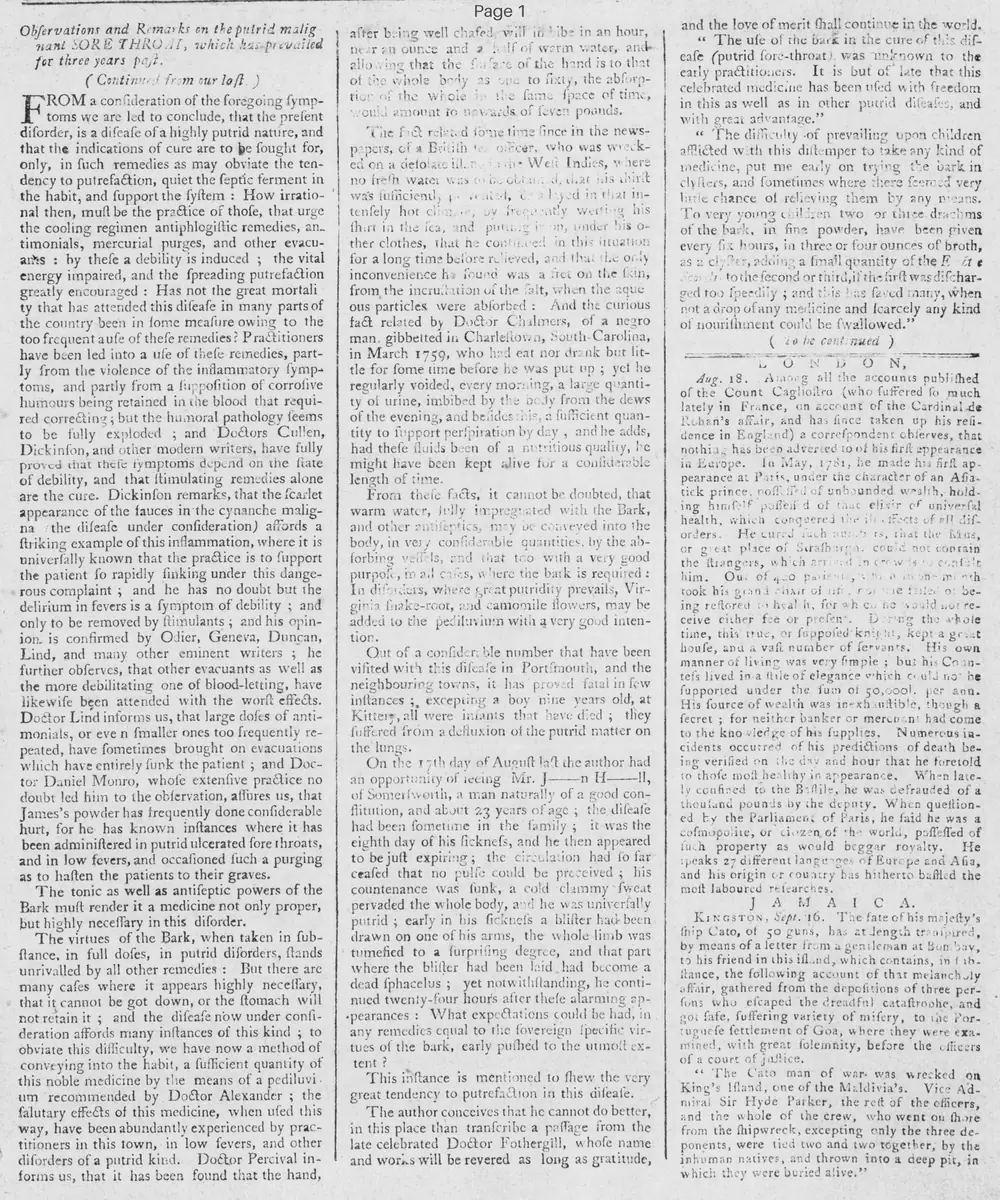
From a consideration of the foregoing symptoms we are led to conclude, that the present disorder, is a disease of a highly putrid nature, and that the indications of cure are to be sought for, only, in such remedies as may obviate the tendency to putrefaction, quiet the septic ferment in the habit, and support the system: How irrational then, must be the practice of those, that urge the cooling regimen antiphlogistic remedies, antimonials, mercurial purges, and other evacuants: by these a debility is induced; the vital energy impaired, and the spreading putrefaction greatly encouraged: Has not the great mortality that has attended this disease in many parts of the country been in some measure owing to the too frequent use of these remedies? Practitioners have been led into a use of these remedies, partly from the violence of the inflammatory symptoms, and partly from a supposition of corrosive humours being retained in the blood that required correcting; but the humoral pathology seems to be fully exploded; and Doctors Cullen, Dickinson, and other modern writers, have fully proved that these symptoms depend on the state of debility, and that stimulating remedies alone are the cure. Dickinson remarks, that the scarlet appearance of the fauces in the cynanche maligna (the disease under consideration) affords a striking example of this inflammation, where it is universally known that the practice is to support the patient so rapidly sinking under this dangerous complaint; and he has no doubt but the delirium in fevers is a symptom of debility; and only to be removed by stimulants; and his opinion is confirmed by Odier, Geneva, Duncan, Lind, and many other eminent writers; he further observes, that other evacuants as well as the more debilitating one of blood-letting, have likewise been attended with the worst effects. Doctor Lind informs us, that large doses of antimonials, or even smaller ones too frequently repeated, have sometimes brought on evacuations which have entirely sunk the patient; and Doctor Daniel Monro, whose extensive practice no doubt led him to the observation, assures us, that James's powder has frequently done considerable hurt, for he has known instances where it has been administered in putrid ulcerated sore throats, and in low fevers, and occasioned such a purging as to hasten the patients to their graves. The tonic as well as antiseptic powers of the Bark must render it a medicine not only proper, but highly necessary in this disorder. The virtues of the Bark, when taken in substance, in full doses, in putrid disorders, stands unrivalled by all other remedies: But there are many cases where it appears highly necessary, that it cannot be got down, or the stomach will not retain it; and the disease now under consideration affords many instances of this kind; to obviate this difficulty, we have now a method of conveying into the habit, a sufficient quantity of this noble medicine by the means of a pediluvium recommended by Doctor Alexander; the salutary effects of this medicine, when used this way, have been abundantly experienced by practitioners in this town, in low fevers, and other disorders of a putrid kind. Doctor Percival informs us, that it has been found that the hand, after being well chafed will imbibe in an hour, near an ounce and a half of warm water. and allowing that the surface of the hand is to that of the whole body as one to sixty, the absorption of the whole in the same space of time. would amount to towards of seven pounds. The fact related some time since in the newspapers, of a British sea officer, who was wrecked on a desolate island in the West Indies. where no fresh water was to be obtained, that his thirst was sufficed, by constantly wetting his shirt in the sea, and putting it in, under his other clothes, that he continued in this situation for a long time before relieved, and that the only inconvenience he found was a jitt on the skin, from the incrustation of the salt, when the aqueous particles were absorbed: And the curious fact related by Doctor Chalmers, of a negro man. gibbeted in Charlestown, South-Carolina, in March 1759, who had eat nor drank but little for some time before he was put up; yet he regularly voided, every morning, a large quantity of urine, imbibed by the body from the dews of the evening, and besides this, a sufficient quantity to support perspiration by day, and he adds, had these fluids been of a nutritious quality, he might have been kept alive for a considerable length of time. From these facts, it cannot be doubted, that warm water, fully impregnated with the Bark, and other antiseptics, may be conveyed into the body, in very considerable quantities, by the absorbing vessels, and that too with a very good purpose in all cases, where the bark is required: In disorders, where great putridity prevails, Virginia snake-root, and camomile flowers, may be added to the pediluvium with a very good intention. Out of a considerable number that have been visited with this disease in Portsmouth, and the neighbouring towns, it has proved fatal in few instances; excepting a boy nine years old, at Kittery, all were infants that have died; they suffered from a defluxion of the putrid matter on the lungs. On the 17th day of August last the author had an opportunity of seeing Mr. J-n H-l, of Somersworth, a man naturally of a good constitution, and about 23 years of age; the disease had been sometime in the family; it was the eighth day of his sickness, and he then appeared to be just expiring; the circulation had so far ceased that no pulse could be perceived; his countenance was sunk, a cold clammy sweat pervaded the whole body, and he was universally putrid; early in his sickness a blister had been drawn on one of his arms, the whole limb was tumefied to a surprising degree, and that part where the blister had been laid had become a dead sphacelus; yet notwithstanding, he continued twenty-four hours after these alarming appearances: What expectations could be had, in any remedies equal to the sovereign specific virtues of the bark, early pushed to the utmost extent? This instance is mentioned to shew the very great tendency to putrefaction in this disease. The author conceives that he cannot do better, in this place than transcribe a passage from the late celebrated Doctor Fothergill, whose name and works will be revered as long as gratitude, and the love of merit shall continue in the world. "The use of the bark in the cure of this disease (putrid sore-throat). was unknown to the early practitioners. It is but of late that this celebrated medicine has been used with freedom in this as well as in other putrid diseases, and with great advantage." The difficulty of prevailing upon children afflicted with this distemper to take any kind of medicine, put me early on trying the bark in clysters, and sometimes where there seemed very little chance of relieving them by any means. To very young children two or three drachms of the bark, in fine powder, have been given every six hours, in three or four ounces of broth, as a clyster, adding a small quantity of the electuary to the second or third, if the first was discharged too speedily; and this has saved many, when not a drop of any medicine and scarcely any kind of nourishment could be swallowed. (To be continued)
(Continued from our last.)
From a consideration of the foregoing symptoms we are led to conclude, that the present disorder, is a disease of a highly putrid nature, and that the indications of cure are to be sought for, only, in such remedies as may obviate the tendency to putrefaction, quiet the septic ferment in the habit, and support the system: How irrational then, must be the practice of those, that urge the cooling regimen antiphlogistic remedies, antimonials, mercurial purges, and other evacuants: by these a debility is induced; the vital energy impaired, and the spreading putrefaction greatly encouraged: Has not the great mortality that has attended this disease in many parts of the country been in some measure owing to the too frequent use of these remedies? Practitioners have been led into a use of these remedies, partly from the violence of the inflammatory symptoms, and partly from a supposition of corrosive humours being retained in the blood that required correcting; but the humoral pathology seems to be fully exploded; and Doctors Cullen, Dickinson, and other modern writers, have fully proved that these symptoms depend on the state of debility, and that stimulating remedies alone are the cure. Dickinson remarks, that the scarlet appearance of the fauces in the cynanche maligna (the disease under consideration) affords a striking example of this inflammation, where it is universally known that the practice is to support the patient so rapidly sinking under this dangerous complaint; and he has no doubt but the delirium in fevers is a symptom of debility; and only to be removed by stimulants; and his opinion is confirmed by Odier, Geneva, Duncan, Lind, and many other eminent writers; he further observes, that other evacuants as well as the more debilitating one of blood-letting, have likewise been attended with the worst effects. Doctor Lind informs us, that large doses of antimonials, or even smaller ones too frequently repeated, have sometimes brought on evacuations which have entirely sunk the patient; and Doctor Daniel Monro, whose extensive practice no doubt led him to the observation, assures us, that James's powder has frequently done considerable hurt, for he has known instances where it has been administered in putrid ulcerated sore throats, and in low fevers, and occasioned such a purging as to hasten the patients to their graves. The tonic as well as antiseptic powers of the Bark must render it a medicine not only proper, but highly necessary in this disorder. The virtues of the Bark, when taken in substance, in full doses, in putrid disorders, stands unrivalled by all other remedies: But there are many cases where it appears highly necessary, that it cannot be got down, or the stomach will not retain it; and the disease now under consideration affords many instances of this kind; to obviate this difficulty, we have now a method of conveying into the habit, a sufficient quantity of this noble medicine by the means of a pediluvium recommended by Doctor Alexander; the salutary effects of this medicine, when used this way, have been abundantly experienced by practitioners in this town, in low fevers, and other disorders of a putrid kind. Doctor Percival informs us, that it has been found that the hand, after being well chafed will imbibe in an hour, near an ounce and a half of warm water. and allowing that the surface of the hand is to that of the whole body as one to sixty, the absorption of the whole in the same space of time. would amount to towards of seven pounds. The fact related some time since in the newspapers, of a British sea officer, who was wrecked on a desolate island in the West Indies. where no fresh water was to be obtained, that his thirst was sufficed, by constantly wetting his shirt in the sea, and putting it in, under his other clothes, that he continued in this situation for a long time before relieved, and that the only inconvenience he found was a jitt on the skin, from the incrustation of the salt, when the aqueous particles were absorbed: And the curious fact related by Doctor Chalmers, of a negro man. gibbeted in Charlestown, South-Carolina, in March 1759, who had eat nor drank but little for some time before he was put up; yet he regularly voided, every morning, a large quantity of urine, imbibed by the body from the dews of the evening, and besides this, a sufficient quantity to support perspiration by day, and he adds, had these fluids been of a nutritious quality, he might have been kept alive for a considerable length of time. From these facts, it cannot be doubted, that warm water, fully impregnated with the Bark, and other antiseptics, may be conveyed into the body, in very considerable quantities, by the absorbing vessels, and that too with a very good purpose in all cases, where the bark is required: In disorders, where great putridity prevails, Virginia snake-root, and camomile flowers, may be added to the pediluvium with a very good intention. Out of a considerable number that have been visited with this disease in Portsmouth, and the neighbouring towns, it has proved fatal in few instances; excepting a boy nine years old, at Kittery, all were infants that have died; they suffered from a defluxion of the putrid matter on the lungs. On the 17th day of August last the author had an opportunity of seeing Mr. J-n H-l, of Somersworth, a man naturally of a good constitution, and about 23 years of age; the disease had been sometime in the family; it was the eighth day of his sickness, and he then appeared to be just expiring; the circulation had so far ceased that no pulse could be perceived; his countenance was sunk, a cold clammy sweat pervaded the whole body, and he was universally putrid; early in his sickness a blister had been drawn on one of his arms, the whole limb was tumefied to a surprising degree, and that part where the blister had been laid had become a dead sphacelus; yet notwithstanding, he continued twenty-four hours after these alarming appearances: What expectations could be had, in any remedies equal to the sovereign specific virtues of the bark, early pushed to the utmost extent? This instance is mentioned to shew the very great tendency to putrefaction in this disease. The author conceives that he cannot do better, in this place than transcribe a passage from the late celebrated Doctor Fothergill, whose name and works will be revered as long as gratitude, and the love of merit shall continue in the world. "The use of the bark in the cure of this disease (putrid sore-throat). was unknown to the early practitioners. It is but of late that this celebrated medicine has been used with freedom in this as well as in other putrid diseases, and with great advantage." The difficulty of prevailing upon children afflicted with this distemper to take any kind of medicine, put me early on trying the bark in clysters, and sometimes where there seemed very little chance of relieving them by any means. To very young children two or three drachms of the bark, in fine powder, have been given every six hours, in three or four ounces of broth, as a clyster, adding a small quantity of the electuary to the second or third, if the first was discharged too speedily; and this has saved many, when not a drop of any medicine and scarcely any kind of nourishment could be swallowed. (To be continued)
What sub-type of article is it?
Essay
What themes does it cover?
Death Mortality
What keywords are associated?
Putrid Sore Throat
Bark Treatment
Medical Debility
Antiphlogistic Remedies
Pediluvium
Cynanche Maligna
Fothergill
Literary Details
Title
Observations And Remarks On The Putrid Malignant Sore Throat, Which Has Prevailed For Three Years Past.
Subject
Putrid Malignant Sore Throat Disease And Its Treatment
Key Lines
How Irrational Then, Must Be The Practice Of Those, That Urge The Cooling Regimen Antiphlogistic Remedies, Antimonials, Mercurial Purges, And Other Evacuants: By These A Debility Is Induced; The Vital Energy Impaired, And The Spreading Putrefaction Greatly Encouraged:
"The Use Of The Bark In The Cure Of This Disease (Putrid Sore Throat). Was Unknown To The Early Practitioners. It Is But Of Late That This Celebrated Medicine Has Been Used With Freedom In This As Well As In Other Putrid Diseases, And With Great Advantage."