Thank you for visiting SNEWPapers!
Sign up free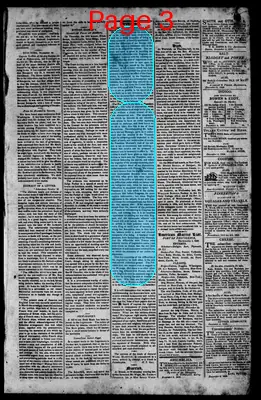
Editorial
December 5, 1809
The Rhode Island American, And General Advertiser
Providence, Providence County, Rhode Island
What is this article about?
Editorial critiques President Madison's 1809 message for vaguely addressing U.S. diplomatic troubles with Britain and France, especially the Chesapeake incident and potential embargo, while accusing it of downplaying French aggressions. It also mocks Democrats' indifference to Jerome Bonaparte's ennoblement.
Clipping
OCR Quality
95%
Excellent
Full Text
TUESDAY, DECEMBER 5. 1809.
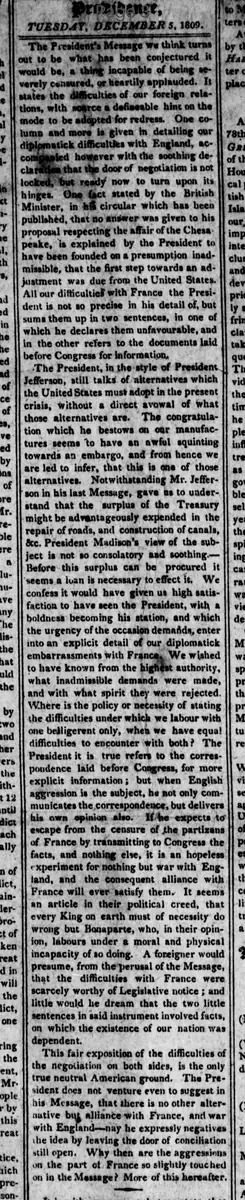
The President's Message we think turns out to be what has been conjectured it would be, a thing incapable of being severely censured, or heartily applauded. It states the difficulties of our foreign relations, with scarce a definable hint on the mode to be adopted for redress. One column and more is given in detailing our diplomatick difficulties with England, accompanied however with the soothing declaration that the door of negotiation is not locked, but ready now to turn upon its hinges. One fact stated by the British Minister, in his circular which has been published, that no answer was given to his proposal respecting the affair of the Chesapeake, is explained by the President to have been founded on a presumption inadmissible, that the first step towards an adjustment was due from the United States. All our difficulties with France the President is not so precise in his detail of, but sums them up in two sentences, in one of which he declares them unfavourable, and in the other refers to the documents laid before Congress for information.
The President, in the style of President Jefferson, still talks of alternatives which the United States must adopt in the present crisis, without a direct avowal of what those alternatives are. The congratulation which he bestows on our manufactures seems to have an awful squinting towards an embargo, and from hence we are led to infer, that this is one of those alternatives. Notwithstanding Mr. Jefferson in his last Message, gave us to understand that the surplus of the Treasury might be advantageously expended in the repair of roads, and construction of canals, &c. President Madison's view of the subject is not so consolatory and soothing.- Before this surplus can be procured it seems a loan is necessary to effect it. We confess it would have given us high satisfaction to have seen the President, with a boldness becoming his station, and which the urgency of the occasion demands, enter into an explicit detail of our diplomatick embarrassments with France. We wished to have known from the highest authority, what inadmissible demands were made and with what spirit they were rejected. Where is the policy or necessity of stating the difficulties under which we labour with one belligerent only, when we have equal difficulties to encounter with both? The President it is true refers to the correspondence laid before Congress, for more explicit information; but when English aggression is the subject, he not only communicates the correspondence, but delivers his own opinion also. If he expects to escape from the censure of the partizans of France by transmitting to Congress the facts, and nothing else, it is an hopeless experiment for nothing but war with England, and the consequent alliance with France will ever satisfy them. It seems an article in their political creed, that every King on earth must of necessity do wrong but Bonaparte, who, in their opinion, labours under a moral and physical incapacity of so doing. - A foreigner would presume, from the perusal of the Message, that the difficulties with France were scarcely worthy of Legislative notice; and little would he dream that the two little sentences in said instrument involved facts, on which the existence of our nation was dependent.
This fair exposition of the difficulties of the negotiation on both sides, is the only true neutral American ground. The President does not venture even to suggest in his Message, that there is no other alternative but alliance with France, and war with England--nay he expressly negatives the idea by leaving the door of conciliation still open. Why then are the aggressions on the part of France so slightly touched on in the Message? More of this hereafter.
It is with amazement that we state, that notwithstanding our democrats have such an utter aversion to monarchy and nobility that the very names almost frighten them into ague fits, none of their papers that we have heard of express the slightest concern in consequence of young Jerome Bonaparte's being created a Prince in this country. What can this ominous silence mean? We hope our right worthy friends, the Editors of the Chronicle, that grand safeguard of our rights, franchises and immunities, civil and religious, will graciously turn their attention to this subject.-- While Ben Austin lives we are perfectly secure from the encroachments of monarchy. We hope he will shortly rub up his eyes and favour us with some more profound and erudite lucubrations, under the signature of Honestus. With what raptures are we already prepared to admire first and read afterwards!
The President's Message we think turns out to be what has been conjectured it would be, a thing incapable of being severely censured, or heartily applauded. It states the difficulties of our foreign relations, with scarce a definable hint on the mode to be adopted for redress. One column and more is given in detailing our diplomatick difficulties with England, accompanied however with the soothing declaration that the door of negotiation is not locked, but ready now to turn upon its hinges. One fact stated by the British Minister, in his circular which has been published, that no answer was given to his proposal respecting the affair of the Chesapeake, is explained by the President to have been founded on a presumption inadmissible, that the first step towards an adjustment was due from the United States. All our difficulties with France the President is not so precise in his detail of, but sums them up in two sentences, in one of which he declares them unfavourable, and in the other refers to the documents laid before Congress for information.
The President, in the style of President Jefferson, still talks of alternatives which the United States must adopt in the present crisis, without a direct avowal of what those alternatives are. The congratulation which he bestows on our manufactures seems to have an awful squinting towards an embargo, and from hence we are led to infer, that this is one of those alternatives. Notwithstanding Mr. Jefferson in his last Message, gave us to understand that the surplus of the Treasury might be advantageously expended in the repair of roads, and construction of canals, &c. President Madison's view of the subject is not so consolatory and soothing.- Before this surplus can be procured it seems a loan is necessary to effect it. We confess it would have given us high satisfaction to have seen the President, with a boldness becoming his station, and which the urgency of the occasion demands, enter into an explicit detail of our diplomatick embarrassments with France. We wished to have known from the highest authority, what inadmissible demands were made and with what spirit they were rejected. Where is the policy or necessity of stating the difficulties under which we labour with one belligerent only, when we have equal difficulties to encounter with both? The President it is true refers to the correspondence laid before Congress, for more explicit information; but when English aggression is the subject, he not only communicates the correspondence, but delivers his own opinion also. If he expects to escape from the censure of the partizans of France by transmitting to Congress the facts, and nothing else, it is an hopeless experiment for nothing but war with England, and the consequent alliance with France will ever satisfy them. It seems an article in their political creed, that every King on earth must of necessity do wrong but Bonaparte, who, in their opinion, labours under a moral and physical incapacity of so doing. - A foreigner would presume, from the perusal of the Message, that the difficulties with France were scarcely worthy of Legislative notice; and little would he dream that the two little sentences in said instrument involved facts, on which the existence of our nation was dependent.
This fair exposition of the difficulties of the negotiation on both sides, is the only true neutral American ground. The President does not venture even to suggest in his Message, that there is no other alternative but alliance with France, and war with England--nay he expressly negatives the idea by leaving the door of conciliation still open. Why then are the aggressions on the part of France so slightly touched on in the Message? More of this hereafter.
It is with amazement that we state, that notwithstanding our democrats have such an utter aversion to monarchy and nobility that the very names almost frighten them into ague fits, none of their papers that we have heard of express the slightest concern in consequence of young Jerome Bonaparte's being created a Prince in this country. What can this ominous silence mean? We hope our right worthy friends, the Editors of the Chronicle, that grand safeguard of our rights, franchises and immunities, civil and religious, will graciously turn their attention to this subject.-- While Ben Austin lives we are perfectly secure from the encroachments of monarchy. We hope he will shortly rub up his eyes and favour us with some more profound and erudite lucubrations, under the signature of Honestus. With what raptures are we already prepared to admire first and read afterwards!
What sub-type of article is it?
Foreign Affairs
Partisan Politics
War Or Peace
What keywords are associated?
Madison Message
Foreign Relations
England France
Chesapeake Affair
Embargo
Democrats
Jerome Bonaparte
What entities or persons were involved?
President Madison
Jefferson
Bonaparte
England
France
Jerome Bonaparte
Ben Austin
Editors Of The Chronicle
Editorial Details
Primary Topic
Critique Of President Madison's Message On Foreign Relations With England And France
Stance / Tone
Critical And Sarcastic
Key Figures
President Madison
Jefferson
Bonaparte
England
France
Jerome Bonaparte
Ben Austin
Editors Of The Chronicle
Key Arguments
Message States Foreign Difficulties Without Clear Redress Mode
Details Diplomatic Issues With England, Including Chesapeake Affair
Vague On French Difficulties, Refers To Documents
Hints At Embargo As Alternative Via Manufactures Praise
Criticizes Lack Of Explicit Detail On French Demands
Notes Bias In Detailing English Vs French Aggressions
Sarcasm On Democrats' Silence About Jerome Bonaparte's Princely Title