Thank you for visiting SNEWPapers!
Sign up free
The New York Packet
New York, New York County, New York
What is this article about?
Colonel Hamilton speaks in the New York legislature in favor of a bill recommending to Congress the admission of independent Vermont into the Union, warning of its potential British alliances, tax exemptions attracting settlers, and threats to the confederation if left unaddressed.
Merged-components note: Continuation of Colonel Hamilton's speech on the Vermont bill across pages; labeled as domestic_news as it is a report of national political proceedings.
Clippings
1 of 2
OCR Quality
Full Text
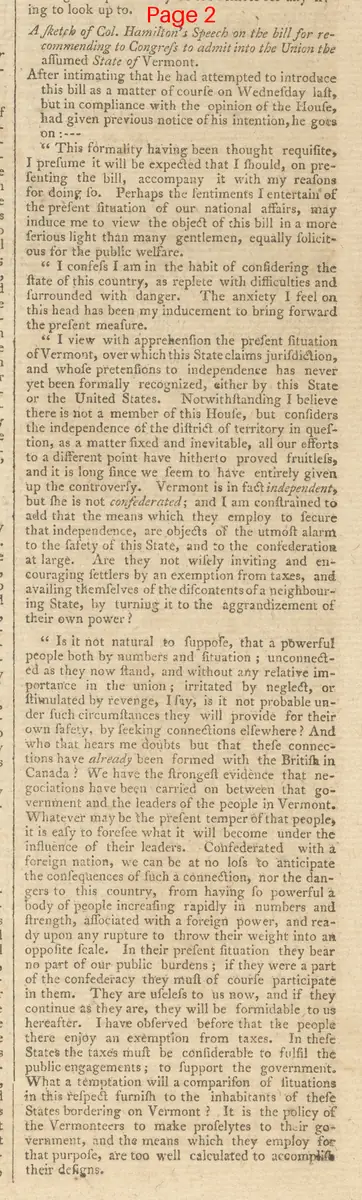
After intimating that he had attempted to introduce this bill as a matter of course on Wednesday last, but in compliance with the opinion of the House, had given previous notice of his intention, he goes on:---
This formality having been thought requisite, I presume it will be expected that I should, on presenting the bill, accompany it with my reasons for doing so. Perhaps the sentiments I entertain of the present situation of our national affairs, may induce me to view the object of this bill in a more serious light than many gentlemen, equally solicitous for the public welfare.
I confess I am in the habit of considering the state of this country, as replete with difficulties and surrounded with danger. The anxiety I feel on this head has been my inducement to bring forward the present measure.
I view with apprehension the present situation of Vermont, over which this State claims jurisdiction, and whose pretensions to independence has never yet been formally recognized, either by this State or the United States. Notwithstanding I believe there is not a member of this House, but considers the independence of the district of territory in question, as a matter fixed and inevitable, all our efforts to a different point have hitherto proved fruitless, and it is long since we seem to have entirely given up the controversy. Vermont is in fact independent, but she is not confederated; and I am constrained to add that the means which they employ to secure that independence, are objects of the utmost alarm to the safety of this State, and to the confederation at large. Are they not wisely inviting and encouraging settlers by an exemption from taxes, and availing themselves of the discontents of a neighboring State, by turning it to the aggrandizement of their own power?
Is it not natural to suppose, that a powerful people both by numbers and situation; unconnected as they now stand, and without any relative importance in the union; irritated by neglect, or stimulated by revenge, I say, is it not probable under such circumstances they will provide for their own safety, by seeking connections elsewhere? And who that hears me doubts but that these connections have already been formed with the British in Canada? We have the strongest evidence that negotiations have been carried on between that government and the leaders of the people in Vermont. Whatever may be the present temper of that people, it is easy to foresee what it will become under the influence of their leaders. Confederated with a foreign nation, we can be at no loss to anticipate the consequences of such a connection, nor the dangers to this country, from having so powerful a body of people increasing rapidly in numbers and strength, associated with a foreign power, and ready upon any rupture to throw their weight into an opposite scale. In their present situation they bear no part of our public burdens; if they were a part of the confederacy they must of course participate in them. They are useless to us now, and if they continue as they are, they will be formidable to us hereafter. I have observed before that the people there enjoy an exemption from taxes. In these States the taxes must be considerable to fulfil the public engagements; to support the government. What a temptation will a comparison of situations in this respect furnish to the inhabitants of these States bordering on Vermont? It is the policy of the Vermonteers to make proselytes to their government, and the means which they employ for that purpose, are too well calculated to accomplish their designs.
Are they not daily encroaching on our State?
In every light 'tis our interest, if possible, to put an end to their present situation.
I am aware there is in the minds of some members an objection, founded on a supposition that if we accede to the independence of Vermont, we are bound to make compensation to the citizens who have claims there under the grants of this State. I shall not say what justice may dictate in respect to those citizens; but I shall observe, that as far as that obligation is binding upon us, it applies more strongly to the actual state of things, than to that which is intended to be produced by the bill. It is the duty of the State, as matters now stand, either to support the claims of its citizens by an exertion of the public forces, or to make compensation to those who are sufferers by the neglect. Passively acquiescing in the independence of Vermont, is not less a violation of that protection and security which the public owes to individuals, than formally acceding to it. Indeed, by acceding to it, we put our citizens in a better situation than that in which they now are. We at least give them a chance for asserting their rights. The bill makes it a condition of the intended acknowledgment of the independence of Vermont, that it should become a part of the confederacy. The claims of individuals may then be submitted to the decision of a federal court, and as far as our citizens have equitable claims, it may be expected they would prevail in such a court.
At any rate we shall not be under a stronger obligation in this respect than we now are; and we may avoid many and extensive mischiefs by acceding to the measure proposed by the bill.
Many more considerations might be urged, but I think it unnecessary to enter into them at present. If any gentleman has arguments to oppose to those I have used, I shall be glad to hear them, and I flatter myself I shall be able to obviate any difficulties that may arise.
What sub-type of article is it?
What keywords are associated?
What entities or persons were involved?
Where did it happen?
Domestic News Details
Primary Location
New York
Key Persons
Event Details
Col. Hamilton presents a bill recommending to Congress the admission of Vermont into the Union, arguing that Vermont's de facto independence, tax exemptions attracting settlers from New York, potential British alliances, and lack of contribution to public burdens pose dangers to the state and confederation. He addresses objections regarding compensation for New York land claims, suggesting federal court resolution, and urges ending Vermont's current situation to integrate it properly.