Thank you for visiting SNEWPapers!
Sign up free
The Gazette
Portland, Cumberland County, Maine
What is this article about?
Letter by Robert G. Harper summarizing U.S. Congressional actions on trade suspension with French islands, retaliation against French edicts, internal laws revisions, rejection of Alien and Sedition Acts repeal, salary increases, trade prosperity, diplomatic maneuvers with France, and foreign affairs updates including loans and potential wars.
Clipping
OCR Quality
Full Text
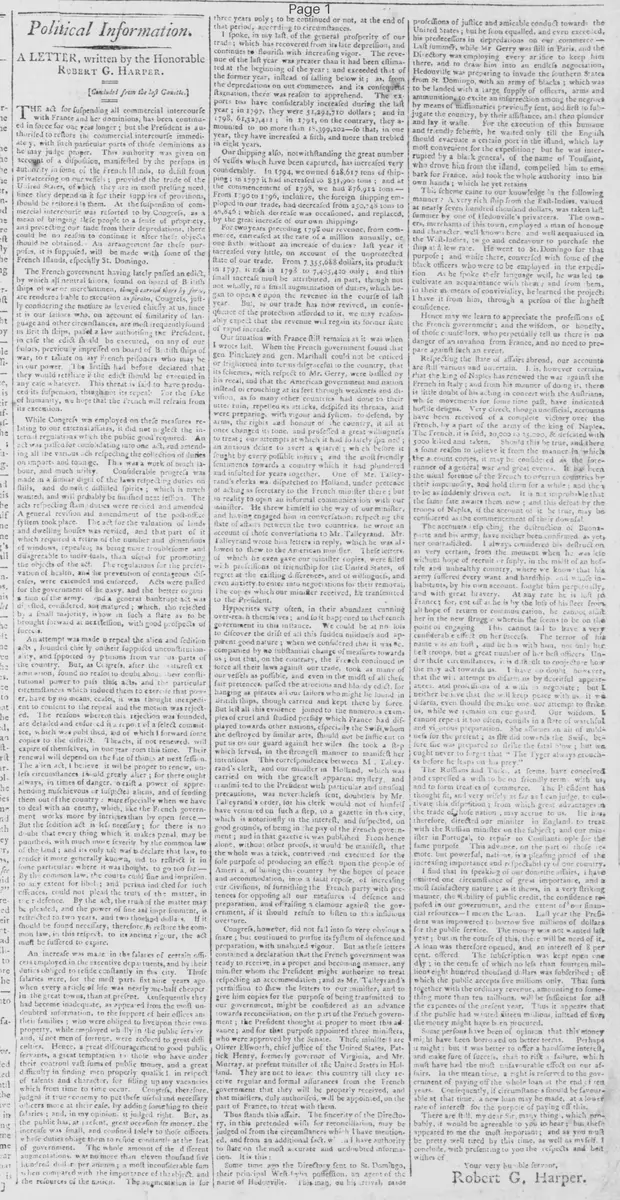
A LETTER, written by the Honorable Robert G. Harper.
[Concluded from the last Gazette.]
The act for suspending commercial intercourse with the French islands, is continued in force for one year longer; but the President is authorized to restore the commercial intercourse immediately, with such particular parts of those dominions as he may judge proper. This authority was given on account of a disposition, manifested by the persons in authority in some of the French Islands, to desist from privateering on our vessels; provided the trade of the United States, of which they are in most pressing need, since they depend on it for their supplies of provisions, should be restored to them. At the suspension of commercial intercourse was resorted to by Congress, as a mean of bringing these people to a sense of propriety, and protecting our trade from their depredations, there could be no reason to continue it after these objects should be obtained. An arrangement for these purposes, it is supposed, will be made with some of the French Islands, especially St. Domingo.
The French government having lately passed an edict, by which all neutral sailors, found on board of British ships of war or merchantmen, though carried there by force, are rendered liable to execution as pirates, Congress, justly considering the measure as levelled chiefly at us, since it is our sailors who, on account of similarity of language and other circumstances, are most frequently found in British ships, passed a law authorizing the President, in case the edict should be executed, on any of our sailors, previously impressed on board of British ships of war, to retaliate on any French prisoners who may be in our power. The British had before declared that they would retaliate if the edict should be executed in any case whatever. This threat is said to have produced its suspension, though not its repeal. For the sake of humanity, we hope that the French will refrain from its execution.
While Congress was employed on these measures relating to our external affairs, it did not neglect the internal regulations which the public good required. An act was passed for consolidating into one act, and amending all the various acts respecting the collection of duties on imports and tonnage. This was a work of much labour, and much utility. Considerable progress was made in a similar digest of the laws respecting duties on stills, and domestic distilled spirits; which is much wanted, and will probably be finished next session. The acts respecting stamp duties were revised and amended. A general revision and amendment of the post-office system took place. The act for the valuation of lands and dwelling houses was revised, and that part of it which required a return of the number and dimensions of windows, repealed; as being more troublesome and disagreeable to individuals, than useful for promoting the objects of the act. The regulations for the preservation of health, and the prevention of contagious diseases, were extended and enforced. Acts were passed for the government of the Navy, and the better organization of the army. And a general bankrupt act was digested, considered, and matured; which, though rejected by a small majority, is now in such a state as to be brought forward at next session, with good prospects of success.
An attempt was made to repeal the alien and sedition acts, founded chiefly on their supposed unconstitutionality, and supported by petitions from various parts of the country. But, as Congress, after the maturest examination, found no reason to doubt about their constitutional power to pass those acts, and the particular circumstances which induced them to exercise that power, have by no means ceased, it was thought inexpedient to consent to the repeal and the motion was rejected. The reasons whereon this rejection was founded, are detailed and enforced in a report of a select committee, which was published, and of which I forward some copies to the district. The acts, if not renewed, will expire of themselves, in one year from this time. Their renewal will depend on the state of things at next session. The alien act, I believe it will be proper to renew, unless circumstances should greatly alter; for there ought always, in times of danger, to exist a power of apprehending mischievous or suspected aliens, and of sending them out of the country: more especially when we have to deal with an enemy, which, like the French government works more by intrigues than by open force.—
But the sedition act is so necessary; for there is no doubt that every thing which it makes penal, may be punished, with much more severity by the common law of the land; and its only use was to declare that law, to render it more generally known, and to restrict it in some particulars, where it was thought to go too far.—By the common law, the courts could fine and imprison, to any extent for libel; and persons indicted for such offences, could not plead the truth of the matter, in their defence. By the act, the truth of the matter may be pleaded, and the power of fine and imprisonment, is restricted to two years, and two thousand dollars. If it should be found necessary, therefore restore the common law, in this respect, to its ancient rigour, the act must be suffered to expire.
An increase was made in the salaries of certain officers employed in the executive departments, and by their duties obliged to reside constantly in this city. Those salaries were, for the most part, fixed nine years ago when every article of life was nearly one-half cheaper in the great towns, than at present. Consequently they had become inadequate, as appeared from the most undoubted information, to the support of their offices and their families; who were obliged to live upon their own property, while employed wholly in the public service and, if not men of fortune, were reduced to great difficulties. Hence, a great discouragement to good public servants, a great temptation to those who have under their control vast sums of public money, and a great difficulty in finding men properly qualified in respect of talents and character, for filling up any vacancies which from time to time occur. Congress, therefore, judged it true economy to put these useful and necessary officers more at their ease, by adding something to their salaries; and, in my opinion, it judged right. But, as the public has, at present, great occasion for money, the increase was small, and confined solely to those officers whose duties oblige them to reside constantly at the seat of government. The whole amount of the different augmentations, was no more than eleven thousand five hundred dollars per annum; a most inconsiderable sum when compared with the importance of the object, and the resources of the nation. The augmentation is for three years only; to be continued or not, at the end of that period, according to circumstances.
I spoke, in my last, of the general prosperity of our trade; which has recovered from its late depression, and continues to flourish with increasing vigor. The revenue of the last year was greater than it had been estimated at the beginning of the year; and exceeded that of the former year, instead of falling below it; as, from the depredations on our commerce, and its consequent stagnation, there was reason to apprehend. The exports too have considerably increased during the last year; in 1797, they were 51,294,710 dollars; and in 1798, 61,327,411; in 1791, on the contrary, they amounted to no more than 18,399,202—so that, in one year, they have increased a fifth, and more than trebled in eight years.
Our shipping also, notwithstanding the great number of vessels which have been captured, has increased very considerably. In 1794, we owned 628,617 tons of shipping; in 1797 it had increased to 831,900 tons; and at the commencement of 1798, we had 876,912 tons—From 1790 to 1796, inclusive, the foreign shipping employed in our trade, had decreased from 250,748 tons to 4,846; which decrease was occasioned, and replaced, by the great increase of our own shipping.
For two years preceding 1798 our revenue, from commerce, increased at the rate of a million annually, or one sixth, without an increase of duties? last year it increased very little, on account of the unprotected state of our trade. From 7,355,688 dollars, its product in 1797 it rose in 1798 to 7,405,420 only; and this small increase must be attributed, in part, though not wholly, to a small augmentation of duties, which began to operate upon the revenue in the course of last year. But, as our trade has now revived, in consequence of the protection afforded to it, we may reasonably expect that the revenue will regain its former state of rapid increase.
Our situation with France still remains as it was when I wrote last. When the French government found that Gen. Pinckney and Gen. Marshall could not be enticed or frightened into terms disgraceful to the country, that its schemes, with respect to Mr. Gerry, were baffled by his recall, and that the American government and nation instead of crouching at its feet through weakness and division, as so many other countries had done to their utter ruin, repelled its attacks, despised its threats, and were preparing, with vigour and system, to defend, by arms, the rights and honour of the country, it all at once changed its tone, and professed a great willingness to treat; our attempts at which it had so lately spurned; an anxious desire to avert a quarrel; which before it sought by every possible injury; and the most friendly sentiments towards a country which it had plundered and insulted for years together. One of Mr. Talleyrand's clerks was dispatched to Holland, under pretence of acting as secretary to the French minister there; but in reality to open an informal communication with our minister. He threw himself in the way of our minister, and having engaged him in conversation respecting the state of affairs between the two countries, he wrote an account of those conversations to Mr. Talleyrand. Mr. Talleyrand wrote him letters in reply, which he was allowed to show to the American minister. These letters, of which he even gave our minister copies, were filled with professions of friendship for the United States, of regret at the existing difference, and of willingness, and even anxiety to enter into negotiations for their removal.
The copies which our minister received, he transmitted to the President.
Hypocrites very often, in their abundant cunning over-reach themselves; and so it happened to the French government in this instance. We could be at no loss to discover the drift of all this sudden mildness and apparent good nature; when we considered that it was accompanied by no substantial change of measures towards us; but that, on the contrary, the French continued in force all their laws against our trade, took as many of our vessels as possible, and even in the midst of all these fair pretences, passed the atrocious and bloody edict, for hanging as pirates all our sailors who might be found in British ships, though carried and kept there by force. But let all this evidence joined to the numerous examples of cruel and studied perfidy which France had displayed towards other nations, especially the Swiss whom she destroyed by similar arts, should not be sufficient to put us on our guard against her wiles she took a step which served, in the strongest manner to manifest her intentions This correspondence between M. Talleyrand's clerk, and our minister in Holland, which was carried on with the greatest apparent mystery, and transmitted to the President with particular and unusual precautions, was nevertheless sent, doubtless by Mr. Talleyrand's order, for his clerk would not of himself have ventured on such a step, to a gazette in this city, which is notoriously in the interest, and suspected, on good grounds, of being in the pay of the French government; and in that gazette it was published From hence alone, without other proofs, it would be manifest, that the whole was a trick, contrived and executed for the sole purpose of producing an effect upon the people of America, of lulling this country by the hopes of peace and accommodation, into a fatal repose, of increasing our divisions, of furnishing the French party with pretexts for opposing all our measures of defence and preparation, and of raising a clamour against the government, if it should refuse to listen to this insidious overture.
Congress, however, did not fall into so very obvious a snare; but continued to pursue its system of defence and preparation, with unabated vigour. But as these letters contained a declaration that the French government was ready to receive, in a proper and becoming manner, any minister whom the President might authorize to treat respecting an accommodation; and as Mr. Talleyrand's permission to show the letters to our minister, and to give him copies for the purpose of being transmitted to our government, might be considered as an advance towards reconciliation, on the part of the French government; the President thought it proper to meet this advance; and for that purpose appointed three ministers, who were approved by the Senate. These ministers are Oliver Ellsworth, chief justice of the United States, Patrick Henry, formerly governor of Virginia, and Mr. Murray, at present minister of the United States in Holland. They are not to leave this country till they receive regular and formal assurances from the French government that they will be properly received, and that ministers, duly authorized, will be appointed, on the part of France, to treat with them.
Thus stands this affair. The sincerity of the Directory, in this pretended wish for reconciliation, may be judged of from the circumstances which I have mentioned, and from an additional fact, which I have authority to state on the most accurate and undoubted information. It is this:
Some time ago the Directory sent to St. Domingo, their principal West India possession, an agent of the name of Hedouville. This man, on his arrival, made professions of justice and amicable conduct towards the United States; but he soon equalled, and even exceeded, his predecessors in depredations on our commerce—Last summer, while Mr Gerry was still in Paris, and the Directory was employing every artifice to keep him there, and to draw him into an endless negotiation, Hedouville was preparing to invade the southern States from St. Domingo, with an army of blacks; which was to be landed with a large supply of officers, arms and ammunition, to excite an insurrection among the negroes by means of missionaries previously sent, and first to subjugate the country, by their assistance, and then plunder and lay it waste. For the execution of this humane and friendly scheme, he waited only till the English should evacuate a certain port in the island, which lay most convenient for the expedition; but he was interrupted by a black general, of the name of Toussaint, who drove him from the island, compelled him to embark for France, and took the whole authority into his own hands; which he yet retains.
This scheme came to our knowledge in the following manner: A very rich ship from the East-Indies, valued at nearly seven hundred thousand dollars, was taken last summer by one of Hedouville's privateers. The owners, merchants of this town, employed a man of honour and character, well known here and well acquainted in the West-Indies, to go and endeavour to purchase the ship at a low rate. He went to St. Domingo for that purpose; and while there, conversed with some of the black officers who were to be employed in the expedition As he spoke their language well, he was led to cultivate an acquaintance with them; and from them, in their moments of conviviality, he learned the project: I have it from him, through a person of the highest confidence.
Hence may we learn to appreciate the professions of the French government; and the wisdom, or honesty, of those counsellors, who perpetually tell us there is no danger of any invasion from France, and no need to prepare against such an event.
Respecting the state of affairs abroad, our accounts are still various and uncertain. It is, however certain, that the king of Naples has renewed the war against the French in Italy; and from his manner of doing it, there is little doubt of his acting in concert with the Austrians, whose movements for some time past, have indicated hostile designs. Very direct, though unofficial, accounts have been received of a complete victory over the French, by a part of the army of the king of Naples. The French, it is said, 20,000 to 25,000, & defeated with 5000 killed and taken. Should this be true, and there is some reason to believe it from the manner in which the account comes, it may be considered as the forerunner of a general war and great events. It has been the usual fortune of the French to overrun countries by their impetuosity, and hold them for a while; and then to be as suddenly driven out. It is not improbable that the same fate awaits them now; and this defeat by the troops of Naples, if the account of it be true, may be considered as the commencement of their downfall.
The accounts respecting the destruction of Buonaparte and his army, have neither been confirmed as yet nor contradicted. I always considered his destruction as very certain, from the moment when he was left without hope of recruit or supply, in the midst of a hostile and unhealthy country, where we know that his army suffered every want and hardship and whole inhabitants, by his own account, fought him perpetually, and with great bravery. At any rate he is lost to France; for, cut off as he is by the loss of his fleet from all hope of return or communication, he cannot assist her in the new struggle wherein she seems to be on the point of engaging. This cannot fail to have a very considerable effect on her success The terror of his name as a host, and he has with him, not only her best troops, but a great number of her best officers Under these circumstances, it is difficult to conjecture how she may act towards us. I have no doubt however, that she will attempt to disarm us by deceitful appearances, and professions of a wish to negotiate; but I neither believe that she will keep peace with us if we disarm, even should she make one nor attempt to strike us, while we remain on our guard. Our wisdom, I cannot repeat it too often, consists in a state of watchful and vigorous preparation. She assumes an air of mildness for the present; as she did towards the Swiss, before she was prepared to strike the fatal blow; but we ought never to forget that "The tiger always crouches before he leaps, on his prey."
The Russians and Turks, it seems, have conceived and expressed a wish to be on friendly terms with us and to form treaties of commerce. The President has thought fit, and very wisely as far as I can judge, to cultivate this disposition; from which great advantages in the trade of those nations, may accrue to us. He has, therefore, directed our minister in England, to treat with the Russian minister on the subject; and our minister in Portugal, to repair to Constantinople for the same purpose This advance, on the part of those remote, but powerful, nations, is a pleasing proof of the increasing importance and respectability of our country.
I find that in speaking of our domestic affairs, I have omitted one circumstance of great importance, and a most satisfactory nature; as it shows, in a very striking manner, the stability of public credit, the confidence reposed in our government, and the extent of our financial resources—I mean the Loan. Last year the President was empowered to borrow five millions of dollars for the public service. The money was not wanted last year; but in the course of this, there will be need of it. A loan was therefore opened, and an interest of 8 per cent. offered The subscription was kept open one day; in the course of which no less than fourteen million eight hundred thousand dollars was subscribed: of which the public accepts five millions only. That sum together with the ordinary revenue, amounting to something more than ten millions, will be sufficient for all the expenses of the present year. Thus it appears that if the public had wanted sixteen millions, instead of five the money might have been procured.
Some persons have been of opinion that this money might have been borrowed on better terms. Perhaps it might: but it was better to offer a handsome interest, and make sure of success, than to risk a failure, which must have had the most unfavorable effect on our affairs. In the mean time, a right is reserved to the government of paying off the whole loan at the end of ten years. Consequently, if circumstances should be favourable at that time, a new loan may be made, at a lower rate of interest for the purpose of paying off this.
There are still, my dear Sir, many things, which probably, it would be agreeable to you to hear; but these appeared to me the most important; and as you must be pretty well tired by this time, as well as myself I conclude, with presenting to you the respects and best wishes of
Your very humble servant,
Robert G. Harper.
What sub-type of article is it?
What themes does it cover?
What keywords are associated?
What entities or persons were involved?
Where did it happen?
Story Details
Key Persons
Location
United States, France, St. Domingo, Holland
Event Date
1798 1799
Story Details
Robert G. Harper's letter details U.S. Congressional measures on trade with French islands, retaliation against French edicts on sailors, internal law revisions including duties, post-office, health, navy, army, and bankrupt act; rejection of Alien and Sedition Acts repeal; officer salary increases; trade and revenue growth; diplomatic responses to French overtures via envoys Ellsworth, Henry, Murray; foiled French invasion plot from St. Domingo; European war updates; and successful public loan.