Thank you for visiting SNEWPapers!
Sign up free
The New Hampshire Gazette
Portsmouth, Rockingham County, New Hampshire
What is this article about?
U.S. House of Representatives debates response to President Adams' speech on France's rejection of minister Gen. Pinckney, May 22-29, 1797. Focus: conciliatory vs. firm language, negotiation renewal, national security. Mr. Nicholas proposes amendments for milder tone; opposed by Messrs. Harper, Smith. Debate features speeches on French intentions, war preparation, alliances.
Merged-components note: These components form a continuous narrative report on House of Representatives proceedings regarding the response to the President's speech, spanning multiple days; merging for coherent logical unit.
Clippings
1 of 2
OCR Quality
Full Text
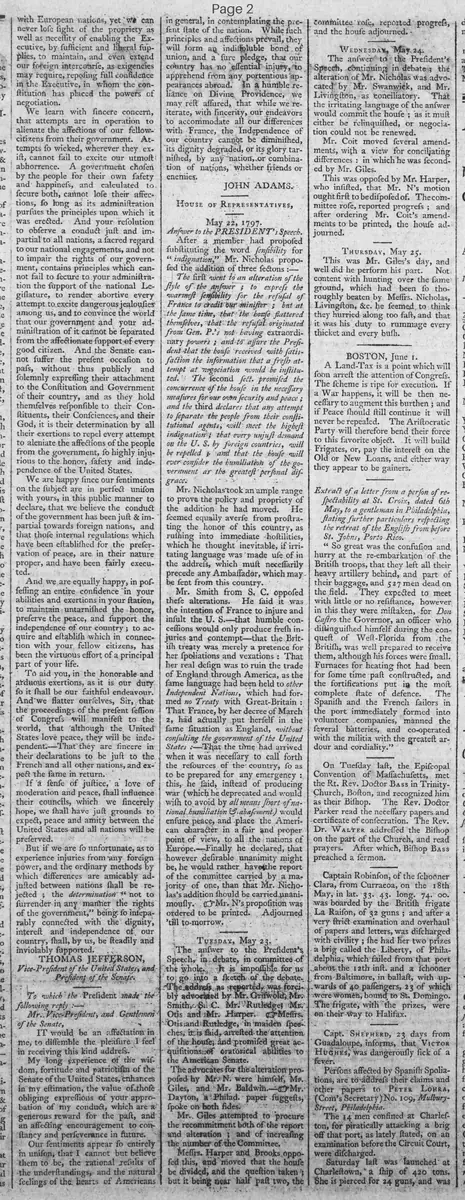
Answer to the PRESIDENT's Speech.
After a member had proposed substituting the word sensibility for "indignation," Mr. Nicholas proposed the addition of three sections:--
The first went to an alteration of the style of the answer; to express the warmest sensibility for the refusal of France to credit our minister; but at the same time, that the house flattered themselves, that the refusal originated from Gen. P.'s not having extraordinary powers; and to assure the President that the house received with satisfaction the information that a fresh attempt at negotiation would be instituted. The second sect. promised the concurrence of the house in the necessary measures for our own security and peace; and the third declares that any attempt to separate the people from their constitutional agents, will meet the highest indignation; that every unjust demand on the U. S. by foreign countries, will be repelled; and that the house will ever consider the humiliation of the government as the greatest personal disgrace.
Mr. Nicholas took an ample range to prove the policy and propriety of the addition he had moved. He seemed equally averse from protracting the honor of this country, as rushing into immediate hostilities, which he thought inevitable, if irritating language was made use of in the address, which must necessarily precede any Ambassador, which may be sent from this country.
Mr. Smith from S. C. opposed these alterations. He said it was the intention of France to injure and insult the U. S.--that humble concessions would only produce fresh injuries and contempt--that the British treaty was merely a pretence for her spoliations and vexations: That her real design was to ruin the trade of England through America, as the same language had been held to other Independent Nations, which had formed no Treaty with Great-Britain: That France, by her decree of March 2, had actually put herself in the same situation as England, without consulting the government of the United States:--That the time had arrived when it was necessary to call forth the resources of the country, so as to be prepared for any emergency: this, he said, instead of producing war (which he deprecated and would wish to avoid by all means short of national humiliation abasement.) would ensure peace, and place the American character in a fair and proper point of view, to all the nations of Europe.--Finally he declared, that however desirable unanimity might be, he would rather have the report of the committee carried by a majority of one, than that Mr. Nicholas's addition should be carried unanimously. Mr. N's proposition was ordered to be printed. Adjourned till to-morrow.
TUESDAY, May 23.
The answer to the President's Speech, in debate, in committee of the whole. It is impossible for us to go into a sketch of the debate. The address as reported, was forcibly advocated by Mr. Griswold, Mr. Smith, of S. C. Mr. Rutledge Mr. Otis and Mr. Harper. Messrs. Otis and Rutledge, in maiden speeches, it is said, arrested the attention of the house; and promised great acquisitions of oratorical abilities to the American Senate.
The advocates for the alteration proposed by Mr. N. were himself, Mr. Giles, and Mr. Baldwin.--Mr. Dayton, a Philad. paper suggests; spoke on both sides.
Mr. Giles attempted to procure the recommitment both of the report and alteration; and of increasing the number of the Committee.
Messrs. Harper and Brooks opposed this, and moved that the house be divided, and the question taken; but it being near half past two, the
committee rose, reported progress. and the house adjourned.
Wednesday, May 24:
The answer to the President's Speech, continuing in debate; the alteration of Mr. Nicholas was advocated by Mr. Swanwick, and Mr. Livingston, as conciliatory. That the irritating language of the answer would commit the house; as it must either be relinquished, or negotiation could not be renewed.
Mr. Coit moved several amendments, with a view for conciliating differences: in which he was seconded by Mr. Giles.
This was opposed by Mr. Harper, who insisted, that Mr. N's motion ought first to be disposed of. The committee rose, reported progress; and after ordering Mr. Coit's amendments to be printed, the house adjourned.
Thursday, May 25.
This was Mr. Giles's day, and well did he perform his part. Not content with hunting over the same ground, which had been so thoroughly beaten by Messrs. Nicholas, Livingston, &c. he seemed, to think they hurried along too fast, and that it was his duty to rummage every thicket and every bush.
By last evening's Mail.
Proceedings of Congress.
House of Representatives, May 26.
The house, in a committee of the whole, proceeded to a discussion of the report on the President's speech, and Mr. Nicholas's amendment...
In this discussion--or rather, indeed discussions, remotely, if at all, connected with it--the attention of the committee was occupied until half past three o'clock.
At that hour, Mr. Nicholas having just sat down, there was a call for the committee to rise; this did not prevent Mr. Harper rising, and requesting a few minutes indulgence from the committee--this increased the cry of rise, rise! but Mr. Harper still continuing on his legs, the chairman was obliged to put the question, when there appeared 48 ayes and 44 nays.
The committee accordingly rose, reported progress, and obtained leave to sit again.
The house then adjourned till to-morrow.
The first speaker this day was Mr. Dennis, a new member from Maryland, who gave a very pleasing specimen of his oratorical abilities--and who equally disclaimed French and English influence, although he admitted having, some time since, felt strong prepossessions for the Republic. He, like the speakers of the preceding days, took a wide range, which we shall not now attempt to follow him in; and concluded by giving his assent to the report of the committee.
He was followed, on the same side, by Mr. Sewall, who was scarcely less excursive.
Mr. Findley next rose, and lamented the extensive and time-wasting discussions which had unnecessarily grown out of the report. And although he confined himself much more to the point before the committee, yet he too, introduced a variety of collateral topics, and concluded by giving his opinion in favor of Mr. Nicholas's amendment.
Mr. Otis and Mr. Nicholas also spoke, principally in explanation of their former sentiments; or to repel unfounded ideas which their respective speeches on this subject had given rise to.
On the whole, unless by counting the number of speakers who have already appeared, and who we may naturally suppose will not again occupy so much of the time of the committee, the decision of this question, "where more is meant than meets the ear," is almost as remote as it was on Monday morning, when it first attracted their attention.
SATURDAY, MAY 27.
The House again went into a Committee of the Whole on the reported answer to the President's Address; when Mr. Nicholas's amendment being under consideration, Mr. Bayard opened the debate against the amendment. General Shepard followed on the same side. Mr. Rutledge also occupied the attention of the Committee against the amendment; afterwards Mr. Dana, who was opposed to the former part of it, which related to the rejection of our Minister, but in favour of that part which had reference to the placing France on the footing of other countries with respect to Treaties, and with some small exceptions to the other parts. Mr. Dana having finished his observations, and it being the usual hour of adjournment, there seemed to be a pretty general wish to take the question, the call for it being very loud; when Mr. Harper rose, and wished to deliver his sentiments on the occasion. After he had been on his legs about half an hour, in opposition to the amendment, Mr. Otis informed the Committee that he was sorry to say that the Speaker was indisposed, and suggested the propriety of the Committee's rising, that the House might adjourn. The motion was immediately put and carried, and the House adjourned. Mr. Davis, from Kentucky, and Mr. Skinner, from Massachusetts, appeared and took their seats in the House.
MONDAY, MAY 29.
The principal speakers this day were Mr. Harper against the amendment, and Mr. Gallatin in favour of it. The former was up nearly three hours.
A little after three o'clock, the cry of the question, the question, being pretty general, the chairman divided the committee, when there appeared for Mr. Nicholas's amendment 48, and against it 52--this was an error occasioned by some persons crowding within the bar who were counted by mistake: the actual division of the members were 48 in favor of the amendment and 50 against it.
The committee then rose, reported progress, and obtained leave to sit again...
It was moved that when the house should rise, the adjournment should be until ten o'clock to-morrow. On this the house divided; ayes 36, noes 56.
The speaker then adjourned the house until 11 o'clock to-morrow.
Mr. Harper's speech was a most violent philippic against France, which he accused of the most herculean ambition. He asserted that he was the aggressor in the present European war--that her maxim was every where, to divide the people from their government--and by that division to conquer and destroy them.
In the course of these remarks, he mentioned Spain, Holland, and Belgium, in terms far from respectful--and called the king of Spain, the humbled and vassal monarch.
In his enumeration of the resources of this country for carrying on a war, the necessity of an early declaration of which he strongly enforced, he stated the inhabitants of the United States to be 6,000,000.
The propriety of making a common cause with England, and entering into an alliance offensive and defensive with her, was also urged. Her fleets would then protect our commerce, and she would be enabled to recruit her armies and man her navies in the United States.
He laid it down as a certain position, that Spain would join France in her war against the United States---and then, after endeavoring to rouse the passions of the committee, he made an appeal to their cupidity, by holding out the temptations of possessing themselves of Louisiana, Florida, and even Mexico.
In his ardent zeal against every thing French--he insinuated, that French pensioners in that house, were paid by the produce of the spoliations of American commerce. This part, however, we did not distinctly hear, but believe he implicated Mr. Monroe in his charge.
Mr. Giles called the attention of the committee to some insinuations of corruption or misconduct which had been made by Mr. Harper and seemed to apply to Mr. Monroe. His friendship for that gentleman, and his absence from this country, made it a duty on him to enquire of Mr. Harper, whether he meant the insinuations to imply our late ambassador to France: and if so why he did not bring forward the proofs or documents on which they were founded.
Mr. Harper, in reply, admitted that he did mean to include Mr. Monroe in the charges alleged; and that he should hereafter bring forward his proofs.
We remark, in order that improper impressions may not go abroad, which would have a tendency to spread an alarm as to the interruption of our peace with the French Republic, that there is no doubt, that a majority will be ultimately found in favour of the chief feature of the amendment, that which contemplates removing, by a negotiation with France, such inequalities as arise against her from the operation of existing treaties.
No member on the floor has said that the inequalities ought not to be removed, and some who voted against the amendment have expressed their opinion that the House ought to declare it as their sentiment that they should be removed so there cannot therefore, be a doubt but that the important feature in the amendment will finally prevail.
(Aurora.)
What sub-type of article is it?
What themes does it cover?
What keywords are associated?
What entities or persons were involved?
Where did it happen?
Story Details
Key Persons
Location
House Of Representatives
Event Date
May 22 29, 1797
Story Details
Debate on response to President's speech addressing France's refusal to receive U.S. minister Gen. Pinckney. Mr. Nicholas proposes amendments for conciliatory language emphasizing negotiation and security. Opponents like Mr. Harper and Mr. Smith argue for firm stance against French aggression, preparation for war, and alliance with England. Vote on amendment: 48-50 against. Accusations against Mr. Monroe raised.