Thank you for visiting SNEWPapers!
Sign up free
Richmond Enquirer
Richmond, Richmond County, Virginia
What is this article about?
Historical account of the mahogany tree's grandeur, discovery in Trinidad in 1595 by a carpenter on Sir Walter Raleigh's ship, and its accidental introduction to England in the late 17th or early 18th century, leading to its use in furniture and establishment as a key commercial wood.
Clipping
OCR Quality
Full Text
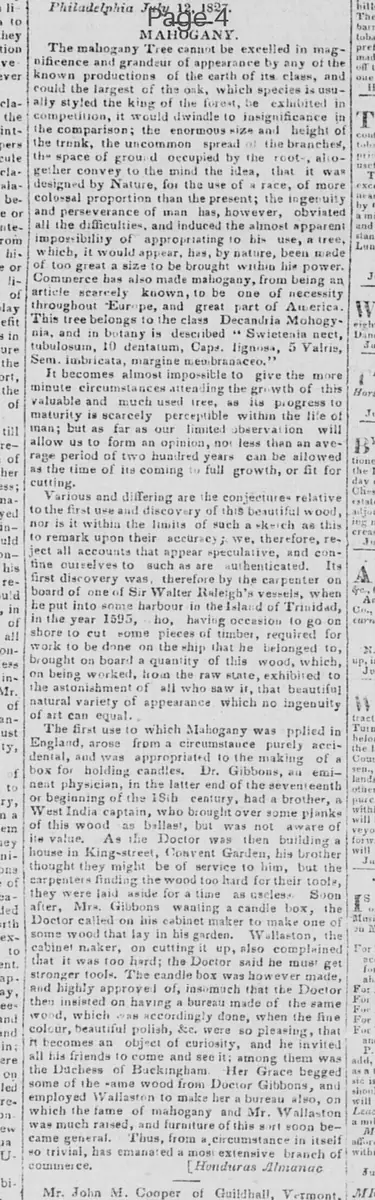
The mahogany Tree cannot be excelled in magnificence and grandeur of appearance by any of the known productions of the earth of its class, and could the largest of the oak, which species is usually styled the king of the forest, be exhibited in competition, it would dwindle to insignificance in the comparison; the enormous size and height of the trunk, the uncommon spread the branches, the space of ground occupied by the roots, altogether convey to the mind the idea, that it was designed by Nature, for the use of a race, of more colossal proportion than the present; the ingenuity and perseverance of man has, however, obviated all the difficulties, and induced the almost apparent impossibility of appropriating to his use, a tree, which, it would appear, has, by nature, been made of too great a size to be brought within his power.
Commerce has also made mahogany, from being an article scarcely known, to be one of necessity throughout Europe, and great part of America. This tree belongs to the class Decandria Mahogynia, and in botany is described "Swietenia nect, tubulosum, 10 dentatum, Caps. lignosa, 5 Valvis, Sem. imbricata, margine membranaceo."
It becomes almost impossible to give the more minute circumstances attending the growth of this valuable and much used tree, as its progress to maturity is scarcely perceptible within the life of man; but as far as our limited observation will allow us to form an opinion, no less than an average period of two hundred years can be allowed as the time of its coming to full growth, or fit for cutting:
Various and differing are the conjectures relative to the first use and discovery of this beautiful wood, nor is it within the limits of such a sketch as this to remark upon their accuracy; we, therefore, reject all accounts that appear speculative, and confine ourselves to such as are authenticated. Its first discovery was, therefore by the carpenter on board of one of Sir Walter Raleigh's vessels, when he put into some harbour in the Island of Trinidad, in the year 1595, who, having occasion to go on shore to cut some pieces of timber, required for work to be done on the ship that he belonged to, brought on board a quantity of this wood, which, on being worked, from the raw state, exhibited to the astonishment of all who saw it, that beautiful natural variety of appearance which no ingenuity of art can equal.
The first use to which Mahogany was applied in England, arose from a circumstance purely accidental, and was appropriated to the making of a box for holding candles. Dr. Gibbons, an eminent physician, in the latter end of the seventeenth or beginning of the 18th century, had a brother, a West India captain, who brought over some planks of this wood as ballast, but was not aware of its value. As the Doctor was then building a house in King-street, (Covent Garden, his brother thought they might be of service to him, but the carpenters finding the wood too hard for their tools, they were laid aside for a time as useless. Soon after, Mrs. Gibbons wanting a candle box, the Doctor called on his cabinet maker to make one of some wood that lay in his garden. Wallaston, the cabinet maker, on cutting it up, also complained that it was too hard; the Doctor said he must get stronger tools. The candle box was however made, and highly approved of, insomuch that the Doctor then insisted on having a bureau made of the same wood, which was accordingly done, when the fine colour, beautiful polish, &c. were so pleasing, that it becomes an object of curiosity, and he invited all his friends to come and see it; among them was the Duchess of Buckingham. Her Grace begged some of the same wood from Doctor Gibbons, and employed Wallaston to make her a bureau also, on which the fame of mahogany and Mr. Wallaston was much raised, and furniture of this sort soon became general. Thus, from a circumstance in itself so trivial, has emanated a most extensive branch of commerce.
[Honduras Almanac]
What sub-type of article is it?
What themes does it cover?
What keywords are associated?
What entities or persons were involved?
Where did it happen?
Story Details
Key Persons
Location
Island Of Trinidad, England, King Street Covent Garden
Event Date
1595, Latter End Of The Seventeenth Or Beginning Of The 18th Century
Story Details
Description of the majestic mahogany tree, its botanical classification, slow growth to maturity over 200 years, discovery in 1595 by a carpenter on Raleigh's vessel in Trinidad, and accidental introduction to England via Dr. Gibbons' brother, leading to its use in furniture and widespread commerce.