Thank you for visiting SNEWPapers!
Sign up free
Letter to Editor
October 2, 1798
The New Hampshire Gazette
Portsmouth, Rockingham County, New Hampshire
What is this article about?
Pseudonymous essay 'Marcus Brutus' argues that nations must pair diplomatic negotiations with robust military preparations to ensure security and honor, criticizing U.S. policy of negotiating with France without defensive measures, which invited insults and delayed readiness.
Clipping
OCR Quality
98%
Excellent
Full Text
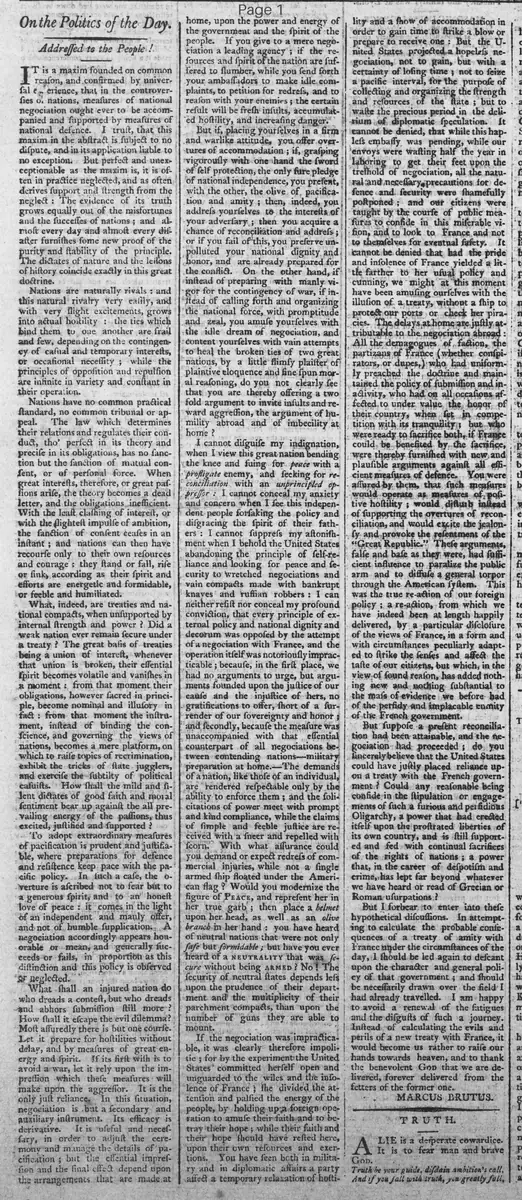
On the Politics of the Day.
Addressed to the People!
It is a maxim founded on common reason, and confirmed by universal experience, that in the controversies of nations, measures of national negotiation ought ever to be accompanied and supported by measures of national defence. I trust, that this maxim in the abstract is subject to no dispute, and in its application liable to no exception. But perfect and exceptionable as the maxim is, it is often in practice neglected, and as often derives support and strength from the neglect: The evidence of its truth grows equally out of the misfortunes and the success of nations; and almost every day and almost every disaster furnishes some new proof of the purity and stability of the principle.
The dictates of nature and the lessons of history coincide exactly in this great doctrine.
Nations are naturally rivals: and this natural rivalry very easily, and with very slight excitements, grows into actual hostility: the ties which bind them to one another are frail and few, depending on the contingency of casual and temporary interests or occasional necessity; while the principles of opposition and repulsion are infinite in variety and constant in their operation.
Nations have no common practical standard, no common tribunal or appeal. The law which determines their relations and regulates their conduct, tho' perfect in its theory and precise in its obligations, has no sanction but the sanction of mutual consent, or of personal force. When great interests, therefore, or great passions arise, the theory becomes a dead letter, and the obligations inefficient.
With the least clashing of interest, or with the slightest impulse of ambition, the sanction of consent ceases in an instant; and nations can then have recourse only to their own resources and courage: they stand or fall, rise or sink, according as their spirit and efforts are energetic and formidable, or feeble and humiliated.
What, indeed, are treaties and national compacts, when unsupported by internal strength and power? Did a weak nation ever remain secure under a treaty? The great basis of treaties being a union of interest, whenever that union is broken, their essential spirit becomes volatile and vanishes in a moment: from that moment their obligations, however sacred in principle, become nominal and illusory in fact: from that moment the instrument, instead of binding the conscience, and governing the views of nations, becomes a mere platform, on which to raise topics of recrimination, exhibit the tricks of state jugglers, and exercise the subtlety of political casuists.
How shall the mild and silent dictates of good faith and moral sentiment bear up against the all prevailing energy of the passions, thus excited, justified and supported:
To adopt extraordinary measures of pacification is prudent and justifiable, where preparations for defence and resistance keep pace with the pacific policy. In such a case, the overture is ascribed not to fear but to a generous spirit, and to an honest love of peace: it comes in the light of an independent and manly offer, and not of humble supplication. A negotiation accordingly appears honorable or mean, and generally succeeds or fails, in proportion as this distinction and this policy is observed or neglected.
What shall an injured nation do who dreads a contest, but who dreads and abhors submission still more? How shall it escape the evil dilemma? Most assuredly there is but one course. Let it prepare for hostilities without delay, and by measures of great energy and spirit. If its first wish is to avoid war, let it rely upon the impression which these measures will make upon the aggressor. It is the only just reliance. In this situation, negotiation is but a secondary and auxiliary instrument. Its efficacy is derivative. It is useful and necessary, in order to adjust the ceremony and manage the details of pacification; but the essential impression and the final effect depend upon the arrangements that are made at home, upon the power and energy of the government and the spirit of the people. If you give to a mere negotiation a leading agency; if the resources and spirit of the nation are suffered to slumber, while you send forth your ambassadors to make idle complaints, to petition for redress, and to reason with your enemies; the certain result will be fresh insults, accumulated hostility, and increasing danger.
But if, placing yourselves in a firm and warlike attitude, you offer overtures of accommodation; if, grasping vigorously with one hand the sword of self protection, the only sure pledge of national independence, you present, with the other, the olive of pacification and amity; then, indeed, you address yourselves to the interests of your adversary; then you acquire a chance of reconciliation and redress; or if you fail of this, you preserve unpolluted your national dignity and honor, and are already prepared for the conflict. On the other hand, if instead of preparing with manly vigor for the contingency of war, if instead of calling forth and organizing the national force, with promptitude and zeal, you amuse yourselves with the idle dream of negotiation, and content yourselves with vain attempts to heal the broken ties of two great nations, by a little slimy plaster of plaintive eloquence and fine spun moral reasoning, do you not clearly see that you are thereby offering a two fold argument to invite insults and reward aggression, the argument of humility abroad and of imbecility at home?
I cannot disguise my indignation, when I view this great nation bending the knee and suing for peace with a profligate enemy, and seeking for reconciliation with an unprincipled oppressor: I cannot conceal my anxiety and concern when I see this independent people forsaking the policy and disgracing the spirit of their fathers: I cannot suppress my astonishment when I behold the United States abandoning the principle of self-reliance and looking for peace and security to wretched negotiations and vain compacts made with bankrupt knaves and ruffian robbers: I can neither resist nor conceal my profound conviction, that every principle of external policy and national dignity and decorum was opposed by the attempt of a negotiation with France, and the operation itself was notoriously impracticable; because, in the first place, we had no arguments to urge, but arguments founded upon the justice of our cause and the injustice of hers, no gratifications to offer, short of a surrender of our sovereignty and honor and secondly, because the measure was unaccompanied with that essential counterpart of all negotiations between contending nations--military preparation at home. The demands of a nation, like those of an individual are rendered respectable only by the ability to enforce them; and the solicitations of power meet with prompt and kind compliance, while the claims of simple and feeble justice are received with a sneer and repelled with scorn. With what assurance could you demand or expect redress of commercial injuries, while not a single armed ship floated under the American flag? Would you modernize the figure of Peace, and represent her in her true garb; then place a helmet upon her head, as well as an olive branch in her hand: you have heard of neutral nations that were not only safe but formidable; but have you ever heard of a NEUTRALITY that was secure without being ARMED? No! The security of neutral states depends less upon the prudence of their department and the multiplicity of their parchment compacts, than upon the number of guns they are able to mount.
If the negotiation was impracticable, it was clearly therefore impolitic; for by the experiment the United States committed herself open and unguarded to the wiles and the insolence of France; she divided the attention and palsied the energy of the people, by holding up a foreign operation to amuse their faith and to betray their hope; while their faith and their hope should have rested here upon their own resources and exertions. You have seen both in military and in diplomatic affairs a party affect a temporary relaxation of hostility and a show of accommodation in order to gain time to strike a blow or prepare to receive one: But the United States projected a hopeless negotiation, not to gain, but with a certainty of losing time; not to seize a pacific interval, for the purpose of collecting and organizing the strength and resources, of the state; but to waste the precious period in the delirium of diplomatic speculation. It cannot be denied, that while this hapless embassy was pending, while our envoys were wasting half the year in laboring to get their feet upon the threshold of negotiation, all the natural and necessary precautions for defence and security were shamefully postponed; and our citizens were taught by the course of public measures to confide in this miserable vision, and to look to France and not to themselves for eventual safety. It cannot be denied that had the pride and insolence of France yielded a little farther to her usual policy and cunning, we might at this moment have been amusing ourselves with the illusion of a treaty, without a ship to protect our ports or check her piracies. The delays at home are justly attributable to the negotiation abroad: All the demagogues of faction, the partizans of France (whether conspirators, or dupes,) who had uniformly preached the doctrine and maintained the policy of submission and inactivity, who had on all occasions affected, to under value the honor, of their country, when set in competition with its tranquility; but who were ready to sacrifice both, if France could be benefited by, the sacrifice, were thereby furnished with new and plausible arguments against all efficient measures of defence. You were assured by them, that such measures would operate as measures of positive hostility; would disturb instead of supporting the overtures of reconciliation, and would excite the jealousy and provoke the resentment of the "Great Republic." These arguments, false and base as they were, had sufficient influence to paralyze the public arm and to diffuse a general torpor through the American system. This was the true re-action of our foreign policy; a re-action, from which we have indeed been at length happily delivered, by a particular disclosure of the views of France, in a form and with circumstances peculiarly adapted to strike the senses and affect the state of our citizens, but which, in the view of sound reason, has added nothing new and nothing substantial to the mass of evidence we before had of the perfidy and implacable enmity of the French government.
But suppose a present reconciliation had been attainable, and the negotiation had proceeded; do you sincerely believe that the United States could have justly placed reliance upon a treaty with the French government? Could any reasonable being confide in the stipulation or engagements of such a furious and perfidious Oligarchy, a power that had erected itself upon the prostrated liberties of its own country, and is still supported and fed with continual sacrifices of the rights of nations; a power that, in the career of despotism and crime, has leapt far beyond whatever we have heard or read of Grecian or Roman usurpations?
But I forbear to enter into these hypothetical discussions. In attempting to calculate the probable consequences, of a treaty of amity with France under the circumstances of the day, I should be led again to descant upon the character and general policy of that government; and should be necessarily drawn over the field I had already travelled. I am happy to avoid a renewal of the fatigues and the disgusts of such a journey.
Instead of calculating the evils and perils of a new treaty with France, it would become us rather to raise our hands towards heaven, and to thank the benevolent God that we are delivered, forever delivered from the fetters of the former one.
MARCUS BRUTUS.
Addressed to the People!
It is a maxim founded on common reason, and confirmed by universal experience, that in the controversies of nations, measures of national negotiation ought ever to be accompanied and supported by measures of national defence. I trust, that this maxim in the abstract is subject to no dispute, and in its application liable to no exception. But perfect and exceptionable as the maxim is, it is often in practice neglected, and as often derives support and strength from the neglect: The evidence of its truth grows equally out of the misfortunes and the success of nations; and almost every day and almost every disaster furnishes some new proof of the purity and stability of the principle.
The dictates of nature and the lessons of history coincide exactly in this great doctrine.
Nations are naturally rivals: and this natural rivalry very easily, and with very slight excitements, grows into actual hostility: the ties which bind them to one another are frail and few, depending on the contingency of casual and temporary interests or occasional necessity; while the principles of opposition and repulsion are infinite in variety and constant in their operation.
Nations have no common practical standard, no common tribunal or appeal. The law which determines their relations and regulates their conduct, tho' perfect in its theory and precise in its obligations, has no sanction but the sanction of mutual consent, or of personal force. When great interests, therefore, or great passions arise, the theory becomes a dead letter, and the obligations inefficient.
With the least clashing of interest, or with the slightest impulse of ambition, the sanction of consent ceases in an instant; and nations can then have recourse only to their own resources and courage: they stand or fall, rise or sink, according as their spirit and efforts are energetic and formidable, or feeble and humiliated.
What, indeed, are treaties and national compacts, when unsupported by internal strength and power? Did a weak nation ever remain secure under a treaty? The great basis of treaties being a union of interest, whenever that union is broken, their essential spirit becomes volatile and vanishes in a moment: from that moment their obligations, however sacred in principle, become nominal and illusory in fact: from that moment the instrument, instead of binding the conscience, and governing the views of nations, becomes a mere platform, on which to raise topics of recrimination, exhibit the tricks of state jugglers, and exercise the subtlety of political casuists.
How shall the mild and silent dictates of good faith and moral sentiment bear up against the all prevailing energy of the passions, thus excited, justified and supported:
To adopt extraordinary measures of pacification is prudent and justifiable, where preparations for defence and resistance keep pace with the pacific policy. In such a case, the overture is ascribed not to fear but to a generous spirit, and to an honest love of peace: it comes in the light of an independent and manly offer, and not of humble supplication. A negotiation accordingly appears honorable or mean, and generally succeeds or fails, in proportion as this distinction and this policy is observed or neglected.
What shall an injured nation do who dreads a contest, but who dreads and abhors submission still more? How shall it escape the evil dilemma? Most assuredly there is but one course. Let it prepare for hostilities without delay, and by measures of great energy and spirit. If its first wish is to avoid war, let it rely upon the impression which these measures will make upon the aggressor. It is the only just reliance. In this situation, negotiation is but a secondary and auxiliary instrument. Its efficacy is derivative. It is useful and necessary, in order to adjust the ceremony and manage the details of pacification; but the essential impression and the final effect depend upon the arrangements that are made at home, upon the power and energy of the government and the spirit of the people. If you give to a mere negotiation a leading agency; if the resources and spirit of the nation are suffered to slumber, while you send forth your ambassadors to make idle complaints, to petition for redress, and to reason with your enemies; the certain result will be fresh insults, accumulated hostility, and increasing danger.
But if, placing yourselves in a firm and warlike attitude, you offer overtures of accommodation; if, grasping vigorously with one hand the sword of self protection, the only sure pledge of national independence, you present, with the other, the olive of pacification and amity; then, indeed, you address yourselves to the interests of your adversary; then you acquire a chance of reconciliation and redress; or if you fail of this, you preserve unpolluted your national dignity and honor, and are already prepared for the conflict. On the other hand, if instead of preparing with manly vigor for the contingency of war, if instead of calling forth and organizing the national force, with promptitude and zeal, you amuse yourselves with the idle dream of negotiation, and content yourselves with vain attempts to heal the broken ties of two great nations, by a little slimy plaster of plaintive eloquence and fine spun moral reasoning, do you not clearly see that you are thereby offering a two fold argument to invite insults and reward aggression, the argument of humility abroad and of imbecility at home?
I cannot disguise my indignation, when I view this great nation bending the knee and suing for peace with a profligate enemy, and seeking for reconciliation with an unprincipled oppressor: I cannot conceal my anxiety and concern when I see this independent people forsaking the policy and disgracing the spirit of their fathers: I cannot suppress my astonishment when I behold the United States abandoning the principle of self-reliance and looking for peace and security to wretched negotiations and vain compacts made with bankrupt knaves and ruffian robbers: I can neither resist nor conceal my profound conviction, that every principle of external policy and national dignity and decorum was opposed by the attempt of a negotiation with France, and the operation itself was notoriously impracticable; because, in the first place, we had no arguments to urge, but arguments founded upon the justice of our cause and the injustice of hers, no gratifications to offer, short of a surrender of our sovereignty and honor and secondly, because the measure was unaccompanied with that essential counterpart of all negotiations between contending nations--military preparation at home. The demands of a nation, like those of an individual are rendered respectable only by the ability to enforce them; and the solicitations of power meet with prompt and kind compliance, while the claims of simple and feeble justice are received with a sneer and repelled with scorn. With what assurance could you demand or expect redress of commercial injuries, while not a single armed ship floated under the American flag? Would you modernize the figure of Peace, and represent her in her true garb; then place a helmet upon her head, as well as an olive branch in her hand: you have heard of neutral nations that were not only safe but formidable; but have you ever heard of a NEUTRALITY that was secure without being ARMED? No! The security of neutral states depends less upon the prudence of their department and the multiplicity of their parchment compacts, than upon the number of guns they are able to mount.
If the negotiation was impracticable, it was clearly therefore impolitic; for by the experiment the United States committed herself open and unguarded to the wiles and the insolence of France; she divided the attention and palsied the energy of the people, by holding up a foreign operation to amuse their faith and to betray their hope; while their faith and their hope should have rested here upon their own resources and exertions. You have seen both in military and in diplomatic affairs a party affect a temporary relaxation of hostility and a show of accommodation in order to gain time to strike a blow or prepare to receive one: But the United States projected a hopeless negotiation, not to gain, but with a certainty of losing time; not to seize a pacific interval, for the purpose of collecting and organizing the strength and resources, of the state; but to waste the precious period in the delirium of diplomatic speculation. It cannot be denied, that while this hapless embassy was pending, while our envoys were wasting half the year in laboring to get their feet upon the threshold of negotiation, all the natural and necessary precautions for defence and security were shamefully postponed; and our citizens were taught by the course of public measures to confide in this miserable vision, and to look to France and not to themselves for eventual safety. It cannot be denied that had the pride and insolence of France yielded a little farther to her usual policy and cunning, we might at this moment have been amusing ourselves with the illusion of a treaty, without a ship to protect our ports or check her piracies. The delays at home are justly attributable to the negotiation abroad: All the demagogues of faction, the partizans of France (whether conspirators, or dupes,) who had uniformly preached the doctrine and maintained the policy of submission and inactivity, who had on all occasions affected, to under value the honor, of their country, when set in competition with its tranquility; but who were ready to sacrifice both, if France could be benefited by, the sacrifice, were thereby furnished with new and plausible arguments against all efficient measures of defence. You were assured by them, that such measures would operate as measures of positive hostility; would disturb instead of supporting the overtures of reconciliation, and would excite the jealousy and provoke the resentment of the "Great Republic." These arguments, false and base as they were, had sufficient influence to paralyze the public arm and to diffuse a general torpor through the American system. This was the true re-action of our foreign policy; a re-action, from which we have indeed been at length happily delivered, by a particular disclosure of the views of France, in a form and with circumstances peculiarly adapted to strike the senses and affect the state of our citizens, but which, in the view of sound reason, has added nothing new and nothing substantial to the mass of evidence we before had of the perfidy and implacable enmity of the French government.
But suppose a present reconciliation had been attainable, and the negotiation had proceeded; do you sincerely believe that the United States could have justly placed reliance upon a treaty with the French government? Could any reasonable being confide in the stipulation or engagements of such a furious and perfidious Oligarchy, a power that had erected itself upon the prostrated liberties of its own country, and is still supported and fed with continual sacrifices of the rights of nations; a power that, in the career of despotism and crime, has leapt far beyond whatever we have heard or read of Grecian or Roman usurpations?
But I forbear to enter into these hypothetical discussions. In attempting to calculate the probable consequences, of a treaty of amity with France under the circumstances of the day, I should be led again to descant upon the character and general policy of that government; and should be necessarily drawn over the field I had already travelled. I am happy to avoid a renewal of the fatigues and the disgusts of such a journey.
Instead of calculating the evils and perils of a new treaty with France, it would become us rather to raise our hands towards heaven, and to thank the benevolent God that we are delivered, forever delivered from the fetters of the former one.
MARCUS BRUTUS.
What sub-type of article is it?
Persuasive
Political
Provocative
What themes does it cover?
Politics
Military War
What keywords are associated?
Foreign Policy
Negotiation With France
National Defense
Military Preparation
Us Neutrality
Treaty Criticism
What entities or persons were involved?
Marcus Brutus
The People
Letter to Editor Details
Author
Marcus Brutus
Recipient
The People
Main Argument
nations must support diplomatic negotiations with strong military preparations to ensure security and national honor; the u.s. erred by pursuing negotiations with france without defensive measures, leading to insults and delayed readiness.
Notable Details
References To Natural Rivalry Of Nations
Criticism Of French Government As Perfidious Oligarchy
Allusion To Xyz Affair Disclosure
Emphasis On Armed Neutrality For Security