Thank you for visiting SNEWPapers!
Sign up free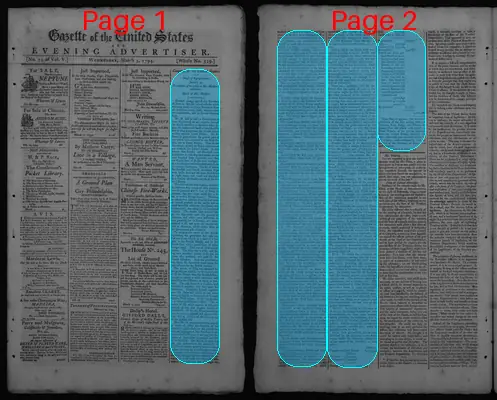
Gazette Of The United States & Evening Advertiser
Philadelphia, Philadelphia County, Pennsylvania
What is this article about?
In a House of Representatives debate on January 30, James Madison defends the Secretary of State's report against Mr. Smith's charges regarding trade duties on American wood, fish, whale oil, tonnage calculations, and re-exports to Britain, highlighting inaccuracies in the criticisms.
Merged-components note: Continuation of Mr. Madison's speech in Congress across pages 1 and 2.
Clippings

1 of 2
OCR Quality
Full Text
House of Representatives.
January 30.
In committee of the whole on Mr. Madison's
resolutions.
Speech of Mr. Madison.
[Continued.]
Another charge against the Secretary
of State is, that his report calls the discriminating duties in Great Britain in favor
of American wood, small, whereas they
are considerable, and in several instances,
high.
Mr. M. said he had not found leisure to
trace this branch of our exports into all
the details necessary to decide in what degree the duties were small or considerable,
and in what proportion the several duties
articles went to Great Britain. He observed in general that the greater part of
our woods were exported to the West-Indies, not to Great Britain. That in the
ship-woods, at least the Baltic nations were
not rivals to the United States. It was
known that Sweden and Denmark were
so deficient in oak, that their public navies
were supplied from Germany, and that
the ship timbers of Russia were transported
a thousand or twelve hundred miles from
her interior dominions. The fir, of which
the Swedish and Danish merchant ships
were built, does not last more than seven
or eight years, and could not therefore
be a rival to the durable woods of the United States.
He observed also that lumber, and particularly the ship woods of this country,
were so precious and so sure of being in
demand, that they never could fear a rival, or need a foreign bounty. This was
an article very different from such as were
an annual product of the earth: and as
could be raised wherever the climate and
soil permitted, according to the occasional
demand. The forests that were to supply the ship-yards were the growth of
centuries, and where once destroyed, as
they generally are in Europe, are rarely
replaced at all, and never can become the
rival to America, which enjoys them as
the spontaneous gift of nature.
To enhance the merit of the British
regulation, the gentleman had told us,
that wood was subject to a duty of 1 per
cent. in the French Islands, and in the
British free, with a prohibition of other
foreign wood. This was of little consequence. The duty was a trifle, and falling on a necessary article to be got no
where else, probably was paid by the
French Islanders. And the prohibition
was ideal, the American wood being the
only resource for the British market.
The article of Fish, was admitted by
the gentleman himself, to be more favored by the French than the British system,
though he admits it with reluctance and
diminishes the difference as much as possible. The case however is so clear, and
the facts so palpable, that they speak for
themselves. Under the French regulations, this important article of our commerce, is subject to duties only, in Europe
and the West-Indies. Under the British,
it is under prohibition in both. The amount of the whole exports is 383,237
quintals of dry, and 57,424 barrels of
pickled fish. Of this the French consumption, is 252,171 quintals and 45,164 barrels; that is, nearly 3 of the dry, and 4-5
of the pickled fish.
Here Mr. M. proceeding to the subject
of whale oil, called the attention of the
committee particularly to the representation and language of Mr. Smith as to the
conduct of France, in inviting the fishermen of Nantucket to remove and settle at Dunkirk. Mr. Smith, he said, had
not only undervalued the monopoly of
the French market granted to the United
States, but had, by a mutilated quotation
of a report of the Secretary of State on the
fisheries, changed the true aspect of the attempt to draw away the Nantucket fishermen. The fact was, that although the
The conduct of France was very different from what was to have been wished, as well as from what was contemplated by the Marquis la Fayette, who had patronized the interest of the fishermen, yet that the project of tempting them to emigrate had originated in Great-Britain, and was a counter-project on the part of France. How the gentleman happened to omit the antecedent attempt of Great-Britain, and thereby exaggerate that of France, Mr. M. did not undertake to explain: but it was the more extraordinary, as the whole account of the transaction was contained in the same page of the report, nay in the same paragraph, from which the gentleman had extracted his information.
Here he read the passage in that report, and produced the British statute, inviting the whale fishermen, by an offer of certain privileges to emigrate to Great Britain.
A further charge against the Secretary of State is, that in his statement of the tonnage of the United States employed in the trade with the French and British dominions, he founded it, not on the actual number of ships, but on the number of entries. This charge was as singular as it was uncandid.
The report stated the fact, that the American tonnage entering our ports from the several nations with which the United States traded, was so and so; and in this statement, it pursued the official returns made on the subject. What more was to be required?
In giving the fact, the Secretary imposed evil on no one, because he stated the tonnage to be entry tonnage, as it really was.
He followed the best guide that existed, an official return from the proper offices.
No return of the actual tonnage, as distinguished from the entry tonnage, had at the time, ever been made from any office, or called for by any act of Congress.
The first return ever made in the latter form, was called for since the resolutions on the table were proposed.
These considerations might have restrained the gentleman from this unwarrantable attack on the accuracy of the report. But he ought at least to have been sure, that whilst he was charging the Secretary with following an erroneous guide, he was himself following one that was not erroneous. The examination of this point involved facts which merited the particular attention of the committee.
The statement of the entry tonnage of the United States in foreign trade for 1792, actually called for and reported, is 415,331 tons. The statement of the actual tonnage for the same year is 289,394 tons.
On comparing these two quantities, it was evident that both could not be right. If the entry tonnage was no more than was stated, it was inconceivable that the actual tonnage could be as much as was stated. It would allow the vessels in the European and West India trades together but somewhat more than one voyage and a third a year. It could never be supposed, that this corresponded with the fact.
How then was the inconsistency in the two statements to be explained?
Mr. M. said, as he did not know by what rule the actual tonnage was made up, he would form no conjecture on the subject. He hoped, and wished that some gentleman more conversant with it, would solve the phenomenon. He did not call on the gentleman from South Carolina, because he most of all, must be puzzled to account for it; having stated that our vessels in the trade to Europe make two voyages, and in the West India trade four voyages a year.
Besides the evidence contained in this comparison of the aggregate tonnage in the two different forms, in which it had been reported, the existence of error somewhere, and probably in the account of the actual tonnage resulted from a comparative view of our exports to the British dominions, for the two years of 1790 and 1792, and of the whole tonnage American and British employed in conveying them.
In the former year the exports were 9,363,416 dollars. In the latter 8,269,495 dollars; the excess for 1790, 1,093,921 dollars.
The entry tonnage, British and American for 1790, was 272,580 tons.
The British entry tonnage for 1792 was 206,384 tons. The actual American tonnage for 1792, was according to this official statement, 66,582 tons; which turned into entry tonnage, according to the proportion of the whole actual, to the whole entry tonnage for that year, makes the American entry tonnage, in the trade to Great Britain about 95,000 tons.
Adding this to the British entry tonnage of 206,384 tons, the British and American together for 1792, amounts to 301,384 tons; which exceeds the tonnage of 1790 no less than 27,804 tons.
According to this calculation, which embraces the actual tonnage as stated to the house, there would be 27,804 tons more, employed in transporting 1,093,921 dollars less; making our tonnage to increase in that proportion as the employment of it decreased.
There was a possibility, Mr. M. observed, that the course of trade in the two years, might be such that more of the vessels employed in the exportations to Great Britain might be entered in 1790 as coming from some other country, than in 1792; but as there was no known circumstance which authorized this solution, and as it seemed demonstrable in general, that error existed somewhere in the statements, and most probably in those of the actual tonnage, he concluded that it ought to be referred to that source; and consequently, that the guide followed by the Secretary of State, to wit, the entry tonnage, the only one he had to follow, was not more inaccurate, than the actual tonnage would have been, which guided the member from South Carolina.
Another position of the Secretary of State on which a charge is founded, is, "that the greater part of what Great Britain receives from the United States is re-exported." This position, Mr. M. reminded the committee, related to Great Britain without comprehending the West India islands, which formed a distinct branch in the Secretary's report. How far it was liable to the exceptions taken against it, would appear from an examination of facts.
To obviate criticisms, Mr. M. said he would take for the basis of his calculations, the statement given in detail by the gentleman himself, of the exports for 1790, to the French and British dominions; which though not extended to every item, approached so near to a full view of the trade, as to be adequate to the purpose.
In this statement the exports to Great Britain stand at 6,651,429 dollars; from which must be subtracted, for the comparison, the amount of the several re-exportations as far as they can be liquidated.
TOBACCO. It appears from an official document, that the tobacco exported to Great Britain in 1791, was 67,216 hogsheads. A return for another year states the quantity to be 52,505 hogsheads. It appeared from the revenue returns of Great Britain, that the consumption of this article amounted to 9,600 hogsheads. The proportion re-exported might then be reasonably set down at four-fifths of the quantity imported.
RICE. To obtain the proportion of rice re-exported, we may take the medium quantity imported for three years, immediately preceding the revolution, which, according to a table in Anderson's History of Commerce, was 486,543 cwt. By another table for the same period, the medium quantity exported was 349,653 cwt. The difference marks the consumption, and is 136,890 cwt. The quantity exported to Great Britain from the United States in 1792, was 58,978 barrels, equal to 294,890 cwt. Comparing the quantity consumed with this quantity, it appears that more than half, though less than two thirds, is re-exported. Call the re-exportation one half only of the present importation.
INDIGO. According to a statement in Anderson, the medium importations into Great-Britain, for three years immediately preceding the revolution, were about thrice the medium quantity re-exported. Call the proportion re-exported now, however, one-fifth only, which is probably below the fact.
From these proportions, and the data furnished by the gentleman's own statements, results the following justification of the report of the Secretary on this point.
Dollars.
Exports to Great Britain 6,651,429
Dollars.
Tobacco 2,754,493
Consumed 1-5 550,393
Re-exported 2,205,395
Rice 773,852
Consumed 1-2 386,926
Re-exported 386,926
Indigo 473,830
Consumed 4-5 379,064
Re-exported 94,766
Wheat and flour, perhaps the whole re-exported: And more was carried to Great-Britain, in the two succeeding years, though the aggregate exports thither were less than in the year here taken: Say, however, that one fourth was consumed, and let the amount stand according to the gentleman's statement-at 1,087,840
Consumed 1-4 271,960
Re-exported 815,880
3,501,067
Here, then, it appears, that the re-exportations of the four articles alone, of Tobacco, Rice, Indigo and Wheat, are greater than the whole consumption in Great Britain, of the articles imported from the United States, although the most unfavorable year has been taken, for the enquiry; and, consequently, that the position of the Secretary of State, was well founded.
(Speech to be continued.)
What sub-type of article is it?
What themes does it cover?
What keywords are associated?
What entities or persons were involved?
Where did it happen?
Story Details
Key Persons
Location
House Of Representatives, Congress Of The United States
Event Date
January 30
Story Details
James Madison defends the Secretary of State's report on U.S. trade with Britain and France against Mr. Smith's charges concerning duties on wood, favoritism for fish, whale oil incentives, tonnage measurements, and re-exports of goods like tobacco, rice, indigo, and wheat.