Thank you for visiting SNEWPapers!
Sign up free
Editorial
April 9, 1949
The Key West Citizen
Key West, Monroe County, Florida
What is this article about?
Editorial by Hastings Baker discusses U.S. population growth, a cautionary tale of consumer debt leading to home loss, the housing shortage, and innovative mass-production methods by Levitt & Sons to build affordable homes for veterans.
Clipping
OCR Quality
98%
Excellent
Full Text
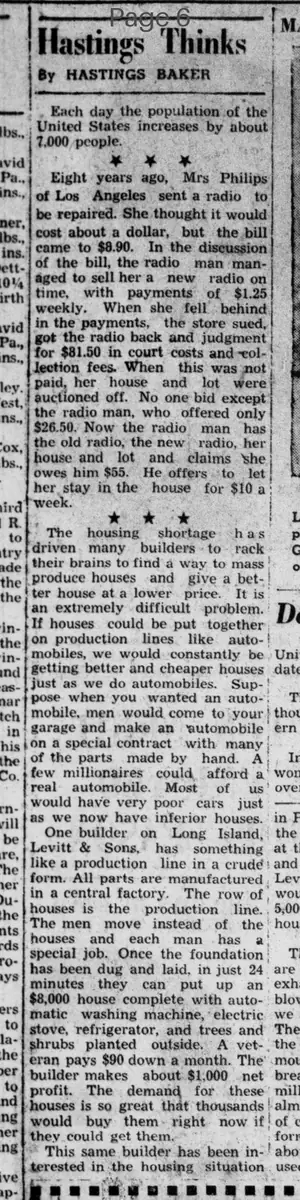
Hastings Thinks
By HASTINGS BAKER
Each day the population of the United States increases by about 7,000 people.
Eight years ago, Mrs. Philips of Los Angeles sent a radio to be repaired. She thought it would cost about a dollar, but the bill came to $8.90. In the discussion of the bill, the radio man managed to sell her a new radio on time, with payments of $1.25 weekly. When she fell behind in the payments, the store sued, got the radio back and judgment for $81.50 in court costs and collection fees. When this was not paid, her house and lot were auctioned off. No one bid except the radio man, who offered only $26.50. Now the radio man has the old radio, the new radio, her house and lot and claims she owes him $55. He offers to let her stay in the house for $10 a week.
The housing shortage has driven many builders to rack their brains to find a way to mass produce houses and give a better house at a lower price. It is an extremely difficult problem.
If houses could be put together on production lines like automobiles, we would constantly be getting better and cheaper houses just as we do automobiles. Suppose when you wanted an automobile, men would come to your garage and make an automobile on a special contract with many of the parts made by hand. A few millionaires could afford a real automobile. Most of us would have very poor cars just as we now have inferior houses.
One builder on Long Island, Levitt & Sons, has something like a production line in a crude form. All parts are manufactured in a central factory. The row of houses is the production line. The men move instead of the houses and each man has a special job. Once the foundation has been dug and laid, in just 24 minutes they can put up an $8,000 house complete with automatic washing machine, electric stove, refrigerator, and trees and shrubs planted outside. A veteran pays $90 down a month. The builder makes about $1,000 net profit. The demand for these houses is so great that thousands would buy them right now if they could get them.
This same builder has been interested in the housing situation
By HASTINGS BAKER
Each day the population of the United States increases by about 7,000 people.
Eight years ago, Mrs. Philips of Los Angeles sent a radio to be repaired. She thought it would cost about a dollar, but the bill came to $8.90. In the discussion of the bill, the radio man managed to sell her a new radio on time, with payments of $1.25 weekly. When she fell behind in the payments, the store sued, got the radio back and judgment for $81.50 in court costs and collection fees. When this was not paid, her house and lot were auctioned off. No one bid except the radio man, who offered only $26.50. Now the radio man has the old radio, the new radio, her house and lot and claims she owes him $55. He offers to let her stay in the house for $10 a week.
The housing shortage has driven many builders to rack their brains to find a way to mass produce houses and give a better house at a lower price. It is an extremely difficult problem.
If houses could be put together on production lines like automobiles, we would constantly be getting better and cheaper houses just as we do automobiles. Suppose when you wanted an automobile, men would come to your garage and make an automobile on a special contract with many of the parts made by hand. A few millionaires could afford a real automobile. Most of us would have very poor cars just as we now have inferior houses.
One builder on Long Island, Levitt & Sons, has something like a production line in a crude form. All parts are manufactured in a central factory. The row of houses is the production line. The men move instead of the houses and each man has a special job. Once the foundation has been dug and laid, in just 24 minutes they can put up an $8,000 house complete with automatic washing machine, electric stove, refrigerator, and trees and shrubs planted outside. A veteran pays $90 down a month. The builder makes about $1,000 net profit. The demand for these houses is so great that thousands would buy them right now if they could get them.
This same builder has been interested in the housing situation
What sub-type of article is it?
Infrastructure
Economic Policy
Social Reform
What keywords are associated?
Population Growth
Housing Shortage
Consumer Debt
Mass Production
Levittown
Veteran Housing
Assembly Line Homes
What entities or persons were involved?
Hastings Baker
Mrs. Philips
Levitt & Sons
Radio Man
Editorial Details
Primary Topic
Housing Shortage And Mass Production Solutions
Stance / Tone
Supportive Of Innovative Housing Production And Critical Of Exploitative Debt Practices
Key Figures
Hastings Baker
Mrs. Philips
Levitt & Sons
Radio Man
Key Arguments
U.S. Population Grows By 7,000 Daily, Exacerbating Housing Needs.
Consumer Debt From Small Repairs Can Lead To Loss Of Home And Assets.
Housing Shortage Requires Mass Production Methods Like Automobiles.
Custom Built Homes Keep Prices High And Quality Low For Most People.
Levitt & Sons Uses Assembly Line Approach To Build Affordable $8,000 Homes Quickly For Veterans.
High Demand For Such Efficient Housing Exists.