Thank you for visiting SNEWPapers!
Sign up free
Domestic News
April 17, 1809
The National Intelligencer And Washington Advertiser
Washington, District Of Columbia
What is this article about?
In the U.S. House of Representatives, Mr. Macon speaks against repealing the embargo except for Great Britain and France in the Non-Intercourse Bill, arguing it protects American property from foreign orders and decrees, prevents submission or war, and highlights burdens on southern agriculture like cotton and tobacco.
Clipping
OCR Quality
95%
Excellent
Full Text
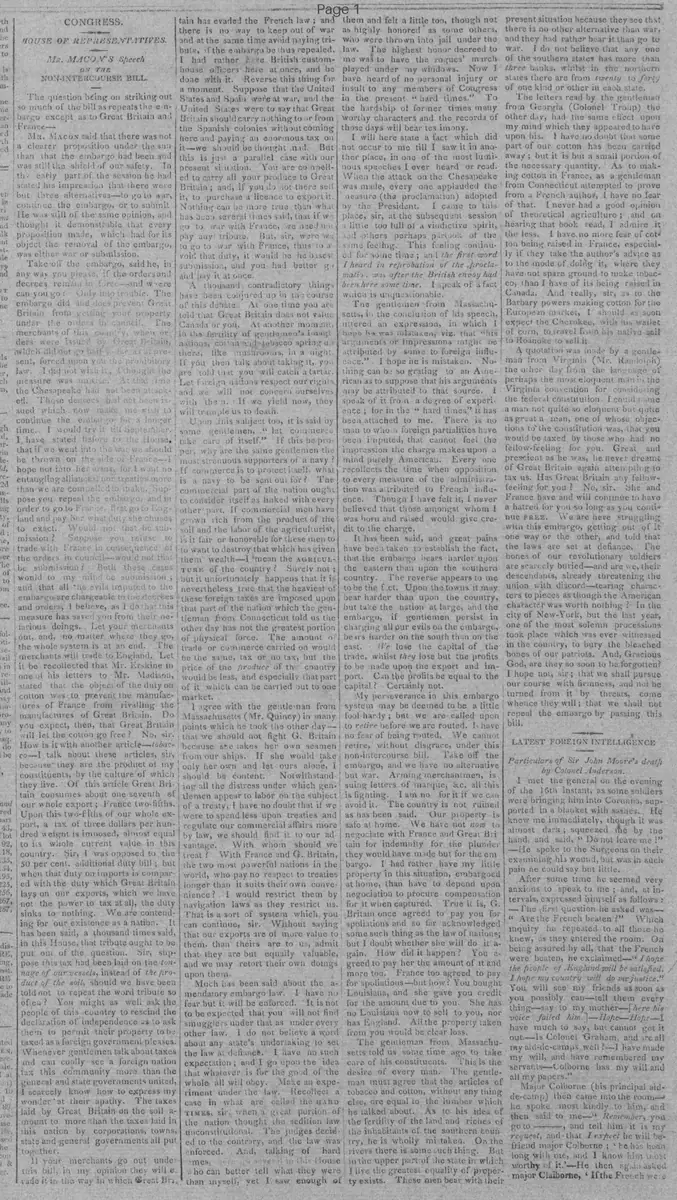
CONGRESS.
HOUSE OF REPRESENTATIVES
MR. MACON'S Speech
ON THE
NON-INTERCOURSE BILL.
The question being on striking out so much of the bill as repeals the embargo except as to Great Britain and France—
Mr. Macon said that there was not a clearer proposition under the sun than that the embargo had been and was still the shield of our safety. In the early part of the session he had stated his impression that there were but three alternatives—to go to war, continue the embargo, or to submit He was still of the same opinion, and thought it demonstrable that every proposition made, which had for its object the removal of the embargo, was either war or submission. Take off the embargo, said he, in any way you please, if the orders and decrees remain in force—and where can you go? Only into trouble. The embargo did and does prevent Great Britain from getting your property under the orders in Council. The merchants of this country, when orders were issued by Great Britain, which did not do half the act at present, forced upon you the prohibitory law. I did not wish it, I thought the measure unwise. At that time the Chesapeake had not been attacked. Those decrees had not been issued which now make me wish to continue the embargo for a longer time. I would try it till September. I have stated before to the House that if we went into the war we should be thrown on the side of France—I hope not into her arms, for I want no entangling alliances, nor treaties more than we are compelled to make. Suppose you repeal the embargo, and in order to go to France, first go to England and pay her what duty she chuses to exact. Would not that be submission? Suppose you refuse to trade with France in consequence of the orders in council—would not that be submission? Both these cases would to my mind be submission; and that all the evils imputed to the embargo are chargeable to the decrees and orders, I believe, as I do that this measure has saved you from their nefarious doings, Let your merchants out, and, no matter where they go, the whole system is at an end. The merchants will trade to England. Let it be recollected that Mr. Erskine in one of his letters to Mr. Madison, stated that the object of the duty on cotton was to prevent the manufactures of France from rivalling the manufactures of Great Britain. Do you expect, then, that Great Britain will let the cotton go free? No, sir. How is it with another article—tobacco—I talk about these articles, sir, because they are the product of my constituents, by the culture of which they live. Of this article Great Britain consumes about one seventh of our whole export; France two-fifths. Upon this two-fifths of our whole export, a tax of three dollars per hundred weight is imposed, almost equal to its whole current value in this country. Sir, I was opposed to the 50 per cent. additional duty bill; but when that duty on imports is compared with the duty which Great Britain lays on our exports, which we have not the power to tax at all, the duty sinks to nothing. We are contending for our existence as a nation. It has been said, a thousand times said, in this House, that tribute ought to be put out of the question. Sir, suppose this tax had been laid on the tonnage of our vessels, instead of the product of the soil, should we have been told not to repeat the word tribute so often? You might as well ask the people of this country to rescind the declaration of independence as to ask them to permit their property to be taxed as a foreign government pleases. Whenever gentlemen talk about taxes and can coolly see a foreign nation tax this community more than the general and state governments united, I scarcely know how to express my wonder at their apathy. The taxes laid by Great Britain on the soil amount to more than the taxes laid in this nation by corporations, towns, state and general governments all put together.
If your merchants go out under this bill, in my opinion they will evade it in the way in which Great Britain has evaded the French law: and there is no way to keep out of war and at the same time avoid paying tribute, if the embargo be thus repealed. I had rather have British custom-house officers here at once, and be done with it. Reverse this thing for a moment. Suppose that the United States and Spain were at war, and the United States were to say that Great Britain should carry nothing to or from the Spanish colonies without coming here and paying an enormous tax on it—we should be thought mad. But this is just a parallel case with our present situation. You are compelled to carry all your produce to Great Britain; and, if you do not there sell it, to purchase a licence to export it. Nothing can be more true than what has been several times said, that if we go to war with France, we need not pay any tribute. But, sir, were we to go to war with France, thus to avoid that duty, it would be basest submission, and you had better go and pay it at once.
A thousand contradictory things have been conjured up in the course of this debate. At one time you are told that Great Britain does not value Canada or you. At another moment, in the fertility of gentlemen's imaginations, nations, cotton and tobacco spring up there, like mushrooms, in a night If you then talk about taking it, you are told that you will catch a tartar. Let foreign nations respect our rights and we will not concern ourselves with theirs. If we yield now, they will trample us to death.
Upon this subject too, it is said by some gentlemen, "let commerce take care of itself." If this be proper, why are the same gentlemen the most strenuous supporters of a navy? If commerce is to protect itself, what is a navy to be sent out for? The commercial part of the nation ought to consider itself as linked with every other part. If commercial men have grown rich from the product of the soil and the labor of the agriculturist, is it fair or honorable for these men to want to destroy that which has given them wealth—I mean the AGRICULTURE of the country? Surely not; but it unfortunately happens that it is nevertheless true that the heaviest of these foreign taxes are imposed upon that part of the nation which the gentleman from Connecticut told us the other day has not the greatest portion of physical force. The amount of trade or commerce carried on would be the same, tax or no tax, but the price of the produce of the country would be less, and especially that part of it which can be carried out to one market.
I agree with the gentleman from Massachusetts (Mr. Quincy) in many points which he took the other day—that we should not fight G. Britain because she takes her own seamen from our ships. If she would take only her own and let ours alone, I should be content. Notwithstanding all the distress under which gentlemen appear to labor on the subject of a treaty, I have no doubt that if we were to spend less upon treaties and regulate our commercial affairs more by law, we should find it to our advantage. With whom should we treat? With France and G. Britain, the two most powerful nations in the world, who pay no respect to treaties longer than it suits their own convenience? I would restrict them by navigation laws as they restrict us. That is a sort of system which you can continue, sir. Without saying that our exports are of more value to them, than theirs are to us, admit that they are but equally valuable, and we may retort their own doings upon them.
Much has been said about the amendatory embargo law. I have no fear but it will be enforced. It is not to be expected that you will not find smugglers under that as under every other law. I do not believe a word about any state's undertaking to set the law at defiance. I have no such expectation; and I go upon the idea that whatever is for the good of the whole all will obey. Make an experiment under the law. Recollect a case in what are called the hard Times, sir, when a great portion of the nation thought the sedition law unconstitutional. The judges decided to the contrary, and the law was enforced. And, talking of hard times, there are several in this House who can better tell what they were than myself, yet I saw enough of them and felt a little too, though not as highly honored as some others, who were thrown into jail under the law. The highest honor decreed to me was to have the rogues' march played under my windows. Now I have heard of no personal injury or insult to any members of Congress in the present "hard times." To the hardship of former times many worthy characters and the records of those days will bear testimony.
I will here state a fact which did not occur to me till I saw it in another place, in one of the most luminous speeches I ever heard or read. When the attack on the Chesapeake was made, every one applauded the measure (the proclamation) adopted by the President. I came to this place, sir, at the subsequent session little too full of a vindictive spirit, and others perhaps partook of the same feeling. This feeling continued for some time; and the first word I heard in refrobation of the proclamation was after the British envoy had been here some time. I speak of a fact which is unquestionable.
The gentleman from Massachusetts, in the conclusion of his speech, uttered an expression, in which I hope he was mistaken, viz. that "his arguments or impressions might be attributed by some to foreign influence." I hope he is mistaken. Nothing can be so grating to an American as to suppose that his arguments may be attributed to that source. I speak of it from a degree of experience; for in the "hard times" it has been attached to me. There is no man to whom foreign partialities have been imputed, that cannot feel the impression the charge makes upon a mind purely American. Every one recollects the time when opposition to every measure of the administration was attributed to French influence. Though I have felt it, I never believed that those amongst whom I was born and raised would give credit to the charge.
It has been said, and great pains have been taken to establish the fact, that the embargo bears harder upon the eastern than upon the southern country. The reverse appears to me to be the fact. Upon the towns it may bear harder than upon the country, but take the nation at large, and the embargo, if gentlemen persist in charging all our evils on the embargo, bears harder on the south than on the east. We lose the capital of the trade, whilst they lose but the profits to be made upon the export and import. Can the profits be equal to the capital? Certainly not.
My perseverance in this embargo system may be deemed to be a little fool hardy; but we are called upon to retire before we are routed. I have no fear of being routed. We cannot retire, without disgrace, under this non-intercourse bill. Take off the embargo, and we have no alternative but war. Arming merchantmen, is suing letters of marque, &c. all this is fighting. I am not for it if we can avoid it. The country is not ruined as has been said. Our property is safe at home. We have not now to negociate with France and Great Britain for indemnity for the plunder they would have made but for the embargo. I had rather have my little property in this situation, embargoed at home, than have to depend upon negociation to procure compensation for it when captured. True it is, G. Britain once agreed to pay you for spoliations and so far acknowledged some such thing as the law of nations; but I doubt whether she will do it again. How did it happen? You agreed to pay her the amount of it and more too. France too agreed to pay for spoliations—but how? You bought Louisiana, and she gave you credit for the amount due to you. She has no Louisiana now to sell to you, nor has England. All the property taken from you would be clear loss.
The gentleman from Massachusetts told us some time ago to take care of his constituents. This is the desire of every man. The gentleman must agree that the articles of tobacco and cotton, without any thing else, are equal to the lumber which he talked about. As to his idea of the fertility of the land and riches of the inhabitants of the southern country, he is wholly mistaken. On the rivers there is some such thing. But in the upper part of the state in which I live the greatest equality of property exists. These men bear with their present situation because they see that there is no other alternative than war. and they had rather bear it than go to war. I do not believe that any one of the southern states has more than three banks, whilst in the northern states there are from twenty to forty of one kind or other in each state.
The letters read by the gentleman from Georgia (Colonel Troup) the other day, had the same effect upon my mind which they appeared to have upon his. I have no doubt that some part of our cotton has been carried away; but it is but a small portion of the necessary quantity. As to making cotton in France, as a gentleman from Connecticut attempted to prove from a French author, I have no fear of that. I never had a good opinion of theoretical agriculture; and on hearing that book read, I admire it the less. I have no more fear of cotton being raised in France, especially if they take the author's advice as to the mode of doing it, where they have not spare ground to make tobacco, than I have of its being raised in Canada. And really, sir, as to the Barbary powers making cotton for the European market, I should as soon expect the Cherokee, with his wallet of corn, to travel from his native soil to Roanoke to sell it
A quotation was made by a gentleman from Virginia (Mr. Randolph) the other day from the language of perhaps the most eloquent man in the Virginia convention for considering the federal constitution I could name a man not quite so eloquent but quite as great a man, one of whose objections to the constitution was, that you would be taxed by those who had no fellow-feeling for you. Great and prescient as he was, he never dreamt of Great Britain again attempting to tax us. Has Great Britain any fellow-feeling for you? No, sir. She and France have and will continue to have a hatred for you so long as you continue FREE. We are here struggling with this embargo, getting out of It one way or the other, and told that the laws are set at defiance. The bones of our revolutionary soldiers are scarcely buried—and are we, their descendants, already threatening the union with discord—tearing characters to pieces as though the American character was worth nothing? In the city of New-York, but the last year, one of the most solemn processions took place which was ever witnessed in the country, to bury the bleached bones of our patriots. And, Gracious God, are they so soon to be forgotten? I hope not, sir; that we shall pursue our course with firmness, and not be turned from it by threats, come whence they will; that we shall not repeal the embargo by passing this bill.
HOUSE OF REPRESENTATIVES
MR. MACON'S Speech
ON THE
NON-INTERCOURSE BILL.
The question being on striking out so much of the bill as repeals the embargo except as to Great Britain and France—
Mr. Macon said that there was not a clearer proposition under the sun than that the embargo had been and was still the shield of our safety. In the early part of the session he had stated his impression that there were but three alternatives—to go to war, continue the embargo, or to submit He was still of the same opinion, and thought it demonstrable that every proposition made, which had for its object the removal of the embargo, was either war or submission. Take off the embargo, said he, in any way you please, if the orders and decrees remain in force—and where can you go? Only into trouble. The embargo did and does prevent Great Britain from getting your property under the orders in Council. The merchants of this country, when orders were issued by Great Britain, which did not do half the act at present, forced upon you the prohibitory law. I did not wish it, I thought the measure unwise. At that time the Chesapeake had not been attacked. Those decrees had not been issued which now make me wish to continue the embargo for a longer time. I would try it till September. I have stated before to the House that if we went into the war we should be thrown on the side of France—I hope not into her arms, for I want no entangling alliances, nor treaties more than we are compelled to make. Suppose you repeal the embargo, and in order to go to France, first go to England and pay her what duty she chuses to exact. Would not that be submission? Suppose you refuse to trade with France in consequence of the orders in council—would not that be submission? Both these cases would to my mind be submission; and that all the evils imputed to the embargo are chargeable to the decrees and orders, I believe, as I do that this measure has saved you from their nefarious doings, Let your merchants out, and, no matter where they go, the whole system is at an end. The merchants will trade to England. Let it be recollected that Mr. Erskine in one of his letters to Mr. Madison, stated that the object of the duty on cotton was to prevent the manufactures of France from rivalling the manufactures of Great Britain. Do you expect, then, that Great Britain will let the cotton go free? No, sir. How is it with another article—tobacco—I talk about these articles, sir, because they are the product of my constituents, by the culture of which they live. Of this article Great Britain consumes about one seventh of our whole export; France two-fifths. Upon this two-fifths of our whole export, a tax of three dollars per hundred weight is imposed, almost equal to its whole current value in this country. Sir, I was opposed to the 50 per cent. additional duty bill; but when that duty on imports is compared with the duty which Great Britain lays on our exports, which we have not the power to tax at all, the duty sinks to nothing. We are contending for our existence as a nation. It has been said, a thousand times said, in this House, that tribute ought to be put out of the question. Sir, suppose this tax had been laid on the tonnage of our vessels, instead of the product of the soil, should we have been told not to repeat the word tribute so often? You might as well ask the people of this country to rescind the declaration of independence as to ask them to permit their property to be taxed as a foreign government pleases. Whenever gentlemen talk about taxes and can coolly see a foreign nation tax this community more than the general and state governments united, I scarcely know how to express my wonder at their apathy. The taxes laid by Great Britain on the soil amount to more than the taxes laid in this nation by corporations, towns, state and general governments all put together.
If your merchants go out under this bill, in my opinion they will evade it in the way in which Great Britain has evaded the French law: and there is no way to keep out of war and at the same time avoid paying tribute, if the embargo be thus repealed. I had rather have British custom-house officers here at once, and be done with it. Reverse this thing for a moment. Suppose that the United States and Spain were at war, and the United States were to say that Great Britain should carry nothing to or from the Spanish colonies without coming here and paying an enormous tax on it—we should be thought mad. But this is just a parallel case with our present situation. You are compelled to carry all your produce to Great Britain; and, if you do not there sell it, to purchase a licence to export it. Nothing can be more true than what has been several times said, that if we go to war with France, we need not pay any tribute. But, sir, were we to go to war with France, thus to avoid that duty, it would be basest submission, and you had better go and pay it at once.
A thousand contradictory things have been conjured up in the course of this debate. At one time you are told that Great Britain does not value Canada or you. At another moment, in the fertility of gentlemen's imaginations, nations, cotton and tobacco spring up there, like mushrooms, in a night If you then talk about taking it, you are told that you will catch a tartar. Let foreign nations respect our rights and we will not concern ourselves with theirs. If we yield now, they will trample us to death.
Upon this subject too, it is said by some gentlemen, "let commerce take care of itself." If this be proper, why are the same gentlemen the most strenuous supporters of a navy? If commerce is to protect itself, what is a navy to be sent out for? The commercial part of the nation ought to consider itself as linked with every other part. If commercial men have grown rich from the product of the soil and the labor of the agriculturist, is it fair or honorable for these men to want to destroy that which has given them wealth—I mean the AGRICULTURE of the country? Surely not; but it unfortunately happens that it is nevertheless true that the heaviest of these foreign taxes are imposed upon that part of the nation which the gentleman from Connecticut told us the other day has not the greatest portion of physical force. The amount of trade or commerce carried on would be the same, tax or no tax, but the price of the produce of the country would be less, and especially that part of it which can be carried out to one market.
I agree with the gentleman from Massachusetts (Mr. Quincy) in many points which he took the other day—that we should not fight G. Britain because she takes her own seamen from our ships. If she would take only her own and let ours alone, I should be content. Notwithstanding all the distress under which gentlemen appear to labor on the subject of a treaty, I have no doubt that if we were to spend less upon treaties and regulate our commercial affairs more by law, we should find it to our advantage. With whom should we treat? With France and G. Britain, the two most powerful nations in the world, who pay no respect to treaties longer than it suits their own convenience? I would restrict them by navigation laws as they restrict us. That is a sort of system which you can continue, sir. Without saying that our exports are of more value to them, than theirs are to us, admit that they are but equally valuable, and we may retort their own doings upon them.
Much has been said about the amendatory embargo law. I have no fear but it will be enforced. It is not to be expected that you will not find smugglers under that as under every other law. I do not believe a word about any state's undertaking to set the law at defiance. I have no such expectation; and I go upon the idea that whatever is for the good of the whole all will obey. Make an experiment under the law. Recollect a case in what are called the hard Times, sir, when a great portion of the nation thought the sedition law unconstitutional. The judges decided to the contrary, and the law was enforced. And, talking of hard times, there are several in this House who can better tell what they were than myself, yet I saw enough of them and felt a little too, though not as highly honored as some others, who were thrown into jail under the law. The highest honor decreed to me was to have the rogues' march played under my windows. Now I have heard of no personal injury or insult to any members of Congress in the present "hard times." To the hardship of former times many worthy characters and the records of those days will bear testimony.
I will here state a fact which did not occur to me till I saw it in another place, in one of the most luminous speeches I ever heard or read. When the attack on the Chesapeake was made, every one applauded the measure (the proclamation) adopted by the President. I came to this place, sir, at the subsequent session little too full of a vindictive spirit, and others perhaps partook of the same feeling. This feeling continued for some time; and the first word I heard in refrobation of the proclamation was after the British envoy had been here some time. I speak of a fact which is unquestionable.
The gentleman from Massachusetts, in the conclusion of his speech, uttered an expression, in which I hope he was mistaken, viz. that "his arguments or impressions might be attributed by some to foreign influence." I hope he is mistaken. Nothing can be so grating to an American as to suppose that his arguments may be attributed to that source. I speak of it from a degree of experience; for in the "hard times" it has been attached to me. There is no man to whom foreign partialities have been imputed, that cannot feel the impression the charge makes upon a mind purely American. Every one recollects the time when opposition to every measure of the administration was attributed to French influence. Though I have felt it, I never believed that those amongst whom I was born and raised would give credit to the charge.
It has been said, and great pains have been taken to establish the fact, that the embargo bears harder upon the eastern than upon the southern country. The reverse appears to me to be the fact. Upon the towns it may bear harder than upon the country, but take the nation at large, and the embargo, if gentlemen persist in charging all our evils on the embargo, bears harder on the south than on the east. We lose the capital of the trade, whilst they lose but the profits to be made upon the export and import. Can the profits be equal to the capital? Certainly not.
My perseverance in this embargo system may be deemed to be a little fool hardy; but we are called upon to retire before we are routed. I have no fear of being routed. We cannot retire, without disgrace, under this non-intercourse bill. Take off the embargo, and we have no alternative but war. Arming merchantmen, is suing letters of marque, &c. all this is fighting. I am not for it if we can avoid it. The country is not ruined as has been said. Our property is safe at home. We have not now to negociate with France and Great Britain for indemnity for the plunder they would have made but for the embargo. I had rather have my little property in this situation, embargoed at home, than have to depend upon negociation to procure compensation for it when captured. True it is, G. Britain once agreed to pay you for spoliations and so far acknowledged some such thing as the law of nations; but I doubt whether she will do it again. How did it happen? You agreed to pay her the amount of it and more too. France too agreed to pay for spoliations—but how? You bought Louisiana, and she gave you credit for the amount due to you. She has no Louisiana now to sell to you, nor has England. All the property taken from you would be clear loss.
The gentleman from Massachusetts told us some time ago to take care of his constituents. This is the desire of every man. The gentleman must agree that the articles of tobacco and cotton, without any thing else, are equal to the lumber which he talked about. As to his idea of the fertility of the land and riches of the inhabitants of the southern country, he is wholly mistaken. On the rivers there is some such thing. But in the upper part of the state in which I live the greatest equality of property exists. These men bear with their present situation because they see that there is no other alternative than war. and they had rather bear it than go to war. I do not believe that any one of the southern states has more than three banks, whilst in the northern states there are from twenty to forty of one kind or other in each state.
The letters read by the gentleman from Georgia (Colonel Troup) the other day, had the same effect upon my mind which they appeared to have upon his. I have no doubt that some part of our cotton has been carried away; but it is but a small portion of the necessary quantity. As to making cotton in France, as a gentleman from Connecticut attempted to prove from a French author, I have no fear of that. I never had a good opinion of theoretical agriculture; and on hearing that book read, I admire it the less. I have no more fear of cotton being raised in France, especially if they take the author's advice as to the mode of doing it, where they have not spare ground to make tobacco, than I have of its being raised in Canada. And really, sir, as to the Barbary powers making cotton for the European market, I should as soon expect the Cherokee, with his wallet of corn, to travel from his native soil to Roanoke to sell it
A quotation was made by a gentleman from Virginia (Mr. Randolph) the other day from the language of perhaps the most eloquent man in the Virginia convention for considering the federal constitution I could name a man not quite so eloquent but quite as great a man, one of whose objections to the constitution was, that you would be taxed by those who had no fellow-feeling for you. Great and prescient as he was, he never dreamt of Great Britain again attempting to tax us. Has Great Britain any fellow-feeling for you? No, sir. She and France have and will continue to have a hatred for you so long as you continue FREE. We are here struggling with this embargo, getting out of It one way or the other, and told that the laws are set at defiance. The bones of our revolutionary soldiers are scarcely buried—and are we, their descendants, already threatening the union with discord—tearing characters to pieces as though the American character was worth nothing? In the city of New-York, but the last year, one of the most solemn processions took place which was ever witnessed in the country, to bury the bleached bones of our patriots. And, Gracious God, are they so soon to be forgotten? I hope not, sir; that we shall pursue our course with firmness, and not be turned from it by threats, come whence they will; that we shall not repeal the embargo by passing this bill.
What sub-type of article is it?
Politics
Economic
What keywords are associated?
Congress
Macon Speech
Non Intercourse Bill
Embargo
Great Britain
France
Trade Restrictions
Agriculture
Taxes
What entities or persons were involved?
Mr. Macon
Mr. Madison
Mr. Erskine
Mr. Quincy
Colonel Troup
Mr. Randolph
Domestic News Details
Key Persons
Mr. Macon
Mr. Madison
Mr. Erskine
Mr. Quincy
Colonel Troup
Mr. Randolph
Event Details
Mr. Macon argues in the House of Representatives against repealing the embargo except for Great Britain and France, stating it protects against foreign tribute and submission, impacts southern agriculture, and maintains national sovereignty amid debates on war alternatives.