Thank you for visiting SNEWPapers!
Sign up free
Letter to Editor
February 7, 1784
The New Hampshire Gazette And General Advertiser
Portsmouth, Exeter, Rockingham County, New Hampshire
What is this article about?
A letter urges the maintenance of a lighthouse light at the harbor entrance to enhance navigation and commerce safety, citing historical examples like the Pharos of Alexandria and Colossus of Rhodes, and warns of reputational damage if neglected. Signed Nauticus.
Clipping
OCR Quality
98%
Excellent
Full Text
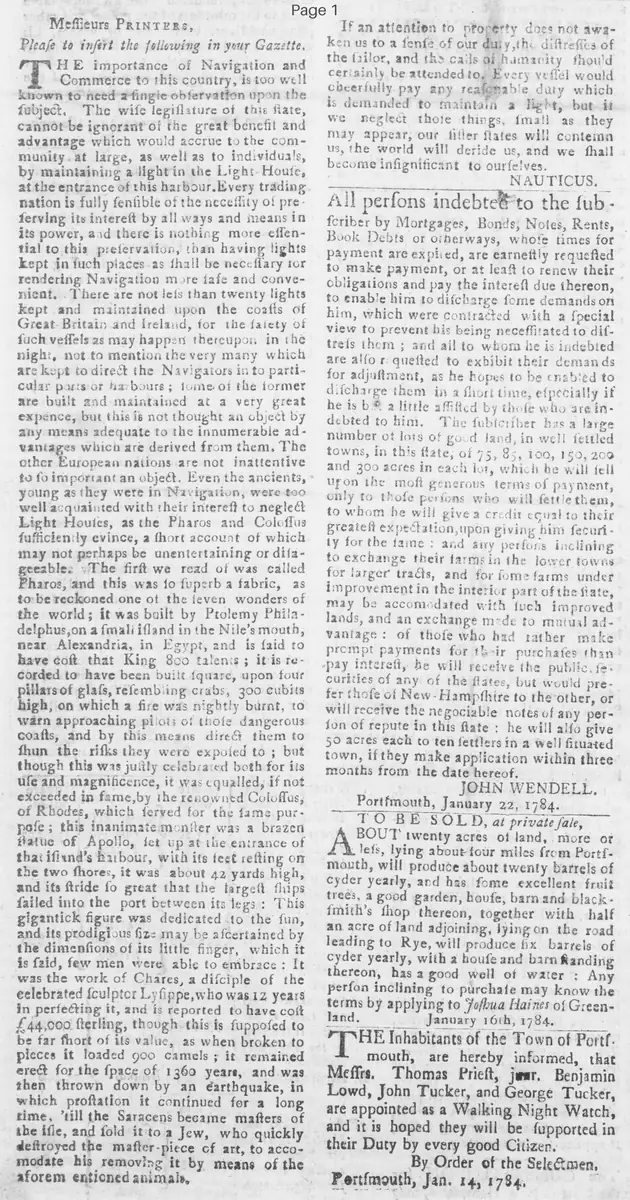
Messieurs Printers,
Please to insert the following in your Gazette.
THE importance of Navigation and Commerce to this country, is too well known to need a single observation upon the subject. The wise legislature of this state, cannot be ignorant of the great benefit and advantage which would accrue to the community at large, as well as to individuals, by maintaining a light in the Light-House, at the entrance of this harbour. Every trading nation is fully sensible of the necessity of preserving its interest by all ways and means in its power, and there is nothing more essential to this preservation, than having lights kept in such places as shall be necessary for rendering Navigation more safe and convenient. There are not less than twenty lights kept and maintained upon the coasts of Great-Britain and Ireland, for the safety of such vessels as may happen thereupon, in the night, not to mention the very many which are kept to direct the Navigators into particular ports or harbours: some of the former are built and maintained at a very great expense, but this is not thought an object by any means adequate to the innumerable advantages which are derived from them. The other European nations are not inattentive to so important an object. Even the ancients, young as they were in Navigation, were too well acquainted with their interest to neglect Light Houses, as the Pharos and Colossus sufficiently evince. A short account of which may not perhaps be unentertaining or disagreeable: The first we read of was called Pharos, and this was so superb a fabric, as to be reckoned one of the seven wonders of the world: it was built by Ptolemy Philadelphus, on a small island in the Nile's mouth, near Alexandria, in Egypt, and is said to have cost that King 800 talents; it is recorded to have been built square, upon four pillars of glass, resembling crabs, 200 cubits high, on which a fire was nightly burnt, to warn approaching pilots of those dangerous coasts, and by this means direct them to shun the risks they were exposed to: but though this was justly celebrated both for its use and magnificence, it was equalled, if not exceeded in fame, by the renowned Colossus, of Rhodes, which served for the same purpose; this inanimate monster was a brazen statue of Apollo, set up at the entrance of that island's harbour, with its feet resting on the two shores, it was about 42 yards high, and its stride so great that the largest ships sailed into the port between its legs: This gigantick figure was dedicated to the sun, and its prodigious size may be ascertained by the dimensions of its little finger, which it is said, few men were able to embrace: It was the work of Chares, a disciple of the celebrated sculptor Lysippe, who was 12 years in perfecting it, and is reported to have cost £44,000 sterling, though this is supposed to be far short of its value, as when broken to pieces it loaded 900 camels; it remained erect for the space of 1300 years, and was then thrown down by an earthquake, in which prostration it continued for a long time, till the Saracens became masters of the isle, and sold it to a Jew, who quickly destroyed the master-piece of art, to accommodate his removing it by means of the aformentioned animals.
If an attention to property does not awaken us to a sense of our duty, the distresses of the sailor, and the calls of humanity should certainly be attended to. Every vessel would cheerfully pay any reasonable duty which is demanded to maintain a light, but if we neglect those things, small as they may appear, our sister states will contemn us, the world will deride us, and we shall become insignificant to ourselves.
NAUTICUS.
Please to insert the following in your Gazette.
THE importance of Navigation and Commerce to this country, is too well known to need a single observation upon the subject. The wise legislature of this state, cannot be ignorant of the great benefit and advantage which would accrue to the community at large, as well as to individuals, by maintaining a light in the Light-House, at the entrance of this harbour. Every trading nation is fully sensible of the necessity of preserving its interest by all ways and means in its power, and there is nothing more essential to this preservation, than having lights kept in such places as shall be necessary for rendering Navigation more safe and convenient. There are not less than twenty lights kept and maintained upon the coasts of Great-Britain and Ireland, for the safety of such vessels as may happen thereupon, in the night, not to mention the very many which are kept to direct the Navigators into particular ports or harbours: some of the former are built and maintained at a very great expense, but this is not thought an object by any means adequate to the innumerable advantages which are derived from them. The other European nations are not inattentive to so important an object. Even the ancients, young as they were in Navigation, were too well acquainted with their interest to neglect Light Houses, as the Pharos and Colossus sufficiently evince. A short account of which may not perhaps be unentertaining or disagreeable: The first we read of was called Pharos, and this was so superb a fabric, as to be reckoned one of the seven wonders of the world: it was built by Ptolemy Philadelphus, on a small island in the Nile's mouth, near Alexandria, in Egypt, and is said to have cost that King 800 talents; it is recorded to have been built square, upon four pillars of glass, resembling crabs, 200 cubits high, on which a fire was nightly burnt, to warn approaching pilots of those dangerous coasts, and by this means direct them to shun the risks they were exposed to: but though this was justly celebrated both for its use and magnificence, it was equalled, if not exceeded in fame, by the renowned Colossus, of Rhodes, which served for the same purpose; this inanimate monster was a brazen statue of Apollo, set up at the entrance of that island's harbour, with its feet resting on the two shores, it was about 42 yards high, and its stride so great that the largest ships sailed into the port between its legs: This gigantick figure was dedicated to the sun, and its prodigious size may be ascertained by the dimensions of its little finger, which it is said, few men were able to embrace: It was the work of Chares, a disciple of the celebrated sculptor Lysippe, who was 12 years in perfecting it, and is reported to have cost £44,000 sterling, though this is supposed to be far short of its value, as when broken to pieces it loaded 900 camels; it remained erect for the space of 1300 years, and was then thrown down by an earthquake, in which prostration it continued for a long time, till the Saracens became masters of the isle, and sold it to a Jew, who quickly destroyed the master-piece of art, to accommodate his removing it by means of the aformentioned animals.
If an attention to property does not awaken us to a sense of our duty, the distresses of the sailor, and the calls of humanity should certainly be attended to. Every vessel would cheerfully pay any reasonable duty which is demanded to maintain a light, but if we neglect those things, small as they may appear, our sister states will contemn us, the world will deride us, and we shall become insignificant to ourselves.
NAUTICUS.
What sub-type of article is it?
Persuasive
Informative
Historical
What themes does it cover?
Commerce Trade
Infrastructure
What keywords are associated?
Navigation
Commerce
Lighthouse
Pharos
Colossus
Rhodes
Alexandria
Harbor Safety
What entities or persons were involved?
Nauticus
Messieurs Printers
Letter to Editor Details
Author
Nauticus
Recipient
Messieurs Printers
Main Argument
maintaining a light in the lighthouse at the harbor entrance is essential for safe navigation and commerce, benefiting the community, as demonstrated by historical precedents like the pharos and colossus; neglecting it would lead to derision from other states and the world.
Notable Details
References Pharos Of Alexandria As One Of The Seven Wonders, Built By Ptolemy Philadelphus
Describes Colossus Of Rhodes As A Statue Of Apollo, 42 Yards High, Dedicated To The Sun
Mentions 20 Lights On Coasts Of Great Britain And Ireland
Highlights Ancient And European Attention To Lighthouses