Thank you for visiting SNEWPapers!
Sign up free
The Liberator
Boston, Suffolk County, Massachusetts
What is this article about?
Richard D. Webb writes from Dublin to Garrison about Henry C. Wright's health issues leading to a water cure trip to Graffenberg with Joseph Poole; extols hydropathy's benefits and Priessnitz's methods; discusses Irish repeal agitation, O'Connell's trial, government distrust, and contrasts with continental despotism. Includes Thompson's Delhi letter. (278 characters)
Merged-components note: Continuation of the same letter from Richard D. Webb, split across pages due to OCR page boundaries; sequential reading order.
Clippings
1 of 2
OCR Quality
Full Text
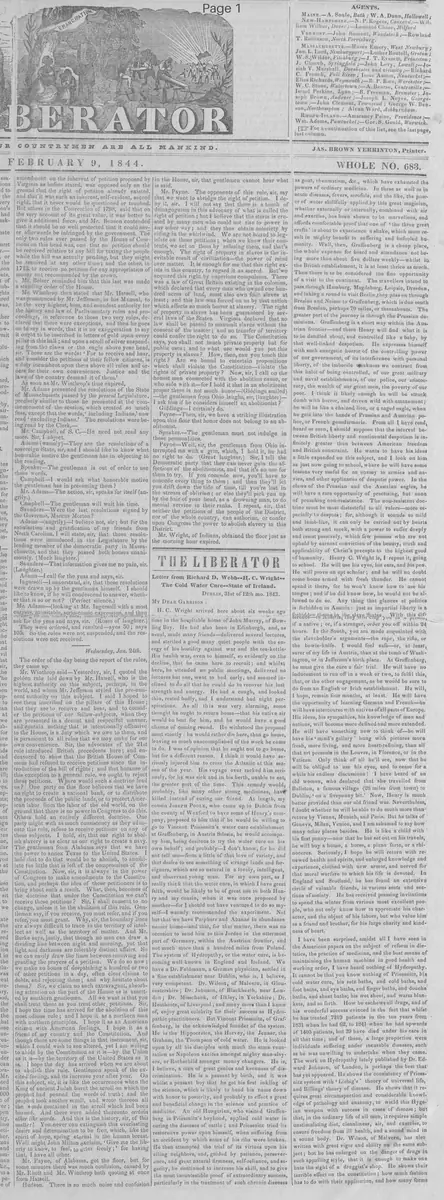
Letter from Richard D. Webb—H. C. Wright—
The Cold Water Cure—State of Ireland.
DUBLIN, 31st of 12th mo. 1843.
My Dear Garrison:
H. C. Wright arrived here about six weeks ago in the hospitable home of John Murray, of Bowling Bay. He had also been in Edinburgh, and, as usual, made many friends—delivered several lectures, and startled a good many quiet people with the energy of his hostility against war and the tea-kettle.
His health was, even to himself, so evidently on the decline, that he came here to recruit; and whilst here, he attended no public meetings, delivered no lectures but one, went to bed early, and seemed inclined to do all that he could do to recover his lost strength and energy. He had a cough, and looked thin, rested badly, and I understand had night perspirations. As all this was very alarming, some thought he ought to return home—that his native air would be best for him, and he would have a good chance of coming round. He withstood the proposal most stoutly: he would rather die here, than go home, leaving so much unaccomplished of the work he came to do. I was of opinion that he ought not to go home, but for a different reason. I think it would have seriously injured him to cross the Atlantic at this season of the year. His voyage over racked him seriously, for he was sick and in his berth, unable to eat, the greater part of the time. This remedy would, probably, like many other strong medicines, have killed instead of curing our friend. At length, my cousin Joseph Poole, who came up to Dublin from the county of Wexford to have some of Henry's company, proposed to him that if he would be willing to go to Vincent Priessnitz's water cure establishment at Graffenberg, in Austria Silesia, he would accompany him, being desirous to try the water cure on his own behalf; and probably—I don't know, for he did not tell me—from a little of that love of variety, and that desire to see something of strange lands and foreigners, which are so natural in a lively, intelligent, and observant young man. For my own part, as I really think that the water cure, in which I have great faith, would be likely to be of great use to both Henry and my cousin, when it was once proposed by another—for I should not have ventured to do so myself—I warmly recommended the experiment. Not but that we have Parphars and Abanas in abundance nearer home—and that, for that matter, there was no occasion to send him to this Jordan in the uttermost part of Germany, within the Austrian frontier, and not much more than a hundred miles from Poland.
The system of Hydropathy, or the water cure, is becoming well known in England and Ireland. We have a Dr. Feldmann, a German physician, settled in a fine establishment near Dublin, who is, I believe, very competent. Dr. Wilcox, of Malvern, in Gloucestershire; Dr. Johnson, of Blackheath, near London; Dr. Misschank, of Ilkley, in Yorkshire; Dr. Heathcote, of Liverpool; and many more than I know of, enjoy great celebrity for their success as Hydropathic practitioners. But Vincent Priessnitz, of Graffenberg, is the acknowledged founder of the system. He is the Hippocrates, the Hervey, the Jenner, the Graham, the Thompson of cold water. He is looked upon by all his disciples with much the same veneration as Napoleon excites amongst mighty man-slayers, or Rothschild amongst money changers. He is I believe, a man of great genius and keenness of discrimination. He is a peasant by birth, and it was whilst a peasant boy that he got his first inkling of the science, which is likely to hand his name down with honor to posterity, and probably to effect a great and beneficial change in the science and practice of medicine. An old Hungarian, who visited Graffenberg in Priessnitz's boyhood, applied cold water in curing the diseases of cattle; and Priessnitz tried its restorative power upon himself, when suffering from an accident by which some of his ribs were broken. He then attempted the trial of its virtues upon his ailing neighbors, and, guided by patience, perseverance, and great natural firmness, self-reliance, and sagacity, he continued to increase his skill, and to give the most incontestible proof of extraordinary success, particularly in the treatment of such chronic diseases as gout, rheumatism, &c., which have exhausted the powers of ordinary medicine. In these as well as in acute diseases, fevers, scrofula, and the like, the power of water skillfully applied by this great magician, whether externally or internally, combined with air and exercise, has been shown to be marvellous, and affords comfortable proof that one of the three great crafts' is about to experience a shake, which must result in mighty benefit to suffering and befooled humanity. Well, then, Graffenberg is a cheap place, the whole expense for board and attendance not being more than about five dollars weekly—whilst in the British establishment, it is at least thrice as much. Then there is to be considered the fine opportunity of a visit to the continent. The travellers intend to pass through Hamburg, Magdeburg, Leipsic, Dresden, and taking a round to visit Berlin, they pass on through Breslau and Neisse to Graffenberg, which is due south from Breslau, perhaps 70 miles, or thereabouts. The greater part of the journey is through the Prussian dominions. Graffenberg is a short way within the Austrian frontier—and there Henry will find what it is to be dandled about, and controlled like a baby, by that well-linked despotism. He expresses himself with such energetic horror of the controlling power of our government, of its interference with personal liberty, of the imbecile weakness we contract from this habit of being controlled, of our great military and naval establishments, of our police, our aristocracy, the wealth of our great men, the poverty of our poor. I think it likely enough he will be struck dumb with horror, and driven wild with amazement; he will be like a chained lion, or a caged eagle, when he gets into the hands of Prussian and Austrian police, or French gensdarmerie. From all I have read, heard or seen, I should suppose that the interval between British liberty and continental despotism is infinitely greater than between American freedom and British constraint. He wants to have his ideas a little expanded on this subject, and I look on him as just now going to school, where he will have some lessons very useful for an enemy to armies and navies, and other appliances of despotic power. In the claws of the Prussian and the Austrian eagles, he will have a rare opportunity of practising, but none of preaching non-resistance. The non-resistant doctrine must be most distasteful to all rulers—more especially to despots; for, although it sounds so mild and lamb-like, it can only be carried out by hearts both strong and meek, with a power to suffer deeply and resist passively, which few possess who are not upheld by earnest conviction of the beauty, truth and applicability of Christ's precepts to the highest good of humanity. Henry C. Wright is, I repeat it, going to school. He will use his eyes, his ears, and his pen. He will prove an apt scholar; and he will no doubt come home armed with fresh thunder. He cannot spend it there, for he won't know how to use his tongue; and if he did know how, he would not be allowed to do so. Any thing that glances at politics is forbidden in Austria: just as impartial liberty is a forbidden fruit to the native; or, if a stranger, order you off within 24 hours. In the South, you are made acquainted with the slaveholder's arguments—the rope, the rifle, or the bowie-knife. I would feel safe—or, at least, surer of my life in Austria, than at the tomb of Washington, or in Jefferson's birth place. At Graffenberg, he must give the cure a fair trial. He will have no inducement to run off in a week or two, to fulfil this, that, or the other engagement, as he would be sure to do from an English or Irish establishment. He will, I hope, remain four months, at least. He will have the opportunity of learning German and French—he will have intercourse with natives of all parts of Europe. His ideas, his sympathies, his knowledge of men and nations, will become more defined and more extended. He will have something new to think of—he will have his 'mind's gallery' hung with pictures more fresh, more living, and more heart-refining, than all that art presents in the Louvre, in Florence, or in the Vatican. Only think of all he'll see, now that he will be obliged to use his eyes, and to cease for a while his endless discussions! I have heard of an old woman, who declared that she travelled from Ballston, a famous village (28 miles from town) to Dublin, 'on a fivepenny bit.' Now, Henry is much better provided than our old friend was. Nevertheless, I doubt whether he will be able to do much more than return by Vienna, Munich, and Paris. But he talks of Geneva, Milan, Venice, and I am ashamed to say how many other places besides. He is like a child with his first penny—now that he has set out on his travels, he will buy a house, a horse, a piano forte, or a rhinoceros. Seriously, I hope he will return with renewed health and spirits, and enlarged knowledge and experience, clothed with new armor, and nerved for that moral warfare to which his life is devoted. In England and Scotland, he has found an extensive circle of valuable friends, in various sects and sections of society. He has received pressing invitations to spend the winter from various most excellent people, who not only know how to appreciate his character, and the object of his labors, but who value him as a friend and brother, for his large charity and kindness of heart.
I have been surprised, amidst all I have seen in the American papers on the subject of reform in dietetics, the practice of medicine, and the best means of maintaining the human machine in good health and working order, I have heard nothing of Hydropathy. It cannot be that you know nothing of Priessnitz, his cold water cure, his setz baths, and cold baths, and foot baths, and eye baths, and finger baths, and douche baths, and sheet baths; his wet sheet, and warm blankets, and so forth. How he eschews all drugs, and of his wonderful success evinced in the fact that whilst he has treated 7219 patients in the ten years from 1831 when he had 62, to 1841 when he had upwards of 1400 patients, but 39 have died under his care in all that time; and of these, a large proportion were individuals suffering under incurable diseases, such as he was unwilling to undertake when they came. The work on Hydropathy lately published by Dr. Edward Johnson, of London, is perhaps the best that has yet appeared. He shows the consistency of Priessnitz system with 'Liebig's' theory of universal life, and Billings' theory of disease. He shows that it requires great circumspection and considerable knowledge of pathology and anatomy, to wield this Hygieian weapon with success in cases of disease; but that, in the ordinary life of all men, it requires simple unstimulating diet, cleanliness, air, and exercise, to ensure freedom from ill health, and a sound mind in a sound body. Dr. Wilson, of Malvern, has also written with great vigor and ability on the same subject; but he has enlarged on the danger of drugs in such appalling style, that it is enough to make one hate the sight of a druggist's shop. He shows their terrible effect on the constitution; how much fashion has to do with their application, and how many forms of disease they create. 22 of disease are induced by their imprudent exhibition. In short, he would away with them altogether, and he holds that there is no disease which can be cured by drugs, which cannot be much more effectually treated with cold water, aided by air and exercise. Herbert Mayo, the distinguished physiologist—Sir Charles Scudamore, who has written upon gout—Edward E. Abdy, who travelled in America, and who denounced the colorphobia so stoutly, that the American booksellers would not venture to speculate on a piracy of his book—all these are converts to the cold water cure, and have published their confessions. I fear me, after all I have said about Hydropathy and its appendage, the apostle of non-resistance, this my lengthy epistle will look like Falstaff's meal, 'a penny worth of bread to such a monstrous deal of sack.' But you must only make the best of it. The travellers left us on the 24th. We had a letter from Hull, from whence they were to cross the German ocean. We do not expect to hear again till they write from Hamburgh, where they intended to take out Prussian and Austrian passports. They were provided with letters of introduction to that city, and to Madgeburgh and Berlin, which may be of some use; but I suppose they will chiefly have to rely upon Henry C. Wright and Joseph Poole. I should say that I am appointed H. C. W's agent, during his absence, for the reception of letters, which I am authorized to open and read, in order that he may be furnished with the contents—for postage to Graffenberg is no trifle. Therefore, all good people, over, and write nothing that you don't want me to read. Though if a secret should drop from your pen inadvertently, I will be discreet, and say nothing, no more than if it were whispered into the dull cold ear of death. Two letters have just arrived for him by the last mail—one from Amasa Walker, the other from W. L. G.—which have been duly read and digested. You are both to attribute his silence to the want of time previous to starting—for, from the time the thing was proposed, he spent a good while in groaning over the idea of having to go, (I should have been delighted at the idea of such sport,) and when at length he got into the spirit of it—which he did at last—he had no thoughts for any thing but packing up, studying Murray's Hand Book to northern Germany, arranging his affairs so as to owe no man any thing, and leaving his parting charge with us. He was very desirous that I should write, as I am writing, to tell thee all about him. His little book, 'A Kiss for a Blow,' is going off very well. Many thousands have been sold, and the sale is steadily continuing.
Ireland is as quiet as possible. The country is virtually undergoing a military occupation, and the government is ostentatiously taking every opportunity of showing their distrust of the great mass of the Irish people. The truth I believe to be, that there is no love lost between them. The people would not have them, if they could help it—and our rulers take good care that they shan't. I am quite of opinion, that the only chance the repealers have is in their non-resistant position, which makes the bristling up of our paternal government appear ridiculous. But, withal, I see no reasonable ground of hope for the repealers until something unforeseen happen to shake the position and prodigious power of England. The cry of all the powerful parties in England is remorseless and bloody. It has been often repeated, and it is this:—The union with Ireland must be maintained at any risk, and at any expense of blood and treasure. Moored like the rifted rock as England appears to be just now, it appears to me inevitable that her pride, her cruelty, her tyranny, and her insatiable lust of conquest, must at length prove her overthrow, I don't believe that, on earth, there is greater wretchedness than amongst some portion of the manufacturing poor of England, or grosser ignorance than amongst her agricultural laborers. But let it be remembered that this is admitted and deplored—that the number is legion who labor to improve this state of things—that it is not provided for and legislated for by the State, and that no man's life or popularity is endangered by fair fame of England are not nurtured as if they were her glory—unlike American slavery, which, as far as can be known from their acts, is the cherished darling of your greatest statesmen, which they protect with the wings of their eloquence, whilst your divines shield the monster with their Bibles, and all the resources of their inhuman theology. A few days ago, I dined at James Haughton's along with Doctor Gray, the editor and proprietor of the Freeman's Journal, the chief organ of the Repeal party. He was one of the principal satellites of O'Connell in the repeal agitation, and he is one of those who, with O'Connell, are to be tried for conspiracy in about a fortnight. How this trial will end, it is impossible to foresee. I hope with all my heart, that the government may be defeated. But, whether they be victorious or not in the courts of law, they cannot win, in the long run, in their blind contest with a nation, whose hearts are with those they are trying to crush. Dr. Gray says that O'Connell is in good health and spirits. He has been for some weeks amongst his mountain fastnesses at Derrynane, on the coast of the Atlantic; but he will be in Dublin a few days previous to the trial. James Haughton told me, to-day, that thy letter to O'Connell, the addresses, &c. have come to hand, and that he will hand them to him when he arrives in Dublin. I agree with James in thinking, that though it is possible sinister influence may have operated upon our great O'Connell, in inducing him to use derogatory language towards thee, of whom he has so often spoken in the most respectful terms, besides paying the unusual compliment of a personal call when thou wast in Dublin—yet this was not necessary to change his mind. His profound and habitual respect for his own priesthood is such, that he would be readily startled by thy frequent denunciations of the whole clergy for their recreancy to the cause of humanity. As to thy anti-Sabbatarian opinions, he has referred to them in terms of righteous disapprobation. Nevertheless, it is true that some of the monster Repeal meetings were held on Sunday—and he defended his intention to hold the very Clontarf meeting (which was proclaimed down,) on that day, on the ground that to seek for Repeal was a good act, and for the good of the poor and the oppressed—and that it was lawful to do good on the Sabbath day. The Protestant clergy were all in an uproar, to be sure—just as they are horrified at Gerrit Smith for his political anti-slavery meetings on 'the holy Sabbath.' Our clergy, who were thus 'struck aghast at O'Connell, are not at all troubled by the troops that march and the military bands that play through Dublin every day in the year, Sundays and all! A few days before H. C. W. left us, I accompanied him to Kingstown, to take our first experimental trip from thence to Dalkey, in the atmospheric railway. It is about two English miles long, and it moves with great ease and smoothness at the rate of from 25 to 30 miles an hour. It is considered a triumphant experiment of that species of locomotion—and we Irish are all boasting and as proud as possible. Well, as we entered the carriage, we heard a shout from Henry, who was first. This explosion was caused by his recognition of an old acquaintance from New-England, who was neither more nor less than the nephew of three great men, viz. Wm. Lloyd, Samuel Sewall, and President Lord, of Hanover—by name, the Rev. John Lord, lecturer on the Middle Ages. He dined with us, and I met him at James Haughton's and R. Allen's afterwards. He is a wonderfully fluent talker, and full of life and energy. His naivete was remarkable, and his revelations of men and things some of the most amusing I ever heard. Though without any pretence to the reformer's fame, or the martyr's crown, he had a good word for the abolitionists, whom he called some of the most honest people in America—whether in condescension to our hallucination or not, I do not know. He had no cant, and but little esprit du corps. It is refreshing to meet with such a man. He was some weeks in Dublin before we fall in with him. Whilst in town, he had several small adventures, which amused us exceedingly—and he met with quite a menagerie of characters, of all sorts and sizes, high and low, gentle and simple. H. C. W. talked with his wonted plainness to John Lord, and, oh rare! John Lord talked with equal plainness to H. C. W. I have received a letter from George Thompson dated Delhi, Oct. 15, 1843, of which I send thee the following extract: At the invitation and most earnest request of the King of Delhi, I have come hither to render him my advice, and, if possible, some assistance. I am thus gaining a greater insight into native character than I could otherwise hope to do; I am learning the manners and customs of the native courts; I am gaining much important information respecting the conduct of the British government towards the imperial family of Delhi, and, at the same time (I hope and trust) espousing, if not forwarding the cause of justice and good faith; and all without neglecting one object of my visit to this country. I can truly say that the conviction of my mind was, and is, that the cause of the Hindoo nation would be promoted, as far as I was concerned, by my coming here and being employed, if there was a necessity, on behalf of the king in England. While here, I have been actively, constantly, and profitably employed. I am in the midst of the most celebrated ruins of this country. The dust of empires forms the soil. I have explored much of the neighborhood—read and re-read the various histories of the Mussulman's rule in India—been over palaces, temples, mosques, gardens, forts, and tombs, and learned many a lesson which can be learned only by visiting the actual scenes where some of the greatest events have occurred. I have, of course, been much engaged in the special business which brought me here. As the friend and counsellor of the king, I have had the confidence and respect of the natives, and have been admitted into their society to an extent that would not be allowed under any other circumstances. In all my intercourse, I have endeavored to disseminate sound principles, and to excite them to such a course of conduct as would be for their own and their country's good. Things are very different here from Calcutta. In the latter place, education has made considerable progress, and there are hundreds who can appreciate a discourse delivered in English upon a subject connected with the cause of improvement. Here, things are as they have been for centuries. Scarcely any inroad has been made upon the ignorance and prejudices of the people. They are naturally gifted with average powers; and in diplomacy and the ordinary affairs of life, exhibit extraordinary subtlety and talent; but their propensities, principles, and actions are purely Asiatic, and it is next to impossible to get them to conceive even the meaning of those ideas and principles which form the standard of men of sound education. I speak of the Hindoo and Mussulman population, both, for there is no marked or essential difference between them in any thing which respects their conduct towards their fellow-men. I could scarcely have been placed in a position for gaining a more accurate knowledge of the habits and feelings of the natives of the interior of India. My business here is now drawing to a close. I intend to leave Calcutta by the steamer 'Bentinck' for Suez on the 14th of December. I expect to be joined here by Dwarkanauth Tagore in a little better than a fortnight. In the mean time, I shall take a run up to the hills and see the Himalaya, and the snowy range, and then descend to Calcutta by way of Agra, Lucknow, Allahabad, and Benares, with Dwarkanauth. Though I have felt the effect of the intense heat during what is called the hot season, my health has been pretty good. The cold weather has now commenced, and I expect to have no more cause to complain of the heat. Present my regards to all friends know every thing you are doing. A batch of Liberators and Heralds came to-day. I wish Rogers could feel how we appreciate and enjoy the sparkling and glittering of his Damascus sabre, peaceable men though we be. He wields a mighty weapon, with terrible effect. How the enemies of truth, and those who rely upon false pretences, must tremble in the light of his revealings! It is long since he wrote to us. If he could feel half the pleasure in writing, that we do in hearing from him, he would write from pure selfishness—though I doubt whether that would be a sufficient motive for him. I hope Samuel May, Jr. has enjoyed good health since his return, and that both Amasa Walker and he will reap permanent benefit from their European sojournings. There will now be no opportunity for writing again till the next month, and by that time I hope to answer the letters that I have received from M. W. C. and E. Q., and to have news for you of H. C. W. and his companion having arrived in Graffenberg. I have heard nothing from Philadelphia, for ever so long. But this letter has grown to an inconceivable length—and as I cannot cut it short, I must conclude, and remain, as ever, thine, affectionately,
RICHARD D. WEBB.
What sub-type of article is it?
What themes does it cover?
What keywords are associated?
What entities or persons were involved?
Letter to Editor Details
Author
Richard D. Webb
Recipient
Garrison
Main Argument
reports on henry c. wright's declining health and his decision, with joseph poole, to travel to vincent priessnitz's water cure establishment in graffenberg for treatment; promotes hydropathy as a superior medical approach; updates on irish politics, the repeal movement, o'connell's trial, and contrasts british liberty with continental despotism.
Notable Details