Thank you for visiting SNEWPapers!
Sign up free
Editorial
August 29, 1926
The Daily Worker
Chicago, Cook County, Illinois
What is this article about?
An editorial mocks the Chicago Tribune's claim of truthful Russia reporting without Soviet correspondents, revealing reliance on unreliable Riga sources like Donald Day and examples of fabricated stories about Stalin and others, contrasted with peaceful Moscow accounts.
Clipping
OCR Quality
100%
Excellent
Full Text
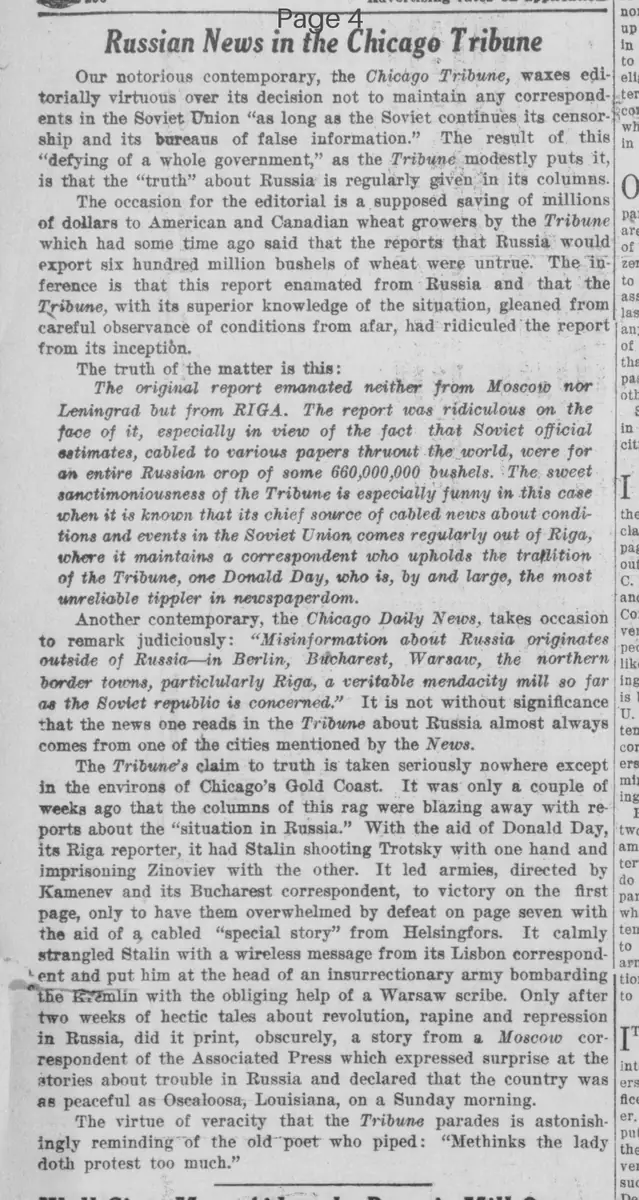
Russian News in the Chicago Tribune
Our notorious contemporary, the Chicago Tribune, waxes editorially virtuous over its decision not to maintain any correspondents in the Soviet Union "as long as the Soviet continues its censorship and its bureaus of false information." The result of this "defying of a whole government," as the Tribune modestly puts it, is that the "truth" about Russia is regularly given in its columns.
The occasion for the editorial is a supposed saving of millions of dollars to American and Canadian wheat growers by the Tribune which had some time ago said that the reports that Russia would export six hundred million bushels of wheat were untrue. The inference is that this report emanated from Russia and that the Tribune, with its superior knowledge of the situation, gleaned from careful observance of conditions from afar, had ridiculed the report from its inception.
The truth of the matter is this:
The original report emanated neither from Moscow nor Leningrad but from RIGA. The report was ridiculous on the face of it, especially in view of the fact that Soviet official estimates, cabled to various papers throughout the world, were for an entire Russian crop of some 660,000,000 bushels. The sweet sanctimoniousness of the Tribune is especially funny in this case when it is known that its chief source of cabled news about conditions and events in the Soviet Union comes regularly out of Riga, where it maintains a correspondent who upholds the tradition of the Tribune, one Donald Day, who is, by and large, the most unreliable tippler in newspaperdom.
Another contemporary, the Chicago Daily News, takes occasion to remark judiciously: "Misinformation about Russia originates outside of Russia in Berlin, Bucharest, Warsaw, the northern border towns, particularly Riga, a veritable mendacity mill so far as the Soviet republic is concerned." It is not without significance that the news one reads in the Tribune about Russia almost always comes from one of the cities mentioned by the News.
The Tribune's claim to truth is taken seriously nowhere except in the environs of Chicago's Gold Coast. It was only a couple of weeks ago that the columns of this rag were blazing away with reports about the "situation in Russia." With the aid of Donald Day, its Riga reporter, it had Stalin shooting Trotsky with one hand and imprisoning Zinoviev with the other. It led armies, directed by Kamenev and its Bucharest correspondent, to victory on the first page, only to have them overwhelmed by defeat on page seven with the aid of a cabled "special story" from Helsingfors. It calmly strangled Stalin with a wireless message from its Lisbon correspondent and put him at the head of an insurrectionary army bombarding the Kremlin with the obliging help of a Warsaw scribe. Only after two weeks of hectic tales about revolution, rapine and repression in Russia, did it print, obscurely, a story from a Moscow correspondent of the Associated Press which expressed surprise at the stories about trouble in Russia and declared that the country was as peaceful as Ottumwa, Iowa, on a Sunday morning.
The virtue of veracity that the Tribune parades is astonishingly reminding of the old poet who piped: "Methinks the lady doth protest too much."
Our notorious contemporary, the Chicago Tribune, waxes editorially virtuous over its decision not to maintain any correspondents in the Soviet Union "as long as the Soviet continues its censorship and its bureaus of false information." The result of this "defying of a whole government," as the Tribune modestly puts it, is that the "truth" about Russia is regularly given in its columns.
The occasion for the editorial is a supposed saving of millions of dollars to American and Canadian wheat growers by the Tribune which had some time ago said that the reports that Russia would export six hundred million bushels of wheat were untrue. The inference is that this report emanated from Russia and that the Tribune, with its superior knowledge of the situation, gleaned from careful observance of conditions from afar, had ridiculed the report from its inception.
The truth of the matter is this:
The original report emanated neither from Moscow nor Leningrad but from RIGA. The report was ridiculous on the face of it, especially in view of the fact that Soviet official estimates, cabled to various papers throughout the world, were for an entire Russian crop of some 660,000,000 bushels. The sweet sanctimoniousness of the Tribune is especially funny in this case when it is known that its chief source of cabled news about conditions and events in the Soviet Union comes regularly out of Riga, where it maintains a correspondent who upholds the tradition of the Tribune, one Donald Day, who is, by and large, the most unreliable tippler in newspaperdom.
Another contemporary, the Chicago Daily News, takes occasion to remark judiciously: "Misinformation about Russia originates outside of Russia in Berlin, Bucharest, Warsaw, the northern border towns, particularly Riga, a veritable mendacity mill so far as the Soviet republic is concerned." It is not without significance that the news one reads in the Tribune about Russia almost always comes from one of the cities mentioned by the News.
The Tribune's claim to truth is taken seriously nowhere except in the environs of Chicago's Gold Coast. It was only a couple of weeks ago that the columns of this rag were blazing away with reports about the "situation in Russia." With the aid of Donald Day, its Riga reporter, it had Stalin shooting Trotsky with one hand and imprisoning Zinoviev with the other. It led armies, directed by Kamenev and its Bucharest correspondent, to victory on the first page, only to have them overwhelmed by defeat on page seven with the aid of a cabled "special story" from Helsingfors. It calmly strangled Stalin with a wireless message from its Lisbon correspondent and put him at the head of an insurrectionary army bombarding the Kremlin with the obliging help of a Warsaw scribe. Only after two weeks of hectic tales about revolution, rapine and repression in Russia, did it print, obscurely, a story from a Moscow correspondent of the Associated Press which expressed surprise at the stories about trouble in Russia and declared that the country was as peaceful as Ottumwa, Iowa, on a Sunday morning.
The virtue of veracity that the Tribune parades is astonishingly reminding of the old poet who piped: "Methinks the lady doth protest too much."
What sub-type of article is it?
Press Freedom
Foreign Affairs
What keywords are associated?
Chicago Tribune
Russia Misinformation
Donald Day
Soviet Union
Press Reliability
Riga Reports
Wheat Exports
What entities or persons were involved?
Chicago Tribune
Donald Day
Stalin
Trotsky
Zinoviev
Kamenev
Associated Press
Editorial Details
Primary Topic
Critique Of Chicago Tribune's Unreliable Reporting On Soviet Russia
Stance / Tone
Mocking And Critical
Key Figures
Chicago Tribune
Donald Day
Stalin
Trotsky
Zinoviev
Kamenev
Associated Press
Key Arguments
Tribune Claims To Provide Truth About Russia Without Correspondents Due To Soviet Censorship
Wheat Export Report Originated From Riga, Not Russia, And Was Ridiculed By Tribune
Tribune's Main Source Is Unreliable Correspondent Donald Day In Riga
Misinformation About Russia Comes From Border Cities Like Riga, As Noted By Chicago Daily News
Tribune Published Contradictory And False Stories About Russian Internal Conflicts
Actual Reports From Moscow Indicate Peace In Russia, Contradicting Tribune's Tales