Thank you for visiting SNEWPapers!
Sign up free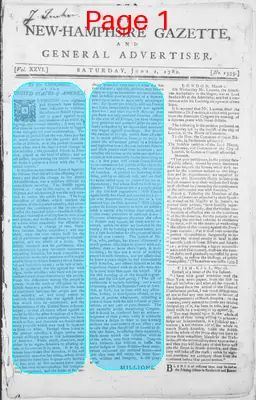
The New Hampshire Gazette And General Advertiser
Portsmouth, Exeter, Rockingham County, New Hampshire
What is this article about?
An anonymous editorial addresses the U.S. Congress, warning against accepting a separate peace with Britain despite potentially favorable terms, as it would betray allies France and Spain, invite future British aggression, and damage America's international reputation. It critiques the British ministry's motives and urges maintaining alliances for true independence.
Merged-components note: The image is positioned within the bounding box of the letter to Congress, indicating it is part of the same component. The content is an opinion piece advising against a separate peace, better classified as editorial rather than letter_to_editor.
Clipping
OCR Quality
Full Text
of the
UNITED STATES of AMERICA.
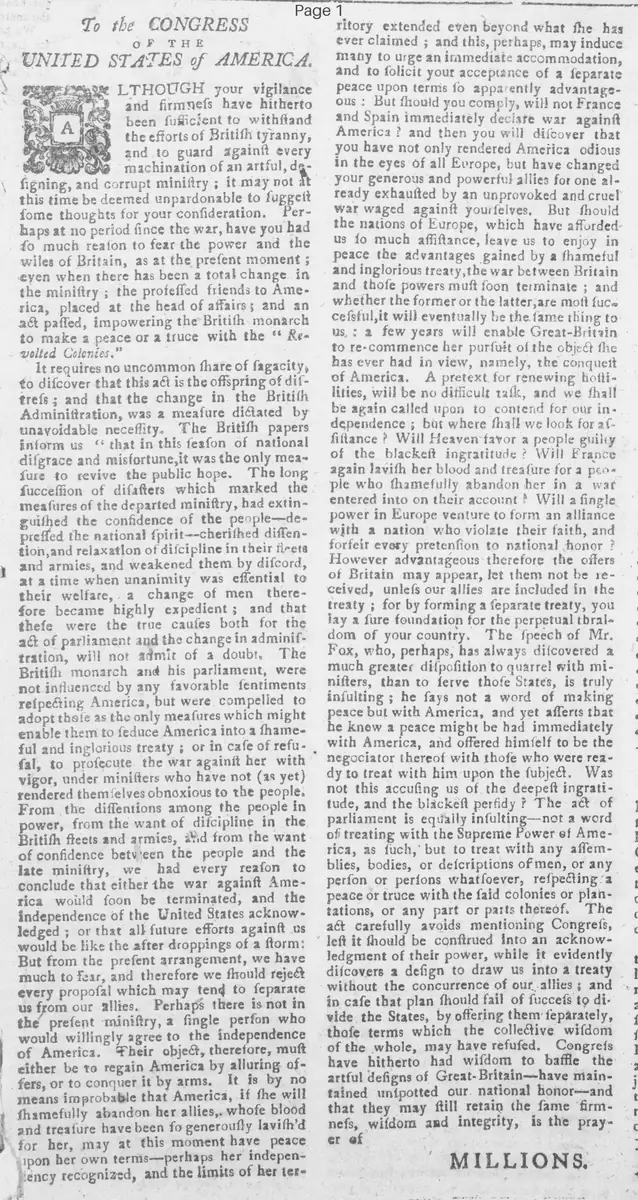
ALTHOUGH your vigilance and firmness have hitherto been sufficient to withstand the efforts of British tyranny, and to guard against every machination of an artful, designing, and corrupt ministry: it may not at this time be deemed unpardonable to suggest some thoughts for your consideration. Perhaps at no period since the war, have you had so much reason to fear the power and the wiles of Britain, as at the present moment; even when there has been a total change in the ministry: the professed friends to America, placed at the head of affairs; and an act passed, empowering the British monarch to make a peace or a truce with the Revolted Colonies.
It requires no uncommon share of sagacity to discover that this act is the offspring of distress: and that the change in the British Administration, was a measure dictated by unavoidable necessity. The British papers inform us that in this season of national disgrace and misfortune, it was the only measure to revive the public hope. The long succession of disasters which marked the measures of the departed ministry, had extinguished the confidence of the people—depressed the national spirit—cherished dissension, and relaxation of discipline in their fleets and armies, and weakened them by discord, at a time when unanimity was essential to their welfare, a change of men therefore became highly expedient; and that these were the true causes both for the act of parliament and the change in administration, will not admit of a doubt. The British monarch and his parliament, were not influenced by any favorable sentiments respecting America, but were compelled to adopt those as the only measures which might enable them to reduce America into a shameful and inglorious treaty: or in case of refusal, to prosecute the war against her with vigor, under ministers who have not (as yet) rendered themselves obnoxious to the people. From the dissensions among the people in power, from the want of discipline in the British fleets and armies, and from the want of confidence between the people and the late ministry, we had every reason to conclude that either the war against America would soon be terminated, and the independence of the United States acknowledged; or that all future efforts against us would be like the after droppings of a storm: But from the present arrangement, we have much to fear, and therefore we should reject every proposal which may tend to separate us from our allies. Perhaps there is not in the present ministry, a single person who would willingly agree to the independence of America. Their object, therefore, must either be to regain America by alluring offers, or to conquer it by arms. It is by no means improbable that America, if she will shamefully abandon her allies, whose blood and treasure have been so generously lavished for her, may at this moment have peace upon her own terms—perhaps her independence recognized, and the limits of her territory extended even beyond what she has ever claimed: and this, perhaps, may induce many to urge an immediate accommodation, and to solicit your acceptance of a separate peace upon terms so apparently advantageous: But should you comply, will not France and Spain immediately declare war against America? and then you will discover that you have not only rendered America odious in the eyes of all Europe, but have changed your generous and powerful allies for one already exhausted by an unprovoked and cruel war waged against yourselves. But should the nations of Europe, which have afforded us so much assistance, leave us to enjoy in peace the advantages gained by a shameful and inglorious treaty, the war between Britain and those powers must soon terminate; and whether the former or the latter, are most successful, it will eventually be the same thing to us: a few years will enable Great-Britain to re-commence her pursuit of the object she has ever had in view, namely, the conquest of America. A pretext for renewing hostilities, will be no difficult task, and we shall be again called upon to contend for our independence: but where shall we look for assistance? Will Heaven favor a people guilty of the blackest ingratitude? Will France again lavish her blood and treasure for a people who shamefully abandon her in a war entered into on their account? Will a single power in Europe venture to form an alliance with a nation who violate their faith, and forfeit every pretension to national honor? However advantageous therefore the offers of Britain may appear, let them not be received, unless our allies are included in the treaty: for by forming a separate treaty, you lay a sure foundation for the perpetual thraldom of your country. The speech of Mr. Fox, who, perhaps, has always discovered a much greater disposition to quarrel with ministers, than to serve those States, is truly insulting; he says not a word of making peace but with America, and yet asserts that he knew a peace might be had immediately with America, and offered himself to be the negotiator thereof with those who were ready to treat with him upon the subject. Was not this accusing us of the deepest ingratitude, and the blackest perfidy? The act of parliament is equally insulting—not a word of treating with the Supreme Power of America, as such, but to treat with any assemblies, bodies, or descriptions of men, or any person or persons whatsoever, respecting a peace or truce with the said colonies or plantations, or any part or parts thereof. The act carefully avoids mentioning Congress, lest it should be construed into an acknowledgment of their power, while it evidently discovers a design to draw us into a treaty without the concurrence of our allies: and in case that plan should fail of success to divide the States, by offering them separately, those terms which the collective wisdom of the whole, may have refused. Congress have hitherto had wisdom to baffle the artful designs of Great-Britain—have maintained unsullied our national honor—and that they may still retain the same firmness, wisdom and integrity, is the prayer of MILLIONS.
What sub-type of article is it?
What keywords are associated?
What entities or persons were involved?
Editorial Details
Primary Topic
Warning Against Separate Peace With Britain
Stance / Tone
Urgently Advisory Against Betrayal Of Allies
Key Figures
Key Arguments