Thank you for visiting SNEWPapers!
Sign up free
Editorial
August 16, 1856
Washington Sentinel
Washington, District Of Columbia
What is this article about?
This editorial defends Maryland Senators Pearce and Pratt against criticism from the Baltimore American for aligning with Democrats to oppose Republicans and preserve the Union, while accusing the newspaper of deserting the Whig party for the Know-Nothings and supporting the hopeless candidacy of Millard Fillmore.
Clipping
OCR Quality
95%
Excellent
Full Text
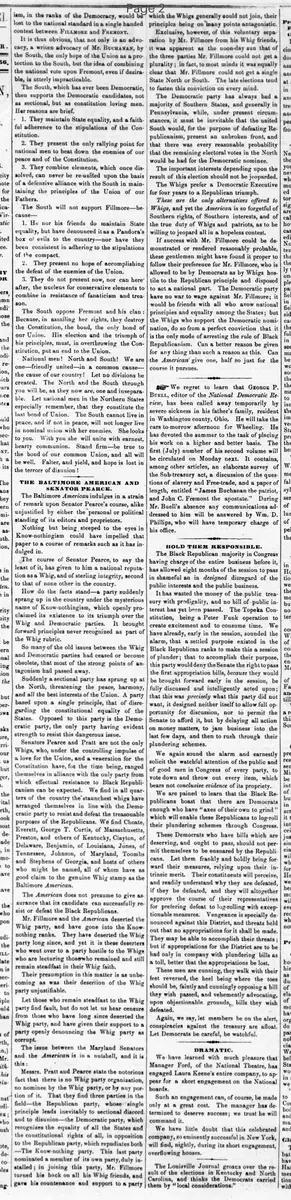
THE BALTIMORE AMERICAN AND SENATOR PEARCE.
The Baltimore American indulges in a strain of remark upon Senator Pearce's course, alike unjustified by either the personal or political standing of its editors and proprietors.
Nothing but being steeped to the eyes in Know-nothingism could have impelled that paper to a course of remarks such as it has indulged in.
The course of Senator Pearce, to say the least of it, has given to him a national reputation as a Whig, and of sterling integrity, second to that of none other in the country.
How do the facts stand-a party suddenly sprang up in the country under the mysterious name of Know-nothingism, which openly proclaimed its existence to its triumph over the Whig and Democratic parties. It brought forward principles never recognized as part of the Whig rubric.
So many of the old issues between the Whig and Democratic parties had ceased or become obsolete, that most of the strong points of antagonism had passed away.
Suddenly a sectional party has sprung up at the North, threatening the peace, harmony and all the best interests of the Union. A party based upon a single principle, that of disregarding the constitutional equality of the States. Opposed to this party is the Democratic party, the only party having evident strength to resist this dangerous issue.
Senators Pearce and Pratt are not the only Whigs, who, under the controlling impulse of a love for the Union, and a veneration for the Constitution have, for the time being, ranged themselves in alliance with the only party from which effectual resistance to Black Republicanism can be expected. We find in all quarters of the country the staunchest whigs have arranged themselves in line with the Democratic party to resist and defeat the treasonable purposes of the Republicans. We find Choate, Everett, George T. Curtis, of Massachusetts. Preston, and others of Kentucky, Clayton, of Delaware, Benjamin, of Louisiana, Jones, of Tennessee, Johnson, of Maryland, Toombs and Stephens of Georgia, and hosts of others who might be named, all of whom have as good claim to the genuine Whig stamp as the Baltimore American.
The American does not presume to give assurance that its candidate can successfully resist or defeat the Black Republicans.
Mr. Fillmore and the American deserted the Whig party, and have gone into the Know nothing ranks. They have deserted the Whig party long since, and yet it is these deserters who went over to a party hostile to the Whigs who are lecturing those who remained and still remain steadfast in their Whig faith.
Their presumption in this matter is as unbecoming as was their desertion of the Whig party unjustifiable.
Let those who remain steadfast to the Whig party find fault, but do not let us hear censure from those who have long since deserted the Whig party, and have given their support to a party openly denouncing the Whig party as corrupt.
The issue between the Maryland Senators and the American is in a nutshell, and it is this:
Messrs. Pratt and Pearce state the notorious fact that there is no Whig party organization no nominee by the Whig party, or by any portion of it. That they find three parties in the field-the Republican party, whose single principle leads inevitably to sectional discord and to disunion-the Democratic party, which recognizes the equality of all the States and the constitutional rights of all, in opposition to the Republican party, which repudiates both —The Know-nothing party. This last party nominated a member of its own party, duly installed: in joining this party, Mr. Fillmore turned his back on all his Whig friends, and gave his countenance and support to a party which the Whigs generally could not join, their principles being on many points antagonistic.
Exclusive, however, of this voluntary separation by Mr. Fillmore from his Whig friends it was apparent as the noon-day sun that of the three parties Mr. Fillmore could not get a plurality; in fact, to most minds it was equally clear that Mr. Fillmore could not get a single State North or South. The late elections tend to fasten this conviction on every mind.
The Democratic party has always had a majority of Southern States, and generally in Pennsylvania, while, under present circumstances, it must be inevitable that the united South would, for the purpose of defeating Republicanism, present an unbroken front, and that there was every reasonable probability that the remaining electoral votes in the North would be had for the Democratic nominee.
The important interests depending upon the result of this election should not be jeoparded. The Whigs prefer a Democratic Executive for four years to a Republican triumph.
These are the only alternatives offered to Whigs, and yet the American is so forgetful of Southern rights, of Southern interests, and of the true duty of Whigs and patriots, as to be willing to jeopard all in a hopeless contest.
If success with Mr. Fillmore could be demonstrated or rendered reasonably probable these gentlemen might have found it proper to follow their preference for Mr. Fillmore, who is allowed to be by Democrats as by Whigs hostile to the Republican principle and disposed to act a national part. The Democratic party have no war to wage against Mr. Fillmore; it would be friends with all who avow national principles and equality among the States; but the Whigs who support the Democratic nomination, do so from a perfect conviction that it is the only mode of arresting the rule of Black Republicanism. Can a better reason be given for any thing than such a reason as this. Can the American give one, half so just for the course it pursues.
The Baltimore American indulges in a strain of remark upon Senator Pearce's course, alike unjustified by either the personal or political standing of its editors and proprietors.
Nothing but being steeped to the eyes in Know-nothingism could have impelled that paper to a course of remarks such as it has indulged in.
The course of Senator Pearce, to say the least of it, has given to him a national reputation as a Whig, and of sterling integrity, second to that of none other in the country.
How do the facts stand-a party suddenly sprang up in the country under the mysterious name of Know-nothingism, which openly proclaimed its existence to its triumph over the Whig and Democratic parties. It brought forward principles never recognized as part of the Whig rubric.
So many of the old issues between the Whig and Democratic parties had ceased or become obsolete, that most of the strong points of antagonism had passed away.
Suddenly a sectional party has sprung up at the North, threatening the peace, harmony and all the best interests of the Union. A party based upon a single principle, that of disregarding the constitutional equality of the States. Opposed to this party is the Democratic party, the only party having evident strength to resist this dangerous issue.
Senators Pearce and Pratt are not the only Whigs, who, under the controlling impulse of a love for the Union, and a veneration for the Constitution have, for the time being, ranged themselves in alliance with the only party from which effectual resistance to Black Republicanism can be expected. We find in all quarters of the country the staunchest whigs have arranged themselves in line with the Democratic party to resist and defeat the treasonable purposes of the Republicans. We find Choate, Everett, George T. Curtis, of Massachusetts. Preston, and others of Kentucky, Clayton, of Delaware, Benjamin, of Louisiana, Jones, of Tennessee, Johnson, of Maryland, Toombs and Stephens of Georgia, and hosts of others who might be named, all of whom have as good claim to the genuine Whig stamp as the Baltimore American.
The American does not presume to give assurance that its candidate can successfully resist or defeat the Black Republicans.
Mr. Fillmore and the American deserted the Whig party, and have gone into the Know nothing ranks. They have deserted the Whig party long since, and yet it is these deserters who went over to a party hostile to the Whigs who are lecturing those who remained and still remain steadfast in their Whig faith.
Their presumption in this matter is as unbecoming as was their desertion of the Whig party unjustifiable.
Let those who remain steadfast to the Whig party find fault, but do not let us hear censure from those who have long since deserted the Whig party, and have given their support to a party openly denouncing the Whig party as corrupt.
The issue between the Maryland Senators and the American is in a nutshell, and it is this:
Messrs. Pratt and Pearce state the notorious fact that there is no Whig party organization no nominee by the Whig party, or by any portion of it. That they find three parties in the field-the Republican party, whose single principle leads inevitably to sectional discord and to disunion-the Democratic party, which recognizes the equality of all the States and the constitutional rights of all, in opposition to the Republican party, which repudiates both —The Know-nothing party. This last party nominated a member of its own party, duly installed: in joining this party, Mr. Fillmore turned his back on all his Whig friends, and gave his countenance and support to a party which the Whigs generally could not join, their principles being on many points antagonistic.
Exclusive, however, of this voluntary separation by Mr. Fillmore from his Whig friends it was apparent as the noon-day sun that of the three parties Mr. Fillmore could not get a plurality; in fact, to most minds it was equally clear that Mr. Fillmore could not get a single State North or South. The late elections tend to fasten this conviction on every mind.
The Democratic party has always had a majority of Southern States, and generally in Pennsylvania, while, under present circumstances, it must be inevitable that the united South would, for the purpose of defeating Republicanism, present an unbroken front, and that there was every reasonable probability that the remaining electoral votes in the North would be had for the Democratic nominee.
The important interests depending upon the result of this election should not be jeoparded. The Whigs prefer a Democratic Executive for four years to a Republican triumph.
These are the only alternatives offered to Whigs, and yet the American is so forgetful of Southern rights, of Southern interests, and of the true duty of Whigs and patriots, as to be willing to jeopard all in a hopeless contest.
If success with Mr. Fillmore could be demonstrated or rendered reasonably probable these gentlemen might have found it proper to follow their preference for Mr. Fillmore, who is allowed to be by Democrats as by Whigs hostile to the Republican principle and disposed to act a national part. The Democratic party have no war to wage against Mr. Fillmore; it would be friends with all who avow national principles and equality among the States; but the Whigs who support the Democratic nomination, do so from a perfect conviction that it is the only mode of arresting the rule of Black Republicanism. Can a better reason be given for any thing than such a reason as this. Can the American give one, half so just for the course it pursues.
What sub-type of article is it?
Partisan Politics
Constitutional
What keywords are associated?
Whig Party
Know Nothingism
Black Republicanism
Senator Pearce
Party Alignment
Union Preservation
Fillmore Candidacy
Democratic Alliance
What entities or persons were involved?
Senator Pearce
Senator Pratt
Baltimore American
Millard Fillmore
Whig Party
Democratic Party
Republican Party
Know Nothing Party
Choate
Everett
George T. Curtis
Preston
Clayton
Benjamin
Jones
Johnson
Toombs
Stephens
Editorial Details
Primary Topic
Defense Of Whig Senators Aligning With Democrats Against Republicans
Stance / Tone
Strongly Supportive Of Union Preserving Party Alliance, Critical Of Know Nothings
Key Figures
Senator Pearce
Senator Pratt
Baltimore American
Millard Fillmore
Whig Party
Democratic Party
Republican Party
Know Nothing Party
Choate
Everett
George T. Curtis
Preston
Clayton
Benjamin
Jones
Johnson
Toombs
Stephens
Key Arguments
Senator Pearce Has National Reputation As Honest Whig
Know Nothingism Is Foreign To Whig Principles
Republicans Threaten Union By Disregarding State Equality
Democrats Are Only Party Strong Enough To Resist Republicans
Many Prominent Whigs Have Allied With Democrats To Save Union
Baltimore American And Fillmore Deserted Whigs For Know Nothings
Fillmore's Candidacy Is Hopeless And Risks Republican Victory
Whigs Prefer Democratic President Over Republican Triumph
Supporting Democrats Is Necessary To Arrest Black Republicanism