Thank you for visiting SNEWPapers!
Sign up free
Editorial
June 28, 1811
The Enquirer
Richmond, Henrico County, Virginia
What is this article about?
Editorial analyzes depreciation of British paper money due to Bank of England's suspension of specie payments, causing trade imbalances. Discusses US trade advantages via Portugal and Spain but warns of potential specie drain if direct trade to Britain resumes without countermeasures like Non-Importation Act.
Clipping
OCR Quality
95%
Excellent
Full Text
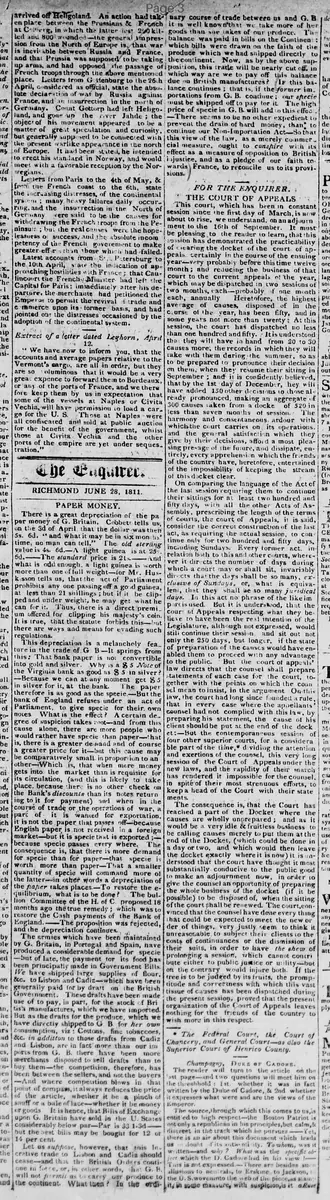
The Enquirer.
RICHMOND JUNE 28, 1811.
PAPER MONEY.
There is a great depreciation of the paper money of G. Britain. Cobbett tells us, on the 3d of April, that the dollar was then 5s. 6d. "and what it may be in six months' time, no man can tell." The old sterling value is 4s. 6d.--A light guinea is at 25. 6d.--The standard price is 21s.--and what is odd enough, a light guinea is worth more than one of full weight for Mr. Huskisson tells us, that the act of Parliament prohibits any one passing off a gold guinea, at less than 21 shillings; but if it be clipped and under weight, he may get what he can for it. Thus, there is a direct premium offered for clipping his majesty's coin. It is true, that the statute forbids this--but there are ways and means for evading such regulations.
This depreciation is a melancholy feature in the trade of G B -It springs from this: That bank paper is not convertible into gold and silver. Why is a $5 Note of the Virginia bank as good as $5 in silver? --Because we can at any moment get $5 in silver for it, at the bank. The paper therefore is as good as the specie,- But the bank of England refuses-under an act of Parliament, to give specie for their own notes. What is the effect? A certain degree of suspicion takes root-and from this cause alone, there are more people who would rather have specie than paper--that is, there is a greater demand and of course a greater price for it--but this cause may be comparatively small in proportion to another-Which is, that when more money gets into the market than is requisite for its circulation, (and this is likely to take place, because there is no other check on the Bank's discounts than its notes returning to it for payment) and when in the course of trade or the operations of war, a part of it is wanted for exportation, it is not the paper that passes off because English paper is not received in a foreign market but it is specie that is exported ;- because specie passes every where. The consequence is, that there is more demand for specie than for paper-that specie is worth, more than paper-That a smaller quantity of specie will command more of the latter--in other words a depreciation of the paper takes place.-To restore the equilibrium, what is to be done? . The bullion Committee of the H. of C. proposed 18 months ago the true remedy; which was to restore the Cash payments of the Bank of England. -The proposition was rejected, and the depreciation continues.
The armies which have been maintained by G. Britain, in Portugal and Spain, have produced a considerable demand for specie --but of late, the payment for its food has been principally made in Government Bills.
We have shipped large supplies of flour, &c. to Lisbon and Cadiz-which have been generally paid for by draft on the British Government. These drafts have been made use of to pay, in part, for the stock of British manufactures, which we have imported.
But as the drafts for the produce, which we have directly shipped to G B for her own Consumption, viz : Cottons, fine tobaccos &c. in addition to those drafts from Cadiz and Lisbon, are in fact more than our imports from G. B. there have been more merchants disposed to sell drafts than to buy them-the competition, therefore, has been between the sellers, and not the buyers --And where competition blows in that point of compass, it always reduces the price of the article, whether it be a pinch of snuff or a bale of lace--whether it be money or goods. It is hence, that Bills of Exchange upon G. Britain have sold in the U. States considerably below par--Par is 33 1-3d -- but the best bills may be bought for 12 or 14 per cent.
Let us suppose, however, that this lucrative trade to Lisbon and Cadiz should cease--and that the British Orders continue in force, or, in other words, that G. B, will not permit us to carry our produce to the continent. What then ? In the ordinary course of trade between us and G. B it is well known that we take more of her goods than she takes of our produce. The balance was paid in bills on the Continent: which bills were drawn on the faith of the produce which we had shipped directly to the continent. Now, as by the above supposition, this trade will be nearly cut off, in which way are we to pay off this balance due on British manufactures? If this balance continues : that is. if the former importations from G. B. continue: our specie must be shipped off to pay for it. The high price of specie in G. B. will add to this effect. --There seems to be no other expedient to prevent the drain of hard money, than to continue our Non-Importation Act--So that this view of the law, as a merely commercial measure, ought to conspire with its effect as a measure of opposition to British injustice, and as a pledge of our faith towards France, to reconcile us to its provisions.
RICHMOND JUNE 28, 1811.
PAPER MONEY.
There is a great depreciation of the paper money of G. Britain. Cobbett tells us, on the 3d of April, that the dollar was then 5s. 6d. "and what it may be in six months' time, no man can tell." The old sterling value is 4s. 6d.--A light guinea is at 25. 6d.--The standard price is 21s.--and what is odd enough, a light guinea is worth more than one of full weight for Mr. Huskisson tells us, that the act of Parliament prohibits any one passing off a gold guinea, at less than 21 shillings; but if it be clipped and under weight, he may get what he can for it. Thus, there is a direct premium offered for clipping his majesty's coin. It is true, that the statute forbids this--but there are ways and means for evading such regulations.
This depreciation is a melancholy feature in the trade of G B -It springs from this: That bank paper is not convertible into gold and silver. Why is a $5 Note of the Virginia bank as good as $5 in silver? --Because we can at any moment get $5 in silver for it, at the bank. The paper therefore is as good as the specie,- But the bank of England refuses-under an act of Parliament, to give specie for their own notes. What is the effect? A certain degree of suspicion takes root-and from this cause alone, there are more people who would rather have specie than paper--that is, there is a greater demand and of course a greater price for it--but this cause may be comparatively small in proportion to another-Which is, that when more money gets into the market than is requisite for its circulation, (and this is likely to take place, because there is no other check on the Bank's discounts than its notes returning to it for payment) and when in the course of trade or the operations of war, a part of it is wanted for exportation, it is not the paper that passes off because English paper is not received in a foreign market but it is specie that is exported ;- because specie passes every where. The consequence is, that there is more demand for specie than for paper-that specie is worth, more than paper-That a smaller quantity of specie will command more of the latter--in other words a depreciation of the paper takes place.-To restore the equilibrium, what is to be done? . The bullion Committee of the H. of C. proposed 18 months ago the true remedy; which was to restore the Cash payments of the Bank of England. -The proposition was rejected, and the depreciation continues.
The armies which have been maintained by G. Britain, in Portugal and Spain, have produced a considerable demand for specie --but of late, the payment for its food has been principally made in Government Bills.
We have shipped large supplies of flour, &c. to Lisbon and Cadiz-which have been generally paid for by draft on the British Government. These drafts have been made use of to pay, in part, for the stock of British manufactures, which we have imported.
But as the drafts for the produce, which we have directly shipped to G B for her own Consumption, viz : Cottons, fine tobaccos &c. in addition to those drafts from Cadiz and Lisbon, are in fact more than our imports from G. B. there have been more merchants disposed to sell drafts than to buy them-the competition, therefore, has been between the sellers, and not the buyers --And where competition blows in that point of compass, it always reduces the price of the article, whether it be a pinch of snuff or a bale of lace--whether it be money or goods. It is hence, that Bills of Exchange upon G. Britain have sold in the U. States considerably below par--Par is 33 1-3d -- but the best bills may be bought for 12 or 14 per cent.
Let us suppose, however, that this lucrative trade to Lisbon and Cadiz should cease--and that the British Orders continue in force, or, in other words, that G. B, will not permit us to carry our produce to the continent. What then ? In the ordinary course of trade between us and G. B it is well known that we take more of her goods than she takes of our produce. The balance was paid in bills on the Continent: which bills were drawn on the faith of the produce which we had shipped directly to the continent. Now, as by the above supposition, this trade will be nearly cut off, in which way are we to pay off this balance due on British manufactures? If this balance continues : that is. if the former importations from G. B. continue: our specie must be shipped off to pay for it. The high price of specie in G. B. will add to this effect. --There seems to be no other expedient to prevent the drain of hard money, than to continue our Non-Importation Act--So that this view of the law, as a merely commercial measure, ought to conspire with its effect as a measure of opposition to British injustice, and as a pledge of our faith towards France, to reconcile us to its provisions.
What sub-type of article is it?
Economic Policy
Trade Or Commerce
Foreign Affairs
What keywords are associated?
Paper Money Depreciation
Bank Of England
Specie Export
Us Trade Balance
Non Importation Act
British Orders
Exchange Rates
What entities or persons were involved?
Bank Of England
G. Britain
Cobbett
Mr. Huskisson
Bullion Committee
H. Of C.
Portugal
Spain
Lisbon
Cadiz
British Government
Virginia Bank
Editorial Details
Primary Topic
Depreciation Of British Paper Money And Implications For Us Trade
Stance / Tone
Analytical Warning Supporting Non Importation Act
Key Figures
Bank Of England
G. Britain
Cobbett
Mr. Huskisson
Bullion Committee
H. Of C.
Portugal
Spain
Lisbon
Cadiz
British Government
Virginia Bank
Key Arguments
British Paper Money Depreciates Because Not Convertible To Specie, Leading To Preference For Gold/Silver.
Depreciation Exacerbated By War Exports Requiring Specie, Not Paper.
Us Trade Via Portugal/Spain Creates Surplus Drafts, Lowering Exchange Rates Below Par.
If Indirect Trade Ceases Due To British Orders, Us Must Export Specie To Balance Imports From Britain.
Continuing Non Importation Act Prevents Specie Drain And Opposes British Injustice.