Thank you for visiting SNEWPapers!
Sign up free
The New York Journal, And Daily Patriotic Register
New York, New York County, New York
What is this article about?
Report of debates in the Boston convention on biennial versus annual elections for federal representatives. Speakers including R. Dench, Mr. Bowdoin, General Heath, Mr. Turner, Mr. Dawes, Gen. Brooks, and General Thompson argued points on election frequency, historical precedents, and security of liberties, ending with a motion to adjourn.
Merged-components note: Continuation of reporting on Boston convention debates.
Clippings
1 of 2
OCR Quality
Full Text
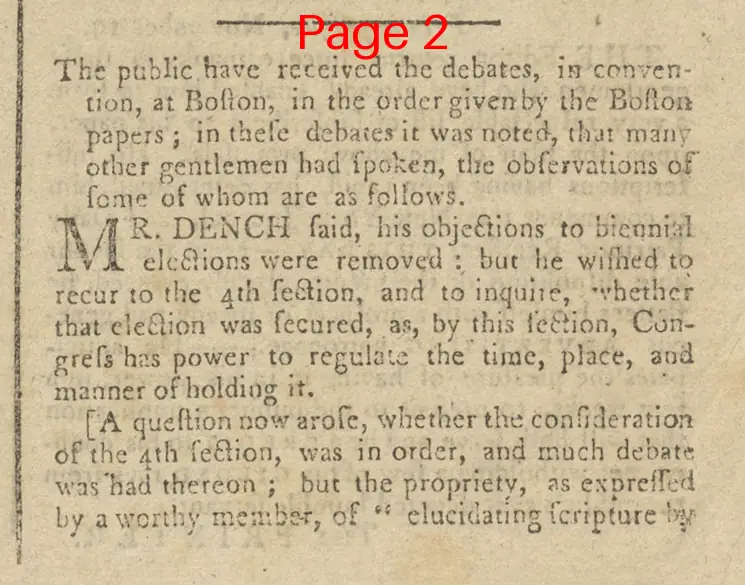
R. DENCH said, his objections to biennial elections were removed: but he wished to recur to the 4th section, and to inquire, whether that election was secured, as, by this section, Congress has power to regulate the time, place, and manner of holding it.
A question now arose, whether the consideration of the 4th section, was in order, and much debate was had thereon; but the propriety, as expressed by a worthy member, of "elucidating scripture by
Being general, admitted, the motion made by the Hon. Mr. Dana, passed, which put an end to the conversation.
The Hon. Mr. Bowdoin remarked on the idea suggested by the honourable gentleman from Scituate (Mr. Turner) who had said that nature pointed out the propriety of annual elections by its annual renewal, and observed, that if the revolution of the heavenly bodies is to be the principle to regulate elections, it was not fixed to any period; as in some of the systems it would be very short; and in the last discovered planet, it would be 80 of our years. Gentlemen, he said, who had gone before him in the debate, had clearly pointed out the alteration of the election of our federal representatives, from annual to biennial, to be justifiable. Annual elections may be necessary in this state; but in the choice of representatives for the continent, it ought to be longer; nor did he see any danger in its being so. Who, he asked, are the men to be elected? Are they not to be among us? If they were to be a distant body, then the doctrine of precaution which gentlemen use, would be necessary:--but, sir, they can make no laws, nor levy any taxes, but those to which they themselves must be subservient--they themselves must bear a part; therefore, our security is guaranteed, by their being thus subject to the laws, if nothing else.
General Heath said, he considered himself not as an inhabitant of Massachusetts, but as a citizen of the United States; and his ideas and views were commensurate with the continent; they extended in length from the St. Croix, to the St. Maria, and in breadth from the Atlantic to the lake of the woods. Having premised this, the worthy gentleman said, he should not have risen, had he not heard gentlemen speak so lightly of lengthening of elections. The opinion of all great writers on government was, that the liberties of the people have always been dependent on the duration of parliament; that that was the opinion of Montesquieu, and several other legislators: and, says he, the history of our country will shew us in what respect frequent elections have been held. It was the wisdom of our ancestors that formed the measure of annual elections, and it is sanctified by age: Therefore, sir, before we alter it, we should carefully examine, that it be for the better. It is a novel idea, said the general, that the representatives ought to have time to learn their duty; he thought they always ought to have a general knowledge of the interest of their constituents. Having mentioned a circumstance, that the British parliament have frequent occasion, before they can determine some important points, to return home to their constituents, to obtain information; and as Congress are to have but one session in a year, and may want such an opportunity to gain information, he sat down, by observing, that he was in favour of biennial elections.
The Hon. Mr. Turner, in reply to the Hon. Mr. Bowdoin, said, he thought it an important consideration, whether the elections are to be for one or for two years; he was, he said, greatly in favour of annual elections, and he thought, in the present instance, it would be establishing a dangerous precedent to adopt a change: for, says he, the principle may so operate, as in time, our elections will be as seldom as the revolution of the star the honourable gentleman talks of.
Mr. Dawes, in answer to general Heath, said, that the passage quoted from Montesquieu, applied to single governments, and not to confederate ones.
Gen. Brooks (of Medford) in reply to general Heath, said, he recollected the passage of Montesquieu; but he also recollected, that that writer had spoken highly of the British government. He then adverted to the objection to this section, of general Thompson, and others, that biennial elections were a novelty, and said we were not to consider whether a measure was new, but whether it was proper. Gentlemen had said, that it had been the established custom of this country to elect annually: but he asked, have we not gone from a colonial to an independent situation? We were then provinces, we are now an independent empire; our measures, therefore, says he, must change with our situation. Under our old government, the objects of legislation were few and divided; under our present, they are many and must be united; and it appears necessary, that according to the magnitude and multiplicity of the business, the duration should be extended; he did not, he said, undertake to say how far. He then went into a view of the history of parliaments. The modern northern nations, he said, had parliaments, but they were called by their kings; and the time, business, &c. of them, depended wholly on their wills. We can, therefore, says he, establish nothing from these; one general remark, was, that in the reigns of weak princes, the power and importance of parliaments increased; in the reigns of strong and arbitrary kings, they always declined: and, says he, they have been triennial, and they have been septennial. The general combated the idea, that the liberties of the people depended on the duration of parliament, with much ability. Do we hear, asked he, that the people of England are deprived of their liberties; or that they are not as free now as when they had short parliaments? On the contrary, do not writers agree, that life, liberty, and property, are no where better secured than in Great-Britain; and that this security arises from their parliaments being chosen for seven years. As such is the situation of the people of England, and as no instance can be given wherein biennial elections have been destructive to the liberties of the people, he concluded by asking, whether so much danger is to be apprehended from such elections as gentlemen imagined?
General Thompson. Sir, gentlemen have said a great deal about the history of old times; I confess, I am not acquainted with such history; but I am, sir, acquainted with the history of my own country. I had the honor to be in the court last year; and am in it this year. I think, sir, that had the last administration continued one year longer, our liberties would have been lost, and the country involved in blood. Not so much, sir, from their bad conduct, but from those suspicions of the people of them. But, sir, a change took place, from this change pardons have been granted to the people, and peace is restored. This, sir, I say, is in favour of frequent elections.
General T. was called to order, on the idea that he reflected on the last administration, a debate ensued, which ended on the Hon. Mr. White's saying, he wished to put out every spark of the fire that appeared to be kindling; therefore moved to adjourn.
What sub-type of article is it?
What keywords are associated?
What entities or persons were involved?
Where did it happen?
Domestic News Details
Primary Location
Boston
Key Persons
Outcome
debate ended with motion to adjourn after general thompson called to order.
Event Details
Debates in the Boston convention on the 4th section regarding biennial elections for federal representatives. Speakers discussed objections, historical precedents from Montesquieu and British parliament, annual vs. biennial terms, and security of liberties, with arguments both for and against the change.