Thank you for visiting SNEWPapers!
Sign up free
Alexandria Daily Gazette, Commercial & Political
Alexandria, Virginia
What is this article about?
US diplomatic documents including Secretary R. Smith's 1810 instructions to Minister Pinkney on French decree repeal, British orders, non-intercourse revival, impressment, and Chesapeake atonement; plus 1799-1800 extracts from King and Marshall on British blockades of Dutch ports and neutral rights violations.
Clipping
OCR Quality
Full Text
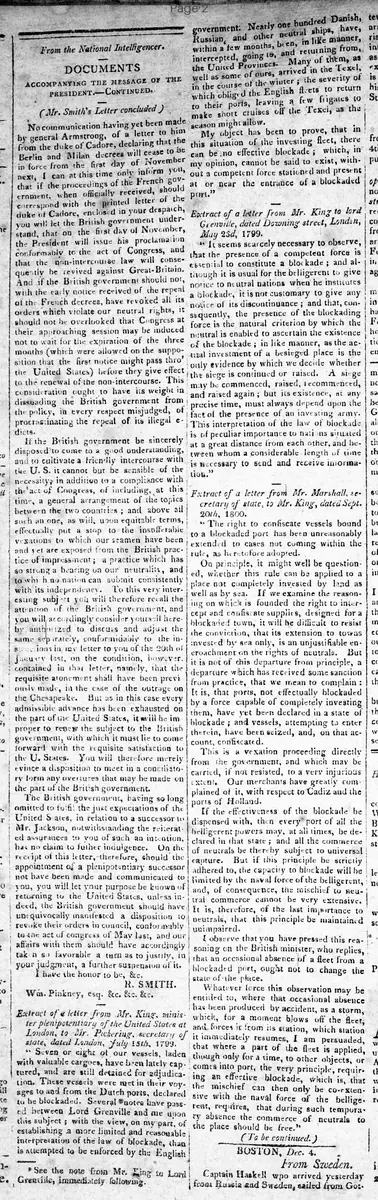
DOCUMENTS
ACCOMPANYING THE MESSAGE OF
THE PRESIDENT. CONTINUED
Mr. Smith's Letter concluded
by general Armstrong, of a letter to him
No communication having yet been made
from the duke of Cadore, declaring that the
Berlin and Milan decrees will cease to be
in force from the first day of November
next, I can at this time only inform you,
that if the proceedings of the French gov-
ernment, when officially received, should
correspond with the printed letter of the
duke of Cadore, enclosed in your despatch,
you will let the British government under-
stand, that on the first day of November,
the President will issue his proclamation
conformably to the act of Congress, and
that the non-intercourse law will conse-
quently be revived against Great-Britain.
And if the British government should not,
with the early notice received of the repeal
of the French decrees, have revoked all its
orders which violate our neutral rights, it
should not be overlooked that Congress at
their approaching session may be induced
not to wait for the expiration of the three
months (which were allowed on the suppo-
sition that the first notice might pass thro'
the United States) before they give effect
to the renewal of the non-intercourse. This
consid-eration ought to have its weight in
dissuading the British government from
the policy, in every respect misjudged, of
procrastinating the repeal of its illegal e-
dicts.
If the British government be sincerely
disposed to come to a good understanding,
and to cultivate a friendly intercourse with
the U.S. it cannot but be sensible of the
necessity, in addition to a compliance with
the act of Congress, of including, at this
time, a general arrangement of the topics
between the two countries ; and above all
such an one, as will, upon equitable terms,
effectually put a stop to the insufferable
vexations to which our seamen have been
and yet are exposed from the British prac-
tice of impressment; a practice which has
so strong a bearing on our neutrality, and
to which no nation can submit consistently
with its independence. To this very inter-
esting subject you will therefore recall the
attention of the British government, and
you will accordingly consider yourself here-
by authorized to discuss and adjust the
same separately, conformably to the in-
structions in my letter to you of the 20th of
January last, on the condition, however,
contained in that letter, namely, that the
requisite atonement shall have been previ-
ously made, in the case of the outrage on
the Chesapeake. But as in this case every
admissible advance has been exhausted on
the part of the United States, it will be im-
proper to renew the subject to the British
government, with which it must lie to come
forward with the requisite satisfaction to
the U. States. You will therefore merely
evince a disposition to meet in a concilia-
tory form any overtures that may be made on
the part of the British government.
The British government, having so long
omitted to fulfil the just expectations of the
United States, in relation to a successor to
Mr. Jackson, notwithstanding the reiterat-
ed assurances to you of such an intention,
has no claim to further indulgence. On the
receipt of this letter, therefore, should the
appointment of a plenipotentiary successor
not have been made and communicated to
you, you will let your purpose be known of
returning to the United States, unless in-
deed, the British government should have
unequivocally manifested a disposition to
revoke their orders in council, conformably
to the act of congress of May last, and our
affairs with them should have accordingly
taken so favorable a turn as to justify, in
your judgment, a further suspension of it.
I have the honor to be, &c.
R. SMITH.
Wm. Pinkney, esq. &c. &c. &c.
Extract of a letter from Mr. King, minis-
ter plenipotentiary of the United States at
London, to Mr. Pickering, secretary of
state, dated London, July 15th, 1799.
"Seven or eight of our vessels, laden
with valuable cargoes, have been lately cap-
tured, and are still detained for adjudica-
tion. These vessels were met in their voy-
ages to and from the Dutch ports, declared
to be blockaded. Several notes have pass-
ed between Lord Grenville and me upon
this subject; with the view, on my part, of
establishing a more limited and reasonable
interpretation of the law of blockade, than
is attempted to be enforced by the English
government: Nearly one hundred Danish,
Russian, and other neutral ships, have,
intercepted, going to, and returning from,
within a few months, been, in like manner,
the United Provinces. Many of them, as
well as some of ours, arrived in the Texel,
which obliged the English fleet to return
in the course of the winter; the severity of
can be no effective blockade; which, in
this situation of the investing fleet, there
My object has been to prove, that in
my opinion, cannot be said to exist, with-
out a competent force stationed and present
at or near the entrance of a blockaded
port."
Extract of a letter from Mr. King to lord
Grenville, dated Downing street, London,
May 23d, 1799.
"It seems scarcely necessary to observe,
that the presence of a competent force is
essential to constitute a blockade; and al-
though it is usual for the belligerent to give
notice to neutral nations when he institutes
a blockade, it is not customary to give any
notice of its discontinuance; and that, con-
sequently, the presence of the blockading
force is the natural criterion by which the
neutral is enabled to ascertain the existence
of the blockade: in like manner, as the ac-
tual investment of a besieged place is the
only evidence by which we decide whether
the siege is continued or raised. A siege
may be commenced, raised, recommenced,
and raised again; but its existence, at any
precise time, must always depend upon the
fact of the presence of an investing army.
This interpretation of the law of blockade
is of peculiar importance to nations situated
at a great distance from each other, and be-
tween whom a considerable length of time
is necessary to send and receive informa-
tion."
Extract of a letter from Mr. Marshall, se-
cretary of state, to Mr. King, dated Sept.
20th, 1800.
"The right to confiscate vessels bound
to a blockaded port has been unreasonably
extended to cases not coming within the
rule, as heretofore adopted.
On principle, it might well be question-
ed, whether this rule can be applied to a
place not completely invested by land as
well as by sea. If we examine the reason-
ing on which is founded the right to inter-
cept and confiscate supplies, designed for a
blockaded town, it will be difficult to resist
the conviction, that its extension to towns
invested by sea only, is an unjustifiable en-
croachment on the rights of neutrals. But
it is not of this departure from principle, a
departure which has received some sanction
from practice, that we mean to complain:
It is, that ports, not effectively blockaded
by a force capable of completely investing
them, have yet been declared in a state of
blockade: and vessels, attempting to enter
therein, have been seized, and, on that ac-
count, confiscated.
This is a vexation proceeding directly
from the government, and which may be
carried, if not resisted, to a very injurious
extent. Our merchants have greatly com-
plained of it, with respect to Cadiz and the
ports of Holland.
If the effectiveness of the blockade be
dispensed with, then every port of all the
belligerent powers may, at all times, be de-
clared in that state; and all the commerce
of neutrals be thereby subject to universal
capture. But if this principle be strictly
adhered to, the capacity to blockade will be
limited by the naval force of the belligerent,
and, of consequence, the mischief to neu-
tral commerce cannot be very extensive.
It is, therefore, of the last importance to
neutrals, that this principle be maintained
unimpaired.
I observe that you have pressed this rea-
soning on the British minister, who replies,
that an occasional absence of a fleet from a
blockaded port, ought not to change the
state of the place.
Whatever force this observation may be
entitled to, where that occasional absence
has been produced by accident, as a storm,
which, for a moment blows off the fleet,
and forces it from its station, which station
it immediately resumes, I am persuaded.
that where a part of the fleet is applied,
though only for a time, to other objects, or
comes into port, the very principle, requir-
ing an effective blockade, which is, that
the mischief can then only be co-exten-
sive with the naval force of the bellige-
rent, requires, that during such tempora-
ry absence the commerce of neutrals to
the place should be free."
(To be continued.)
What sub-type of article is it?
What keywords are associated?
What entities or persons were involved?
Where did it happen?
Foreign News Details
Primary Location
London
Event Date
July 15th, 1799; May 23d, 1799; Sept. 20th, 1800
Key Persons
Outcome
captured us vessels detained; instructions for proclamation reviving non-intercourse against britain if orders not revoked; discussions on effective blockade requirements for neutral rights.
Event Details
US Secretary R. Smith instructs Minister Pinkney on responding to French repeal of Berlin and Milan decrees by November next, warning Britain of non-intercourse revival and urging revocation of orders in council, addressing impressment and Chesapeake incident. Extracts from 1799-1800 correspondence detail US protests against British blockades of Dutch ports, captured neutral vessels, and arguments for requiring competent force presence for valid blockades to protect neutral commerce.