Thank you for visiting SNEWPapers!
Sign up free
Story
February 9, 1941
Atlanta Daily World
Atlanta, Fulton County, Georgia
What is this article about?
Alfred Edgar Smith of the Federal Work Projects Administration recommends over 20 books and reports from the WPA's Federal Writers' Project for Negro History Week (Feb 9-16), emphasizing Negro achievements, especially military service in U.S. wars, and listing key publications on Black history and culture.
Clipping
OCR Quality
95%
Excellent
Full Text
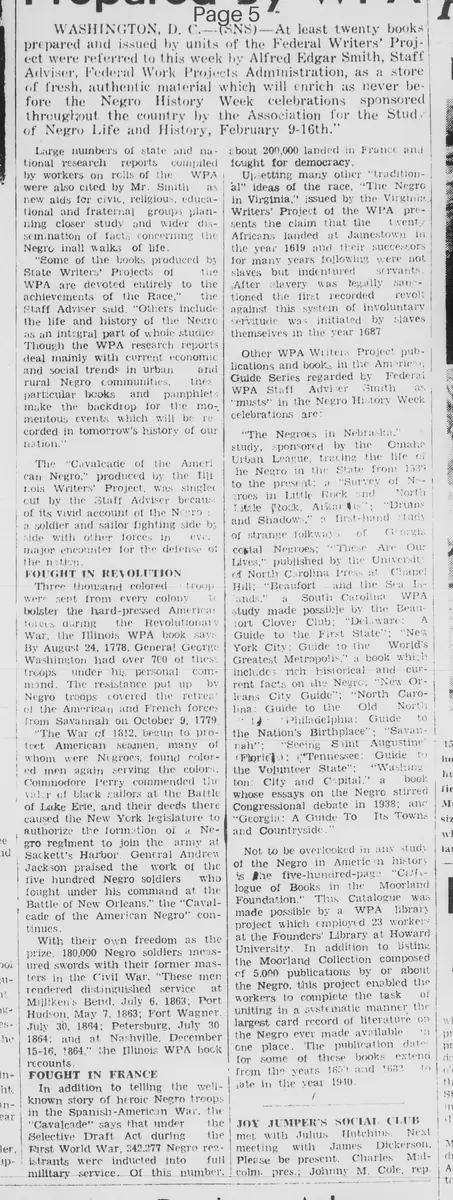
WASHINGTON, D. C.--(SNS)--At least twenty books prepared and issued by units of the Federal Writers' Project were referred to this week by Alfred Edgar Smith, Staff Adviser, Federal Work Projects Administration, as a store of fresh, authentic material which will enrich as never before the Negro History Week celebrations sponsored throughout the country by the Association for the Study of Negro Life and History, February 9-16th.
Large numbers of state and national research reports compiled by workers on rolls of the WPA were also cited by Mr. Smith as new aids for civic, religious, educational and fraternal groups planning closer study and wider dissemination of facts concerning the Negro in all walks of life.
"Some of the books produced by State Writers' Projects of the WPA are devoted entirely to the achievements of the Race," the Staff Adviser said. "Others include the life and history of the Negro as an integral part of whole studies.
Though the WPA research reports deal mainly with current economic and social trends in urban and rural Negro communities, these particular books and pamphlets make the background for the momentous events which will be recorded in tomorrow's history of our nation."
The "Cavalcade of the American Negro," produced by the Illinois Writers' Project, was singled out by the Staff Adviser because of its vivid account of the Negro as a soldier and sailor fighting side by side with other forces in every major encounter for the defense of the nation.
FOUGHT IN REVOLUTION
Three thousand colored soldiers were sent from every colony to bolster the hard-pressed American troops during the Revolutionary War, the Illinois WPA book says:
By August 24, 1778, General George Washington had over 700 of these troops under his personal command. The resistance put up by Negro troops covered the retreat of the American and French forces from Savannah on October 9, 1779.
"The War of 1812, begun to protect American seamen, many of whom were Negroes, found colored men again serving the colors. Commodore Perry commended the valor of black sailors at the Battle of Lake Erie, and their deeds there caused the New York legislature to authorize the formation of a Negro regiment to join the army at Sackett's Harbor. General Andrew Jackson praised the work of the five hundred Negro soldiers who fought under his command at the Battle of New Orleans," the "Cavalcade of the American Negro" continues.
With their own freedom as the prize, 180,000 Negro soldiers measured swords with their former masters in the Civil War. "These men rendered distinguished service at Milliken's Bend, July 6, 1863; Port Hudson, May 7, 1863; Fort Wagner, July 30, 1864; Petersburg, July 30 1864; and at Nashville, December 15-16, 1864," the Illinois WPA book recounts.
FOUGHT IN FRANCE
In addition to telling the well-known story of heroic Negro troops in the Spanish-American War, the "Cavalcade" says that under the Selective Draft Act during the First World War, 342,277 Negro registrants were inducted into full military service. Of this number, about 200,000 landed in France and fought for democracy.
Upending many other "traditional" ideas of the race, "The Negro in Virginia," issued by the Virginia Writers' Project of the WPA, presents the claim that the twenty Africans landed at Jamestown in the year 1619 and their successors for many years following were not slaves but indentured servants. After slavery was legally sanctioned the first recorded revolt against this system of involuntary servitude was initiated by slaves themselves in the year 1687.
Other WPA Writers' Project publications and books in the American Guide Series regarded by Federal WPA Staff Adviser Smith as 'musts' in the Negro History Week celebrations are:
"The Negroes in Nebraska," study, sponsored by the Omaha Urban League, tracing the life of the Negro in the State from 1533 to the present; a "Survey of Negroes in Little Rock and North Little Rock, Arkansas"; "Drums and Shadows," a first-hand study of strange folkways of Georgia coastal Negroes; "These Are Our Lives," published by the University of North Carolina Press at Chapel Hill; "Beaufort and the Sea Islands," a South Carolina WPA study made possible by the Beaufort Clover Club; "Delaware: A Guide to the First State"; "New York City: Guide to the World's Greatest Metropolis," a book which includes rich historical and current facts on the Negro; "New Orleans City Guide"; "North Carolina: Guide to the Old North State"; "Philadelphia: Guide to the Nation's Birthplace"; "Savannah"; "Seeing St. Augustine (Florida)"; "Tennessee: Guide to the Volunteer State"; "Washington, City and Capital," a book whose essays on the Negro stirred Congressional debate in 1938; and "Georgia: A Guide To Its Towns and Countryside."
Not to be overlooked in any study of the Negro in American history is the five-hundred-page "Catalogue of Books in the Moorland Foundation." This Catalogue was made possible by a WPA library project which employed 23 workers at the Founders' Library at Howard University. In addition to listing the Moorland Collection composed of 5,000 publications by or about the Negro, this project enabled the workers to complete the task of uniting in a systematic manner the largest card record of literature on the Negro ever made available in one place. The publication date for some of these books extend from the years 1650 and 1639 to late in the year 1940.
Large numbers of state and national research reports compiled by workers on rolls of the WPA were also cited by Mr. Smith as new aids for civic, religious, educational and fraternal groups planning closer study and wider dissemination of facts concerning the Negro in all walks of life.
"Some of the books produced by State Writers' Projects of the WPA are devoted entirely to the achievements of the Race," the Staff Adviser said. "Others include the life and history of the Negro as an integral part of whole studies.
Though the WPA research reports deal mainly with current economic and social trends in urban and rural Negro communities, these particular books and pamphlets make the background for the momentous events which will be recorded in tomorrow's history of our nation."
The "Cavalcade of the American Negro," produced by the Illinois Writers' Project, was singled out by the Staff Adviser because of its vivid account of the Negro as a soldier and sailor fighting side by side with other forces in every major encounter for the defense of the nation.
FOUGHT IN REVOLUTION
Three thousand colored soldiers were sent from every colony to bolster the hard-pressed American troops during the Revolutionary War, the Illinois WPA book says:
By August 24, 1778, General George Washington had over 700 of these troops under his personal command. The resistance put up by Negro troops covered the retreat of the American and French forces from Savannah on October 9, 1779.
"The War of 1812, begun to protect American seamen, many of whom were Negroes, found colored men again serving the colors. Commodore Perry commended the valor of black sailors at the Battle of Lake Erie, and their deeds there caused the New York legislature to authorize the formation of a Negro regiment to join the army at Sackett's Harbor. General Andrew Jackson praised the work of the five hundred Negro soldiers who fought under his command at the Battle of New Orleans," the "Cavalcade of the American Negro" continues.
With their own freedom as the prize, 180,000 Negro soldiers measured swords with their former masters in the Civil War. "These men rendered distinguished service at Milliken's Bend, July 6, 1863; Port Hudson, May 7, 1863; Fort Wagner, July 30, 1864; Petersburg, July 30 1864; and at Nashville, December 15-16, 1864," the Illinois WPA book recounts.
FOUGHT IN FRANCE
In addition to telling the well-known story of heroic Negro troops in the Spanish-American War, the "Cavalcade" says that under the Selective Draft Act during the First World War, 342,277 Negro registrants were inducted into full military service. Of this number, about 200,000 landed in France and fought for democracy.
Upending many other "traditional" ideas of the race, "The Negro in Virginia," issued by the Virginia Writers' Project of the WPA, presents the claim that the twenty Africans landed at Jamestown in the year 1619 and their successors for many years following were not slaves but indentured servants. After slavery was legally sanctioned the first recorded revolt against this system of involuntary servitude was initiated by slaves themselves in the year 1687.
Other WPA Writers' Project publications and books in the American Guide Series regarded by Federal WPA Staff Adviser Smith as 'musts' in the Negro History Week celebrations are:
"The Negroes in Nebraska," study, sponsored by the Omaha Urban League, tracing the life of the Negro in the State from 1533 to the present; a "Survey of Negroes in Little Rock and North Little Rock, Arkansas"; "Drums and Shadows," a first-hand study of strange folkways of Georgia coastal Negroes; "These Are Our Lives," published by the University of North Carolina Press at Chapel Hill; "Beaufort and the Sea Islands," a South Carolina WPA study made possible by the Beaufort Clover Club; "Delaware: A Guide to the First State"; "New York City: Guide to the World's Greatest Metropolis," a book which includes rich historical and current facts on the Negro; "New Orleans City Guide"; "North Carolina: Guide to the Old North State"; "Philadelphia: Guide to the Nation's Birthplace"; "Savannah"; "Seeing St. Augustine (Florida)"; "Tennessee: Guide to the Volunteer State"; "Washington, City and Capital," a book whose essays on the Negro stirred Congressional debate in 1938; and "Georgia: A Guide To Its Towns and Countryside."
Not to be overlooked in any study of the Negro in American history is the five-hundred-page "Catalogue of Books in the Moorland Foundation." This Catalogue was made possible by a WPA library project which employed 23 workers at the Founders' Library at Howard University. In addition to listing the Moorland Collection composed of 5,000 publications by or about the Negro, this project enabled the workers to complete the task of uniting in a systematic manner the largest card record of literature on the Negro ever made available in one place. The publication date for some of these books extend from the years 1650 and 1639 to late in the year 1940.
What sub-type of article is it?
Historical Event
What themes does it cover?
Triumph
Bravery Heroism
Justice
What keywords are associated?
Negro History Week
Wpa Writers Project
Black Soldiers
American Wars
Historical Publications
What entities or persons were involved?
Alfred Edgar Smith
George Washington
Commodore Perry
Andrew Jackson
Where did it happen?
Washington, D. C.
Story Details
Key Persons
Alfred Edgar Smith
George Washington
Commodore Perry
Andrew Jackson
Location
Washington, D. C.
Event Date
February 9 16
Story Details
Alfred Edgar Smith promotes over 20 WPA Federal Writers' Project books and reports as resources for Negro History Week, highlighting Negro military contributions in American wars from the Revolution to World War I, and listing publications on Negro history and culture.