Thank you for visiting SNEWPapers!
Sign up free
The Virginia Gazette
Richmond, Williamsburg, Richmond County, Virginia
What is this article about?
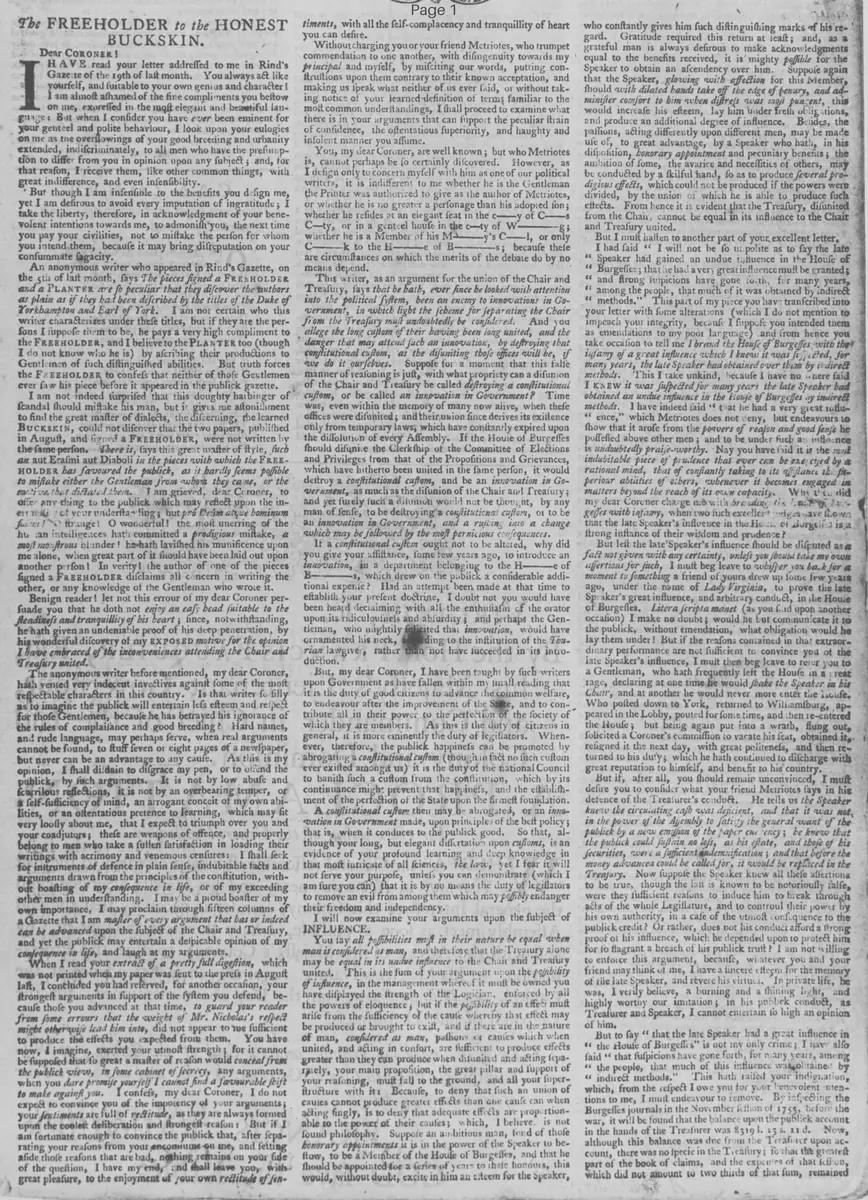
In this 1766 letter, 'A Freeholder' responds to 'Honest Buckskin' (a coroner), defending his opposition to uniting the Speaker's Chair and Treasury in Virginia's House of Burgesses. He argues it enables undue influence, refutes claims of innovation, cites historical suspicions of financial mismanagement by the late Speaker, and critiques opponents' reasoning.
Merged-components note: This is a continuation of the same letter to the editor across pages 1 and 2, as the text flows directly from the end of the first component to the start of the second.
Clippings
1 of 2
OCR Quality
Full Text
Dear Coroner!
I HAVE read your letter addressed to me in Rind's Gazette of the 19th of last month. You always act like yourself, and suitable to your own genius and character!
I am almost ashamed of the fine compliments you bestow on me, expressed in the most elegant and beautiful language: But when I consider you have ever been eminent for your genteel and polite behaviour, I look upon your eulogies on me as the overflowings of your good breeding and urbanity extended, indiscriminately, to all men who have the presumption to differ from you in opinion upon any subject; and, for that reason, I receive them, like other common things, with great indifference, and even insensibility.
But though I am insensible to the benefits you deign me, yet I am desirous to avoid every imputation of ingratitude; I take the liberty, therefore, in acknowledgment of your benevolent intentions towards me, to admonish you, the next time you pay your civilities, not to mistake the person for whom you intend them, because it may bring disreputation on your consummate sagacity.
An anonymous writer who appeared in Rind's Gazette, on the 5th of last month, says The pieces signed a FREEHOLDER and a PLANTER are so peculiar that they discover the authors as plain as if they had been described by the titles of the Duke of Buckingham and Earl of York. I am not certain who this writer characterizes under these titles, but if they are the persons I suppose them to be, he pays a very high compliment to the FREEHOLDER, and I believe to the PLANTER too (though I do not know who he is) by ascribing their productions to Gentlemen of such distinguished abilities. But truth forces the FREEHOLDER to confess that neither of those Gentlemen ever saw his piece before it appeared in the publick gazette.
I am not indeed surprised that this doughty harbinger of scandal should mistake his man, but it gives me astonishment to find the great master of dialects, the discerning, the learned Buckskin, could not discover that the two papers, published in August, and signed a FREEHOLDER, were not written by the same person. -There is, says this great master of style, such an aut Erasmus aut Diaboli in the pieces with which the FREEHOLDER has favoured the publick, as it hardly seems possible to mistake either the Gentleman from whom they came, or the motive that dictated them. I am grieved, dear Coroner, to offer any thing to the publick which may reflect upon the ingenuity of your undertaking; but pro Deum atque hominum verum mirunge! O wonderful! the most unerring of the human intelligences hath committed a prodigious mistake, a most monstrous blunder! he hath lavished his munificence upon me alone, when great part of it should have been laid out upon another person! In verity! the author of one of the pieces signed a FREEHOLDER disclaims all concern in writing the other, or any knowledge of the Gentleman who wrote it.
Benign reader! let not this error of my dear Coroner persuade you that he doth not enjoy an easy head suitable to the readiness and tranquillity of his heart; since, notwithstanding, he hath given an undeniable proof of his deep penetration, by his wonderful discovery of my exposed motive for the opinion I have embraced of the inconveniences attending the Chair and Treasury united.
The anonymous writer before mentioned, my dear Coroner, hath vented very indecent invectives against some of the most respectable characters in this country. Is that writer so silly as to imagine the publick will entertain less esteem and respect for those Gentlemen, because he has betrayed his ignorance of the rules of complaisance and good breeding? Hard names, and rude language, may perhaps serve, when real arguments cannot be found, to stuff seven or eight pages of a newspaper, but never can be an advantage to any cause. As this is my opinion, I shall disdain to disgrace my pen, or to offend the publick, by such arguments. It is not by low abuse and scurrilous reflections, it is not by an overbearing temper, or a self-sufficiency of mind, an arrogant conceit of my own abilities, or an ostentatious pretence to learning, which may strut very loosely about me, that I expect to triumph over you and your coadjutors; these are weapons of offence, and properly belong to men who take a sullen satisfaction in loading their writings with acrimony and venomous censures: I shall seek for instruments of defence in plain, true, indubitable facts and arguments drawn from the principles of the constitution, without boasting of my consequence in life, or of my exceeding other men in understanding. I may be a proud boaster of my own importance, I may proclaim through fifteen columns of a Gazette that I am master of every argument that has or indeed can be advanced upon the Subject of the Chair and Treasury, and yet the publick may entertain a despicable opinion of my consequence in life, and laugh at my arguments.
When I read your extract of a pretty full digestion, which was not printed when my paper was sent to the press in August last, I concluded you had reserved, for another occasion, your strongest arguments in support of the system you defend, because those you advanced at that time, to guard your reader from some errors that the weight of Mr. Nicholas's respect might otherwise lead him into, did not appear to me sufficient to produce the effects you expected from them. You have now, I imagine, exerted your utmost strength; for it cannot be supposed that so great a master of reason would conceal from the publick, in some cabinet of secrecy, any arguments, when you dare promise yourself I cannot find a favourable shift to make against you. I confess, my dear Coroner, I do not expect to convince you of the impotency of your arguments; your sentiments are full of rectitude, as they are always formed upon the coolest deliberation and strongest reason: But if I am fortunate enough to convince the publick that, after separating your reasons from your encomiums on me, and setting aside those reasons that are bad, nothing remains on your side of the question, I have my end, and shall leave you, with great pleasure, to the enjoyment of your own rectitude of sentiments, with all the self-complacency and tranquillity of heart you can desire.
Without charging you or your friend Metriotes, who trumpet commendation to one another, with disingenuity towards my principal and myself, by misquoting our words, putting constructions upon them contrary to their known acceptation, and making us speak what neither of us ever said, or without taking notice of your learned definition of terms familiar to the most common understandings, I shall proceed to examine what there is in your arguments that can support the peculiar strain of confidence, the ostentatious superiority, and haughty and insolent manner you assume.
You, my dear Coroner, are well known; but who Metriotes is, cannot perhaps be so certainly discovered. However, as I design only to concern myself with him as one of our political writers, it is indifferent to me whether he is the Gentleman the Printer was authorized to give as the author of Metriotes, or whether he is no greater a personage than his adopted son; whether he resides at an elegant seat in the c--y of C-s C-ty, or in a genteel house in the cty of W g; whether he is a Member of his M -y's C-l, or only c —k to the H-- e of B- s; because these are circumstances on which the merits of the debate do by no means depend.
This writer, as an argument for the union of the Chair and Treasury, says that he hath, ever since he looked with attention into the political System, been an enemy to innovations in Government, in which light the scheme for separating the Chair from the Treasury must undoubtedly be considered. And you allege the long custom of their having been long united, and the danger that may attend such an innovation, by destroying that constitutional custom, as the disuniting those offices will be, if we do it ourselves. Suppose for a moment that this false manner of reasoning is just, with what propriety can a disunion of the Chair and Treasury be called destroying a constitutional custom, or be called an innovation in Government? Time was, even within the memory of many now alive, when these offices were disunited; and their union since derives its existence only from temporary laws, which have constantly expired upon the dissolution of every Assembly. If the House of Burgesses should disunite the Clerkship of the Committee of Elections and Privileges from that of the Propositions and Grievances, which have hitherto been united in the same person, it would destroy a constitutional custom, and be an innovation in Government, as much as the disunion of the Chair and Treasury; and yet surely such a disunion would not be thought, by any man of sense, to be destroying a constitutional custom, or to be an innovation in Government, and a rushing into a change which may be followed by the most pernicious consequences.
If a constitutional custom ought not to be altered, why did you give your assistance, some few years ago, to introduce an innovation, in a department belonging to the H--e of B S, which drew on the publick a considerable additional expense? Had an attempt been made at that time to establish your present doctrine, I doubt not you would have been heard declaiming with all the enthusiasm of the orator upon its ridiculousness and absurdity; and perhaps the Gentleman, who mightily solicited that innovation, would have ornamented his neck, hanging to the institution of the Thurian lawgiver, rather than not have succeeded in its introduction.
But, my dear Coroner, I have been taught by such writers upon Government as have fallen within my small reading that it is the duty of good citizens to advance the common welfare, to endeavour after the improvement of the State, and to contribute all in their power to the perfection of the society of which they are members. As this is the duty of citizens in general, it is more eminently the duty of legislators. Whenever, therefore, the publick happiness can be promoted by abrogating a constitutional custom (though in fact no such custom ever existed amongst us) it is the duty of the national Council to banish such a custom from the constitution, which by its continuance might prevent that happiness, and the establishment of the perfection of the State upon the firmest foundation.
A constitutional custom then may be abrogated, or an innovation in Government made, upon principles of the best policy; that is, when it conduces to the publick good. So that, although your long, but elegant dissertation upon customs, is an evidence of your profound learning and deep knowledge in that most intricate of all sciences, the law, yet I fear it will not serve your purpose, unless you can demonstrate (which I am sure you can) that it is by no means the duty of legislators to remove an evil from among them which may possibly endanger their freedom and independency.
I will now examine your arguments upon the subject of INFLUENCE.
You lay all possibilities must in their nature be equal when man is considered as man, and therefore that the Treasury alone may be equal in its undue influence to the Chair and Treasury united. This is the sum of your argument upon the possibility of influence, in the management whereof it must be owned you have displayed the strength of the Logician, enforced by all the powers of eloquence; but if the possibility of an effect must arise from the sufficiency of the cause whereby that effect may be produced or brought to exist, and if there are in the nature of man, considered as man, passions or causes which when united, and acting in concert, are sufficient to produce effects greater than they can produce when disunited and acting separately, your main proposition, the great pillar and support of your reasoning, must fall to the ground, and all your superstructure with it: Because, to deny that such an union of causes cannot produce greater effects than one cause can when acting singly, is to deny that adequate effects are proportionable to the power of their causes; which, I believe, is not found philosophy. Suppose an ambitious man, fond of those honorary appointments it is in the power of the Speaker to bestow, to be a Member of the House of Burgesses, and that he should be appointed for a series of years to these honours, this would, without doubt, excite in him an esteem for the Speaker, who constantly gives him such distinguishing marks of his regard. Gratitude required this return at least; and, as a grateful man is always desirous to make acknowledgments equal to the benefits received, it is mighty possible for the Speaker to obtain an ascendency over him. Suppose again that the Speaker, glowing with affection for this Member, should with dilated hands take off the edge of penury, and administer comfort to him when distress was most pungent, this would increase his esteem, lay him under fresh obligations, and produce an additional degree of influence. Besides, the passions, acting differently upon different men, may be made use of, to great advantage, by a Speaker who hath, in his disposition, honorary appointment and pecuniary benefits; the ambition of some, the avarice and necessities of others, may be conducted by a skilful hand, so as to produce several prodigious effects, which could not be produced if the powers were divided, by the union of which he is able to produce such effects. From hence it is evident that the Treasury, disunited from the Chair, cannot be equal in its influence to the Chair and Treasury united.
But I must hasten to another part of your excellent letter. I had said I will not be so uncivil as to say the late Speaker had gained an undue influence in the House of Burgesses; that he had a very great influence must be granted; and strong suspicions have gone forth, for many years, among the people, that much of it was obtained by indirect methods. This part of my piece you have transcribed into your letter with some alterations (which I do not mention to impeach your integrity, because I suppose you intended them as emendations to my poor language) and from hence you take occasion to tell me I brand the House of Burgesses with the infamy of a great influence which I knew it was hated, for many years, the late Speaker had obtained over them by indirect methods. This I take unkind, because I have nowhere said I knew it was suspected for many years the late Speaker had obtained an undue influence in the House of Burgesses by indirect methods. I have indeed said that he had a very great influence, which Metriotes does not deny, but endeavours to show that it arose from the powers of reason and good sense he possessed above other men; and to be under such an influence is undoubtedly praiseworthy. Nay you have said it is the most indubitable piece of prudence that ever can be exercised by a rational mind, that of constantly taking to its assistance the superior abilities of others, whenever it becomes engaged in matters beyond the reach of its own capacity. Why then did my dear Coroner charge me with branding the House of Burgesses with infamy, when two such excellent judges have shown that the late Speaker's influence in the House of Burgesses is a strong instance of their wisdom and prudence?
But lest the late Speaker's influence should be disputed as a fact not given with any certainty, unless you should take my own assertions for such, I must beg leave to whisper you back for a moment to something a friend of yours drew up some few years ago, under the name of Lady Virginia, to prove the late Speaker's great influence, and arbitrary conduct, in the House of Burgesses. Litera scripta manet (as you said upon another occasion) I make no doubt; would he but communicate it to the publick, without emendation, what obligation would he lay them under! But if the reasons contained in that extraordinary performance are not sufficient to convince you of the late Speaker's influence, I must then beg leave to refer you to a Gentleman, who hath frequently left the House in a great rage, declaring at one time he would take the Speaker in his Chair, and at another he would never more enter the House. Who posted down to York, returned to Williamsburg, appeared in the Lobby, pouted for some time, and then re-entered the House; but being again put into a wrath, flung out, solicited a Coroner's commission to vacate his seat, obtained it, resigned it the next day, with great politeness, and then returned to his duty; which he hath continued to discharge with great reputation to himself, and benefit to his country.
But if, after all, you should remain unconvinced, I must desire you to consider what your friend Metriotes says in his defence of the Treasurer's conduct. He tells us the Speaker knew the circulating cash was deficient, and that it was not in the power of the Assembly to satisfy the general want of the publick by a new emission of the paper currency; he knew that the publick could sustain no loss, as his estate, and those of his securities, were a sufficient indemnification; and that before the money advanced could be called for, it would be replaced in the Treasury. Now suppose the Speaker knew all these assertions to be true, though the last is known to be notoriously false, were they sufficient reasons to induce him to break through acts of the whole Legislature, and to controul their power by his own authority, in a case of the utmost consequence to the publick credit? Or rather, does not his conduct afford a strong proof of his influence, which he depended upon to protect him for so flagrant a breach of his publick trust? I am not willing to enforce this argument, because, whatever you and your friend may think of me, I have a sincere esteem for the memory of the late Speaker, and revere his virtues. In private life, he was, I verily believe, a burning and a shining light, and highly worthy our imitation; in his publick conduct, as Treasurer and Speaker, I cannot entertain so high an opinion of him.
But to say that the late Speaker had a great influence in the House of Burgesses is not my only crime; I have also said that suspicions have gone forth, for many years, among the people, that much of this influence was obtained by indirect methods. This hath raised your indignation, which, from the respect I owe you for your benevolent intentions to me, I must endeavour to remove. By inspecting the Burgesses journals in the November session of 1753, before the war, it will be found that the balance upon the publick account in the hands of the Treasurer was £319 l. 13 s. 11 d. Now, although this balance was due from the Treasurer upon account, there was no specie in the Treasury; so that the greatest part of the book of claims, and the expenses of that session, which did not amount to two thirds of that sum, remained
Unpaid until money raising in upon the several funds then existing; and many of the creditors were forced to receive paper money which was emitted by a subsequent Assembly, and particularly appropriated to the use of the war, which was then commenced.
From this time a suspicion prevailed that the public money was misapplied, and perhaps those suspicions might be increased by the conduct of Lady Virginia; for as that Lady stood very high in the opinion of most men, her arguments must have made a deep impression on those to whom she communicated them to the Speaker's disadvantage. However, let that be as it will, it is certain these suspicions rose to a great height in March 1756; and the holders of the Treasury notes, whose currency determined at that time, were confirmed in them, when, upon applying at the Treasury for the redemption of those notes, conformable to the direction of the law, and the Governour's advertisement in the Gazette, the Treasury was found almost totally deficient, and scarce able to redeem a single note. Gentlemen spoke with great freedom upon this occasion; they censured the Speaker's conduct; they censured the House of Burgesses; and gave it as their opinion that the Speaker would not have dared to embezzle the public money if he had not obtained an influence in the House by indirect methods. By the late discovery, this deficiency in the Treasury appears to be full one hundred thousand pounds; which have been flung back into circulation by the single authority of the late Treasurer, in violation of the positive acts of the Legislature. Surely then I had good reason to say "that suspicions have gone forth, for many years, among the people, that much of the Speaker's influence was obtained by indirect methods."
But you have asked me a question, introduced by a very fine exordium, which I must answer. Your question is, Whether I myself were not, during my long silence, labouring under some prodigious undue influence obtained over me, by some indirect method, to be comprehended within the late discovery, &c.?
The true answer to this I will give you in a few words: I never was under any such influence. And I beseech you to make the best use of this answer you can; for, though I was never under any undue influence in favour of the Speaker, yet I confess I had not assurance enough to accuse him as the head of the House of Burgesses of indirect practices upon bare suspicion.
Having thus vindicated myself from branding the House of Burgesses with the infamy of a great influence obtained over them by indirect methods, and answered your question which you think will be a great point gained in favour of the honour of the House of Burgesses and the rights and liberties of the people, I will proceed to the reasons you tender to your reader to show the vast improbability there is in every suspicion and assertion of undue influence in many of the affairs that have been transacted in the House. You say it is reasonable certainly to think that a man clothed with such an influence, as I express, would but rarely (if ever) fail in carrying in that House things that he openly appeared to be so sanguine in, as hardly to avoid showing a discomposure of mind at his failing in them; and, as a proof of this, you give a long detail of questions which were carried in the House against his opinion. But might not the Speaker have had a very great influence in the House without his being able to carry every question according to his own opinion? Might not he, with a select number of friends, constantly adhering to him, fling his weight into this or that scale, as best suited his purpose? I do not say this was the case; I only mention it to show the weakness of your reasoning. Upon questions where the majority of the House were against him, he must submit; but upon a difference of opinion among the other Members (who I will suppose to be under no influence) which must frequently happen, his weight must incline the balance to the side he appeared on. Might not he by this means carry many questions, and embarrass others so as to render them almost of no effect? You are fond of instances taken from history to illustrate your arguments, which you always apply in the most proper manner, as is evident from the anecdote of Edward I. and the Earl Marshal, introduced into your letter with the greatest propriety; I will therefore beg leave to elucidate my reasoning by a passage from the history of England relative to the conduct of the Lord Stanley, at the battle of Bosworth. That Nobleman was not able, with the forces he commanded, to defeat either the King or the Earl of Richmond; yet he had it in his power, by joining the one or the other, to give the victory to which side he pleased.
But you say I have represented the world as very venal; nature does this Gentleman exhibit, when he tells us that we may "talk of virtue as much as we please, yet that a place of 500 l. a year has a mighty bias upon a man's judgment." However proper correction may come from you, who act in every station with the utmost integrity and uprightness, surely it does not come well from a man who has declared that honour independent of profit is a futile empty consideration; that it is a word without a meaning, and is held in no estimation in the eye even of ambition itself: that whosoever follows it follows a delusion, which in the end will bring him to his destruction.
I have described human nature as it is, not I confess as it ought to be; the best divines and moral writers have represented it in much darker colours, and as deserving more severe reprehensions. Consult the great men you have mentioned, Bishop Tillotson, and Cicero; and then give me your sentiments of the venality of the world.
Your reply to my principal's reflection upon respect due to men in eminent stations in government is, without question, the most decisive that ever was made upon any subject. Like a thick cloud, overcharged with a mighty body of electrical fire, it bursts with a sudden flash; amazes, confounds, destroys all before it! But as I have no concern in that question, I shall take no further notice of it.
I have now examined all your arguments pertinent to the principal question; whatever is extrinsic to it, I have not thought necessary to consider. Indeed you run out into such flowers of eloquence that your letter is in many places perfectly unintelligible to me; but I have, as well as I was able, waded through that chaos of ornament with which it is involved.
How I have succeeded must be left to others to determine.
I shall now lay down my pen, after transcribing two lines from Horace's Art of Poetry, which I take the liberty to apply to you and your fellow-writer:
Credite, Pifones, isti tabulæ fore librum
Perhimilem, cujus, velut agri somnia, vana
For the sake of the English reader, I thus translate them:
Fingentur species.
Believe me, my dear Pifos, they have formed a work which, like the dream of the sick, exhibit nothing but vain phantoms.
I am,
My dear Coroner,
Your obliged servant,
OCTOBER 6, 1766.
A Freeholder.
What sub-type of article is it?
What themes does it cover?
What keywords are associated?
What entities or persons were involved?
Letter to Editor Details
Author
A Freeholder
Recipient
The Honest Buckskin
Main Argument
the union of the speaker's chair and treasury enables undue influence over the house of burgesses, contrary to constitutional principles and public good; historical evidence of financial mismanagement and suspicions of indirect methods support separating the offices.
Notable Details