Thank you for visiting SNEWPapers!
Sign up free
Alexandria Gazette
Alexandria, Alexandria County, District Of Columbia
What is this article about?
U.S. Senate proceedings in 1834 on President Andrew Jackson's nomination of Andrew Stevenson of Virginia as Envoy Extraordinary and Minister Plenipotentiary to Great Britain. The nomination was referred to committee, debated over weeks, and rejected by a vote of 22-23 on June 24. Includes correspondence on constitutional concerns about recess appointments.
Clipping
OCR Quality
Full Text
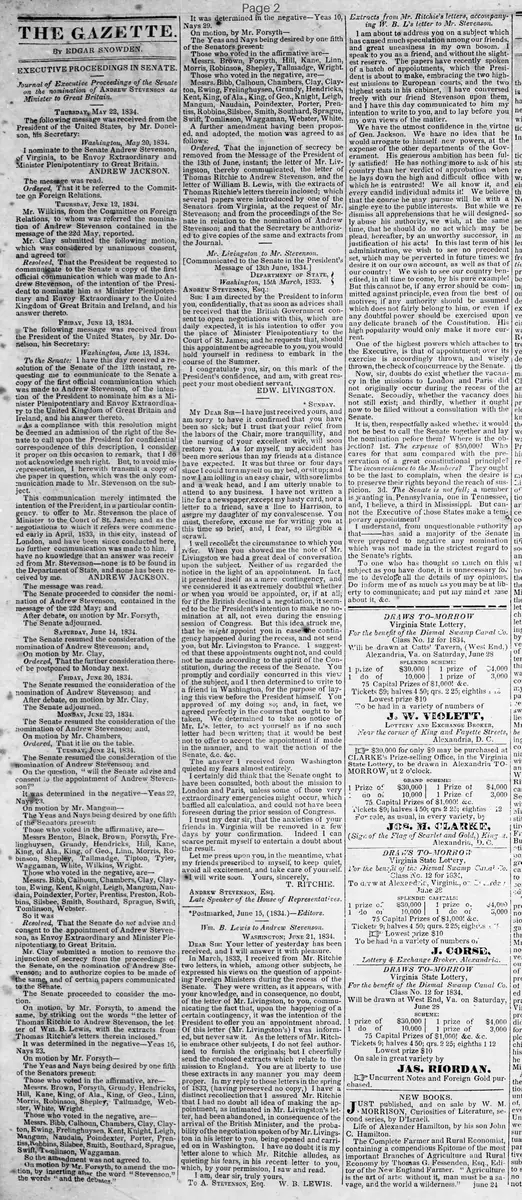
By EDGAR SNOWDEN.
EXECUTIVE PROCEEDINGS IN SENATE.
Journal of Executive Proceedings of the Senate on the nomination of Andrew Stevenson as Minister to Great Britain.
Thursday, May 22, 1834.
The following message was received from the President of the United States, by Mr. Donelson, his Secretary:
Washington, May 20, 1834.
I nominate to the Senate Andrew Stevenson, of Virginia, to be Envoy Extraordinary and Minister Plenipotentiary to Great Britain.
ANDREW JACKSON
The message was read.
Ordered, That it be referred to the Committee on Foreign Relations.
Thursday, June 12, 1834.
Mr. Wilkins, from the Committee on Foreign Relations, to whom was referred the nomination of Andrew Stevenson contained in the message of the 22d May, reported.
Mr. Clay submitted the following motion, which was considered by unanimous consent and agreed to:
Resolved, That the President be requested to communicate to the Senate a copy of the first official communication which was made to Andrew Stevenson, of the intention of the President to nominate him as Minister Plenipotentiary and Envoy Extraordinary to the United Kingdom of Great Britain and Ireland, and his answer thereto.
FRIDAY, JUNE 13, 1834.
The following message was received from the President of the United States, by Mr. Donelson, his Secretary:
Washington, June 13, 1834.
To the Senate:
I have this day received a resolution of the Senate of the 12th instant, requesting me to communicate to the Senate a copy of the first official communication which was made to Andrew Stevenson, of the intention of the President to nominate him as a Minister Plenipotentiary and Envoy Extraordinary to the United Kingdom of Great Britain and Ireland, and his answer thereto.
As a compliance with this resolution might be deemed an admission of the right of the Senate to call upon the President for confidential correspondence of this description, I consider it proper on this occasion to remark, that I do not acknowledge such right. But, to avoid misrepresentation, I herewith transmit a copy of the paper in question, which was the only communication made to Mr. Stevenson on the subject.
This communication merely intimated the intention of the President, in a particular contingency, to offer to Mr. Stevenson the place of Minister to the Court of St. James; and as the negotiations to which it refers were commenced early in April, 1833, in this city, instead of London, and have been since conducted here, no further communication was made to him. I have no knowledge that an answer was received from Mr. Stevenson—none is to be found in the Department of State, and none has been received by me.
ANDREW JACKSON.
The message was read.
The Senate proceeded to consider the nomination of Andrew Stevenson, contained in the message of the 22d May; and
After debate, on motion by Mr. Forsyth,
The Senate adjourned.
SATURDAY, June 14, 1834.
The Senate resumed the consideration of the nomination of Andrew Stevenson; and,
On motion by Mr. Clay,
Ordered, That the further consideration thereof be postponed to Monday next.
Friday, June 20, 1834.
The Senate resumed the consideration of the nomination of Andrew Stevenson; and
After debate, on motion by Mr. Clay,
The Senate adjourned.
Monday, June 23, 1834.
The Senate resumed the consideration of the nomination of Andrew Stevenson; and.
On motion by Mr. Chambers.
Ordered, That it lie on the table.
Tuesday, June 24, 1834.
The Senate resumed the consideration of the nomination of Andrew Stevenson; and
On the question, "will the Senate advise and consent to the appointment of Andrew Stevenson?"
It was determined in the negative—Yeas 22. Nays 23.
On motion by Mr. Mangum—
The Yeas and Nays being desired by one fifth of the Senators present:
Those who voted in the affirmative, are—
Messrs Benton, Black, Brown, Forsyth, Frelinghuysen, Grundy, Hendricks, Hill, Kane, King, of Ala., King. of Geo., Linn, Morris, Robinson, Shepley, Tallmadge, Tipton, Tyler, Waggaman, White, Wilkins, Wright.
Those who voted in the negative, are—
Messrs. Bibb, Calhoun, Chambers, Clay, Clayton, Ewing, Kent, Knight, Leigh, Mangum, Naudain. Poindexter, Porter, Prentiss, Preston, Robbins, Silsbee, Smith, Southard, Sprague, Swift, Tomlinson, Webster.
So it was
Resolved, That the Senate do not advise and consent to the appointment of Andrew Stevenson, as Envoy Extraordinary and Minister Plenipotentiary to Great Britain.
Mr. Clay submitted a motion to remove the injunction of secrecy from the proceedings of the Senate, on the nomination of Andrew Stevenson; and to authorize copies to be made of the same, and of certain papers communicated to the Senate.
The Senate proceeded to consider the motion.
On motion, by Mr. Forsyth, to amend the same, by striking out the words "the letter of Thomas Ritchie to Andrew Stevenson, the letter of Wm. B. Lewis, with the extracts from Thomas Ritchie's letters therein inclosed."
It was determined in the negative—Yeas 16, Nays 23.
On motion by Mr. Forsyth—
The Yeas and Nays being desired by one fifth of the Senators present:
Those who voted in the affirmative, are—
Messrs. Brown, Forsyth, Grundy, Hendricks, Hill, Kane, King, of Ala., King, of Geo., Linn, Morris, Robinson, Shepley, Tallmadge, Webster, White, Wright.
Those who voted in the negative, are—
Messrs. Bibb, Calhoun, Chambers, Clay, Clayton, Ewing, Frelinghuysen, Kent, Knight, Leigh, Mangum, Naudain, Poindexter, Porter, Prentiss, Robbins, Silsbee, Smith, Southard, Sprague, Swift, Tomlinson, Waggaman.
So the amendment was not agreed to.
On motion by Mr. Forsyth, to amend the motion, by inserting after the word "Stevenson,"
the words "and the debates."
It was determined in the negative—Yeas 10, Nays 29.
On motion, by Mr. Forsyth—
The Yeas and Nays being desired by one fifth of the Senators present:
Those who voted in the affirmative are—
Messrs. Brown, Forsyth, Hill, Kane, Linn, Morris, Robinson, Shepley, Tallmadge, Wright.
Those who voted in the negative, are—
Messrs. Bibb, Calhoun, Chambers, Clay, Clayton, Ewing, Frelinghuysen, Grundy, Hendricks, Kent, King, of Ala., King, of Geo., Knight, Leigh, Mangum, Naudain, Poindexter, Porter, Prentiss, Robbins, Silsbee, Smith, Southard, Sprague. Swift, Tomlinson, Waggaman, Webster, White.
A further amendment having been proposed, and adopted, the motion was agreed to as follows:
Ordered. That the injunction of secrecy be removed from the Message of the President of the 13th of June, instant; the letter of Mr. Livingston, thereby communicated, the letter of Thomas Ritchie to Andrew Stevenson, and the letter of William B. Lewis, with the extracts of Thomas Ritchie's letters therein inclosed; which several papers were introduced by one of the Senators from Virginia, at the request of Mr. Stevenson; and from the proceedings of the Senate in relation to the nomination of Andrew Stevenson; and that the Secretary be authorized to give copies of the same and extracts from the Journal.
Mr. Livingston to Mr. Stevenson.
Communicated to the Senate in the President's Message of 13th June, 1834.]
Department of State,
Washington, 15th March, 1833.
Andrew Stevenson. Esq.
SIR: I am directed by the President to inform you, confidentially, that as soon as advices shall be received that the British Government consents to open negotiations with this, which are daily expected, it is his intention to offer you the place of Minister Plenipotentiary to the Court of St. James; and he requests that, should this appointment be agreeable to you, you would hold yourself in readiness to embark in the course of the Summer.
I congratulate you, sir, on this mark of the President's confidence, and am, with great respect your most obedient servant,
EDW. LIVINGSTON.
* SUNDAY.
My Dear SIR—I have just received yours, and am sorry to have it confirmed that you have been so sick; but I trust that your relief from the labors of the Chair, more tranquillity, and the nursing of your excellent wife, will soon restore you. As for myself, my accident has been more serious than my friends at a distance have expected. It was but three or four days since I could turn myself on my bed, or sit up; and now I am lolling in an easy chair, with sore limbs and a weak head, and I am utterly unable to attend to any business. I have not written a line for a newspaper, except my hasty card, nor a letter to a friend, save a line to Harrison, to assure my daughter of my convalescence. You must, therefore, excuse me for writing you at this time so brief, and, I fear, so illegible a scrawl.
I well recollect the circumstance to which you refer. When you showed me the note of Mr. Livingston we had a great deal of conversation upon the subject. Neither of us regarded the notice in the light of an appointment. In fact, it presented itself as a mere contingency, and we considered it as extremely doubtful whether or when you would be appointed, or, if at all; for if the British declined a negotiation, it seemed to be the President's intention to make no nomination at all, not even during the ensuing session of Congress. But this idea struck me, that he might appoint you in case he contingency happened during the recess, and not send you, but Mr. Livingston to France. I suggested that these appointments ought not, and could not be made according to the spirit of the Constitution, during the recess of the Senate. You promptly and cordially concurred in this view of the subject, and I then determined to write to a friend in Washington, for the purpose of laying this view before the President himself. You approved of my doing so; and, in fact, we agreed perfectly in the course that ought to be taken. We determined to take no notice of Mr. L's. letter, to act yourself as if no such letter had been written; that it would be best not to offer to accept the appointment if made in the manner, and to wait the action of the Senate, &c. &c.
The answer I received from Washington quieted my fears almost entirely.
I certainly did think that the Senate ought to have been consulted, both about the mission to London and Paris, unless some of those very extraordinary emergencies might occur, which baffled all calculation, and could not have been foreseen during the prior session of Congress.
I trust my dear sir. that the anxieties of your friends in Virginia will be removed in a few days by your confirmation.
Indeed I can scarce permit myself to entertain a doubt about the result.
Let me press upon you, in the meantime, what my friends prescribed to myself, to keep quiet avoid all excitement, and take care of yourself
I will write soon. Yours, sincerely.
T. RITCHIE.
Andrew Stevenson,
Esq.
Late Speaker of the House of Representatives.
*Postmarked, June 15, (1834.)-Editors
Wm. B. Lewis to Andrew Stevenson.
Washington; June 21, 1834.
Dear Sir: Your letter of yesterday has been received, and I will answer it with pleasure.
In March, 1833, I received from Mr. Ritchie two letters. in which, among other subjects, he expressed his views on the question of appointing Foreign Ministers during the recess of the Senate. They were written, as it appears, with your knowledge, and in consequence, no doubt, of the letter of Mr. Livingston, to you, communicating the fact that, upon the happening of a certain contingency, it was the intention of the President to offer you an appointment abroad.
Of this letter (Mr. Livingston's) I was informed. but never saw it. As the letters of Mr. Ritchie embrace other subjects, I do not feel authorized to furnish the originals; but I cheerfully send the enclosed extracts which relate to the mission to England. You are at liberty to use these extracts in any manner you may deem proper. In my reply to those letters in the spring of 1833, (having preserved no copy,) I have a distinct recollection that I assured Mr. Ritchie that I had no doubt all idea of making the appointment, as intimated in Mr. Livingston's letter, had been abandoned, in consequence of the arrival of the British Minister, and the probability of the negotiation spoken of by Mr. Livingston in his letter to you. being opened and carried on in Washington. ' I have no doubt it is my letter alone to which Mr. Ritchie alludes, as quieting his fears, in his recent letter to you, which, by your permission. I saw and read.
I am, dear sir, truly yours.
To A. Stevenson, Esq.
W. B. LEWIS.
Extracts from Mr. Ritchie's letters, accompanying W. B. L's letter to Mr. Stevenson.
I am about to address you on a subject which has caused much speculation among our friends, and great uneasiness in my own bosom. I speak to you as a friend, and without the slightest reserve. The papers have recently spoken of a batch of appointments, which the President is about to make, embracing the two highest missions to European courts, and the two highest seats in his cabinet, I have conversed freely with our friend Stevenson upon them, and I have this day communicated to him my intention to write to you, and to lay before you my own views of the matter.
We have the utmost confidence in the virtue of Gen. Jackson. We have no idea that he would arrogate to himself new powers, at the expense of the other departments of the Government. His generous ambition has been fully satisfied! He has nothing more to ask of his country than her verdict of approbation when he lays down the high and difficult office with which he is entrusted! We all know it, and every candid individual admits it! We believe that the course he may pursue will be with a single eye to the public interests. But while we dismiss all apprehensions that he will designedly abuse his authority, we wish, at the same time, that he should do no act which may be plead, hereafter, by an unworthy successor, in justification of his acts! In this last term of his administration, we wish to see no precedent set, which may be perverted in future times: we desire it on our own account, as well as that of our country! We wish to see our country benefited. in all time to come. by his pure example!
But this cannot be, if any error should be committed against principle, even from the best of motives; if any authority should be assumed which does not fairly belong to him, or even if any doubtful power should be exercised upon any delicate branch of the Constitution. His high popularity would only make it more current.
One of the highest powers which attaches to the Executive. is that of appointment; over its exercise is accordingly thrown, and wisely thrown, the check of concurrence by the Senate.
Now, sir, doubts do exist whether the vacancy in the missions to London and Paris did not originally occur during the recess of the Senate. Secondly, whether the vacancy does not still exist; and thirdly, whether it ought now to be filled without a consultation with the Senate.
It is, then, respectfully asked whether it would not be best to call the Senate together and lay the nomination before them? Where is the objection? 1st. The expense of $50,000? Who cares for that sum compared with the preservation of a great constitutional principle? The inconvenience to the Members? They ought to be the last to complain, when the desire is to preserve their rights beyond the reach of suspicion. 3d. The Senate is not full; a member is wanting in Pennsylvania, one in Tennessee, and. I believe, a third in Mississippi. But cannot the Executive of those States make a temporary appointment?
I understand, from unquestionable authority that— has said a majority of the Senate were prepared to negative any nomination which was not made in the strictest regard to the Senate's rights.
To one who has thought so much on this subject as you have done, it is unnecessary for me to develope all the details of my opinions.
Do inform me of as much as you may be at liberty to communicate; and put my mind at ease about it, &c.
What sub-type of article is it?
What themes does it cover?
What keywords are associated?
What entities or persons were involved?
Where did it happen?
Story Details
Key Persons
Location
Washington
Event Date
1834 05 22 To 1834 06 24
Story Details
President Jackson nominates Andrew Stevenson as Minister to Great Britain on May 20, 1834. Senate debates the nomination over several sessions, examines prior confidential communications regarding a potential recess appointment, and rejects it by a vote of 22-23 on June 24, 1834. Secrecy injunction is lifted on related documents.