Thank you for visiting SNEWPapers!
Sign up free
Alexandria Gazette, Commercial And Political
Alexandria, Virginia
What is this article about?
In 1816 Philadelphia, a committee of notable citizens, led by Chief Justice William Tilghman, investigates Charles Redheffer's claimed perpetual motion machine at his invitation. Redheffer delays demonstrations, refuses to explain principles to the full group, and ultimately fails to operate it, prompting the committee's withdrawal and strong disapproval of his conduct.
Merged-components note: The text in the second component is a direct continuation of the committee proceedings described in the first component, forming a single coherent story about the examination of Redheffer's perpetual motion machine.
Clipping
OCR Quality
Full Text
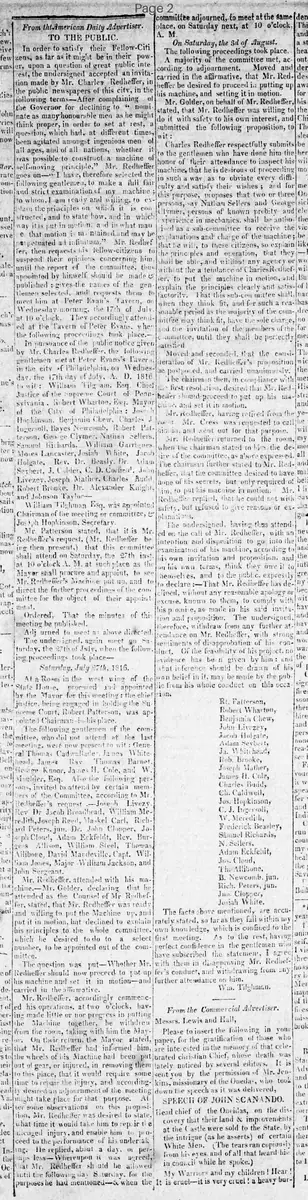
TO THE PUBLIC.
In order to satisfy their Fellow-Citizens, as far as it might be in their power, upon a question of great public interest, the undersigned accepted an invitation made by Mr. Charles Redheffer, in the public newspapers of this city, in the following terms—After complaining of the Governor for declining to "nominate as many honourable men as he might think proper, in order to set at rest, a question, which had at different times, been agitated amongst ingenious men of all ages, and of all nations, whether it was possible to construct a machine of self-moving principle," Mr. Redheffer goes on—I have, therefore selected the following gentlemen, to make a full fair and strict examination of my machine: to whom, I am ready and willing, to explain the principles on which it is constructed, and to state how, and in which way it is put in motion, and in what manner that motion is maintained, and may be perpetuated ad infinitum." Mr. Redheffer, then requests his fellow-citizens to suspend their opinions concerning him, until the report of the committee, thus appointed by himself should be made & published; gives the names of the gentlemen selected, and requests them to meet him at Peter Evans's Tavern, on Wednesday morning, the 17th of July, at 10 o'clock. They accordingly attended at the Tavern of Peter Evans, where the following proceedings took place.
In pursuance of the public notice given by Mr. Charles Redheffer, the following gentlemen met at Peter Evans's Tavern, in the city of Philadelphia, on Wednesday, the 17th day of July, A. D. 1816, to wit: William Tilghman, Esq. Chief Justice of the Supreme Court of Pennsylvania. Robert Wharton, Esq. Mayor of the City of Philadelphia: Joseph Hopkinson, Benjamin Chew, Charles J. Ingersoll, Hayes Newcomb, Robert Patterson, George Clymer, Nathan Sellers, Samuel Richards, William Garrigues, Moses Lancaster, Josiah White, Jacob Holgate, Rev. Dr. Beasley, Dr. Adam Seybert, J. Colder, C. D. Coldfield, John Livezey, Joseph Mather, Charles Budd, Robert Brooke, Dr. Alexander Parker, and Johnson Taylor—
William Tilghman Esq. was appointed Chairman of the meeting or committee, Joseph Hopkinson, Secretary.
Mr. Patterson stated, that it is Mr. Redheffer's request. (Mr. Redheffer being then present,) that this committee shall attend on Saturday, the 27th inst. at 10 o'clock A. M. at such place as the Mayor shall procure and appoint, to see Mr. Redheffer's Machine put up, and to direct the further proceedings of the committee for the object of their appointment.
Ordered, That the minutes of this meeting be published.
Adjourned to meet as above directed.
The undersigned, again met on Saturday, the 27th of July, when the following proceedings took place—
Saturday, July 27th, 1816.
At a Room in the west wing of the State House, procured and appointed by the Mayor for this meeting: the chief justice, being engaged in holding the Supreme Court, Robert Patterson, was appointed Chairman in his place.
The following gentlemen of the committee, who did not attend at the last meeting, were now present to wit: General Thomas Cadwalader, James Whitehead, James Ray, Thomas Barnet, George Knorr, James H. Coles, and W. Moulder, Esq. Also the following persons, invited to attend by certain members of the Committee, according to Mr. Redheffer's request—Joseph Livezy, Rev Dr Jacob Broadhead, William Meredith, Joseph Reed, Michael Carl, Richard Peters, jun. Dr. John Clopper, Joseph Cloud, Adam Eckfeldt, Rev. Burgess Allison, William Steel, Thomas Allibone, David Mandeville, Capt. William Jones, Major William Jackson, and John Sergeant.
Mr. Redheffer, attended with his machine.—Mr. Golder, declaring that he attended as the Counsel of Mr Redheffer, stated, that Mr. Redheffer was ready and willing to put the Machine up, and put it in motion, but declined to explain his principles to the whole committee, which he desired to do to a select number, to be appointed out of the committee.
The question was put—Whether Mr. Redheffer should now proceed to put up his machine and set it in motion—and carried in the affirmative.
Mr. Redheffer, accordingly commenced his operations, at two o'clock, having made little or no progress in putting the Machine together, he withdrew from the room, taking with him the Mayor. On their return, the Mayor stated, that Mr. Redheffer had informed him, the wheels of his Machine had been put out of gear, or injured, in removing them to this place, that it would require some time to repair the injury, and accordingly desired an adjournment of the meeting might take place for that purpose. After some observations on this proposition, Mr. Redheffer was desired to state what time it would take him to repair the alleged injury, and enable him to proceed to the performance of his undertaking. He replied, about a day, or perhaps less—Whereupon it was agreed, that Mr. Redheffer should be allowed until the following day Saturday, for the purposes he had mentioned—when the committee adjourned, to meet at the same place, on Saturday next, at 10 o'clock A. M.
On Saturday, the 3d of August,
The following proceedings took place.
A majority of the committee met, according to adjournment. Moved and carried in the affirmative, that Mr. Redheffer be desired to proceed in putting up his machine, and setting it in motion.
Mr. Golder, on behalf of Mr. Redheffer, stated, that Mr. Redheffer was willing to do it with safety to his own interest, and submitted the following proposition, to wit:
Charles Redheffer respectfully submits to the gentlemen who have done him the honor of their attendance to inspect his machine that he is desirous of proceeding in such a way, as to obviate every difficulty and satisfy their wishes: and for this purpose, proposes that two or three persons, say Nathan Sellers and George Clymer, persons of known probity and experience in mechanics, shall be authorized as a sub-committee to receive the explanations and charge of the machine; that he will, to these citizens, so explain the principles and operation, that they shall be able, and without any agency or without the attendance of Charles Redheffer, to put the machine in motion, and explain the principles clearly and satisfactorily. That this sub-committee shall, when they think fit, and for such a reasonable period as the majority of the committee may think fit, have the sole charge, and the invitation of the members of the committee, until they shall be perfectly satisfied.
Moved and seconded, that the consideration of Mr. Redheffer's proposition be postponed, and carried unanimously.
The chairman then, in compliance with the first resolution, desired that Mr. Redheffer should proceed to put up his machine, and set it in motion.
Mr. Redheffer, having retired from the room Mr. Cress was requested to call him in, and sent out for that purpose. Mr. Redheffer returned to the room, when the chairman stated to him the desire of the committee, as above expressed. The chairman further stated to Mr. Redheffer, that the committee desired to have none of his secrets, but only required of him, to put his machine in motion. Mr. Redheffer replied, that he could not with safety, but refused to give reasons or explanations.
The undersigned, having thus attended on the call of Mr. Redheffer, with an intention and disposition to go into the examination of his machine, according to his own invitation and proposition, and on his own terms, think they owe it to themselves, and to the public, expressly to declare:—That Mr. Redheffer has declined, without any reasonable apology or excuse, known to them, to comply with his promise, as made in his said invitation and proposition. The undersigned, therefore, withdraw from any further attendance on Mr. Redheffer, with strong sentiments of disapprobation of his conduct. Of the feasibility of his project, no evidence has been given by him: and that inference should be drawn of his own belief in it, may be made by the public from his whole conduct on this occasion.
Rt. Patterson,
Robert Wharton,
Benjamin Chew,
John Livezey,
Jacob Holgate,
Adam Seybert,
Ja. Whitehead,
Rob. Brooke,
Joseph Mather,
James H. Coles,
Charles Budd,
Ch. Caldwell,
Jos. Hopkinson,
C. J. Ingersoll,
W. Meredith,
Frederick Beasley,
Samuel Richards,
N. Sellers,
Adam Eckfeldt,
Jos. Cloud,
Th. Allibone,
B. Newcomb, jun.
Rich. Peters, jun.
Jno. Clopper,
Josiah White,
The facts above mentioned, are accurately stated, so far as they fall within my own knowledge, which is confined to the first meeting.
As to the rest, having perfect confidence in the gentlemen who have subscribed the statement, I agree with them in disapproving Mr. Redheffer's conduct, and withdrawing from any further attendance on him.
Wm. Tilghman.
What sub-type of article is it?
What themes does it cover?
What keywords are associated?
What entities or persons were involved?
Where did it happen?
Story Details
Key Persons
Location
Philadelphia
Event Date
1816
Story Details
Charles Redheffer invites a committee of prominent Philadelphians to examine his perpetual motion machine. The committee meets multiple times, but Redheffer delays assembly, claims damage, proposes a sub-committee for explanations, and ultimately refuses to demonstrate or explain it, leading the committee to withdraw with disapprobation.