Thank you for visiting SNEWPapers!
Sign up free
Portland Gazette, And Maine Advertiser
Portland, Cumberland County, Maine
What is this article about?
On June 9, the Massachusetts Senate and House respond to the Governor's address, addressing foreign relations, the Embargo's economic distress, national defense needs, and commitment to union and independence. Addresses are adopted after debate; committees appointed on militia and Maine disturbances.
Clipping
OCR Quality
Full Text
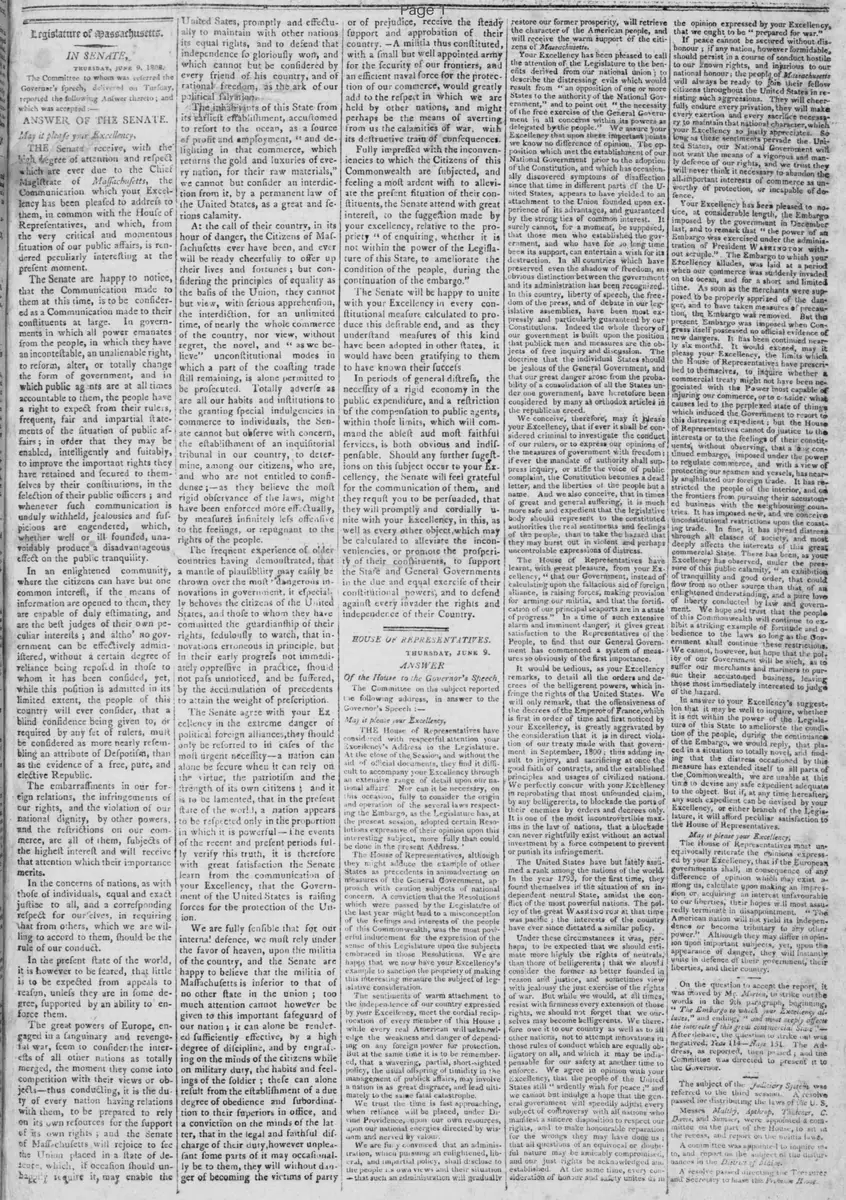
IN SENATE,
THURSDAY, JUNE 9.
The Committee to whom was referred the Governor's speech, delivered on Tuesday, reported the following Answer thereto; and which was accepted:-
ANSWER OF THE SENATE.
May it please your Excellency,
THE Senate receive, with the high degree of attention and respect which are ever due to the Chief Magistrate of Massachusetts, the Communication which your Excellency has been pleased to address to them, in common with the House of Representatives, and which, from the very critical and momentous situation of our public affairs, is rendered peculiarly interesting at the present moment.
The Senate are happy to notice, that the Communication made to them at this time, is to be considered as a Communication made to their constituents at large. In governments in which all power emanates from the people, in which they have an incontestable, an unalienable right, to reform, alter, or totally change the form of government, and in which public agents are at all times accountable to them, the people have a right to expect from their rulers, frequent, fair and impartial statements of the situation of public affairs; in order that they may be enabled, intelligently and suitably, to improve the important rights they have retained and secured to themselves by their constitutions, in the selection of their public officers; and whenever such communication is unduly withheld, jealousies and suspicions are engendered, which, whether well or ill founded, unavoidably produce a disadvantageous effect on the public tranquility.
In an enlightened community, where the citizens can have but one common interest, if the means of information are opened to them, they are capable of duly estimating, and are the best judges of their own peculiar interests; and altho' no government can be effectively administered, without a certain degree of reliance being reposed in those to whom it has been confided, yet, while this position is admitted in its limited extent, the people of this country will ever consider, that a blind confidence being given to, or required by any set of rulers, must be considered as more nearly resembling an attribute of Despotism, than as the evidence of a free, pure, and elective Republic.
The embarrassments in our foreign relations, the infringements of our rights, and the violation of our national dignity, by other powers, and the restrictions on our commerce, are all of them, subjects of the highest interest and will receive that attention which their importance merits.
In the concerns of nations, as with those of individuals, equal and exact justice to all, and a corresponding respect for ourselves, in requiring that from others, which we are willing to accord to them, should be the rule of our conduct.
In the present state of the world, it is however to be feared, that little is to be expected from appeals to reason, unless they are in some degree, supported by an ability to enforce them.
The great powers of Europe, engaged in a sanguinary and revengeful war, seem to consider the interests of all other nations as totally merged, the moment they come into competition with their views or objects—thus conducting, it is the duty of every nation having relations with them, to be prepared to rely on its own resources for the support of its own rights; and the Senate of Massachusetts will rejoice to see the Union placed in a state of defence, which, if occasion should unhappily require it, may enable the United States, promptly and effectually to maintain with other nations its equal rights, and to defend that independence so gloriously won, and which cannot but be considered by every friend of his country, and of rational freedom, as the ark of our political salvation.
The inhabitants of this State from its earliest establishment, accustomed to resort to the ocean, as a source of profit and employment, and delighting in that commerce, which returns the gold and luxuries of every nation, for their raw materials, we cannot but consider an interdiction from it, by a permanent law of the United States, as a great and serious calamity.
At the call of their country, in its hour of danger, the Citizens of Massachusetts ever have been, and ever will be ready cheerfully to offer up their lives and fortunes; but considering the principles of equality as the basis of the Union, they cannot but view, with serious apprehension, the interdiction, for an unlimited time, of nearly the whole commerce of the country, nor view, without regret, the novel, and as we believe unconstitutional modes in which a part of the coasting trade still remaining, is alone permitted to be prosecuted. Totally adverse as are all our habits and institutions to the granting special indulgencies in commerce to individuals, the Senate cannot but observe with concern, the establishment of an iniquisitorial tribunal in our country, to determine, among our citizens, who are, and who are not entitled to confidence;—as they believe the most rigid observance of the laws, might have been enforced more effectually, by measures infinitely less offensive to the feelings, or repugnant to the rights of the people.
The frequent experience of older countries having demonstrated, that a mantle of plausibility may easily be thrown over the most dangerous innovations in government, it especially behoves the citizens of the United States, and those to whom they have committed the guardianship of their rights, sedulously to watch, that innovations erroneous in principle, but in their early progress not immediately oppressive in practice, should not pass unnoticed, and be suffered, by the accumulation of precedents to attain the weight of prescription.
The Senate agree with your Excellency in the extreme danger of political foreign alliances, they should only be resorted to in cases of the most urgent necessity—a nation can alone be secure when it can rely on the virtue, the patriotism and the strength of its own citizens: and it is to be lamented, that in the present state of the world, a nation appears to be respected only in the proportion in which it is powerful—the events of the recent and present periods fully verify this truth, it is therefore with great satisfaction the Senate learn from the communication of your Excellency, that the Government of the United States is raising forces for the protection of the Union.
We are fully sensible that for our internal defence, we must rely under the favor of heaven, upon the militia of the country, and the Senate are happy to believe that the militia of Massachusetts is inferior to that of no other state in the union; too much attention cannot however be given to this important safeguard of our nation; it can alone be rendered sufficiently effective, by a high degree of discipline, and by engrafting on the minds of the citizens while on military duty, the habits and feelings of the soldier; these can alone result from the establishment of a due degree of obedience and subordination to their superiors in office, and a conviction on the minds of the latter, that in the legal and faithful discharge of their duty, however unpleasant some parts of it may occasionally be to them, they will without danger of becoming the victims of party or of prejudice, receive the steady support and approbation of their country.—A militia thus constituted, with a small but well appointed army for the security of our frontiers, and an efficient naval force for the protection of our commerce, would greatly add to the respect in which we are held by other nations, and might perhaps be the means of averting from us the calamities of war, with its destructive train of consequences.
Fully impressed with the inconveniences to which the Citizens of this Commonwealth are subjected, and feeling a most ardent wish to alleviate the present situation of their constituents, the Senate attend with great interest, to the suggestion made by your excellency, relative to the propriety of enquiring, whether it is not within the power of the Legislature of this State, to ameliorate the condition of the people, during the continuation of the embargo."
The Senate will be happy to unite with your Excellency in every constitutional measure calculated to produce this desirable end, and as they understand measures of this kind have been adopted in other states, it would have been gratifying to them to have known their success
In periods of general distress, the necessity of a rigid economy in the public expenditure, and a restriction of the compensation to public agents, within those limits, which will command the ablest and most faithful services, is both obvious and indispensable. Should any further suggestions on this subject occur to your Excellency, the Senate will feel grateful for the communication of them, and they request you to be persuaded, that they will promptly and cordially unite with your Excellency, in this, as well as every other object, which may be calculated to alleviate the inconveniences, or promote the prosperity of their constituents, to support the State and General Governments in the due and equal exercise of their constitutional powers; and to defend against every invader the rights and independence of their Country.
HOUSE OF REPRESENTATIVES.
THURSDAY, JUNE 9.
ANSWER
Of the House to the Governor's Speech
The Committee on the subject reported the following address, in answer to the Governor's Speech:--
May it please your Excellency,
THE House of Representatives have considered with respectful attention your Excellency's Address to the Legislature.
At the close of the Session, and without the aid of official documents, they find it difficult to accompany your Excellency through an extensive range of detail upon our national affairs Nor can it be necessary, on this occasion, fully to consider the origin and operation of the several laws respecting the Embargo, as the Legislature has, at the present session, adopted certain Resolutions expressive of their opinion upon this interesting subject, more fully than could be done in the present Address.
The House of Representatives, although they might adduce the example of other States as precedents in animadverting on measures of the General Government, approach with caution subjects of national concern. A conviction that the Resolutions which were passed by the Legislature of the last year might lead to a misconception of the feelings and interests of the people of this Commonwealth, was the most powerful inducement for the expression of the sense of this Legislature upon the subjects embraced in those Resolutions. We are happy that we now have your Excellency's example to sanction the propriety of making this interesting measure the subject of legislative consideration.
The sentiments of warm attachment to the independence of our country expressed by your Excellency, meet the cordial reciprocation of every member of this House; while every real American will acknowledge the weakness and danger of depending on any foreign power for protection.
But at the same time it is to be remembered, that a wavering, partial, short-sighted policy, the usual offspring of timidity in the management of public affairs, may involve a nation in as great disgrace, and lead ultimately to the same fatal catastrophe.
We trust the time is fast approaching when reliance will be placed, under Divine Providence, upon our own resources, upon our national energies directed by wisdom and nerved by valour.
We are fully convinced that an administration, when pursuing an enlightened, liberal, and impartial policy, shall disclose to the people its own views and their situation—that such an administration will gradually restore our former prosperity, will retrieve the character of the American people, and will receive the warm support of the citizens of Massachusetts.
Your Excellency has been pleased to call the attention of the Legislature to the benefits derived from our national union; to describe the distressing evils which would result from "an opposition of one or more States to the authority of the National Government," and to point out "the necessity of the free exercise of the General Government in all concerns within its powers as delegated by the people." We assure your Excellency that upon these important points we know no difference of opinion. The opposition which met the establishment of our National Government prior to the adoption of the Constitution, and which has occasionally discovered symptoms of disaffection since that time in different parts of the United States, appears to have yielded to an attachment to the Union founded upon experience of its advantages, and guaranteed by the strong ties of common interest. It surely cannot, for a moment, be supposed, that those men who established the government, and who have for so long time been its support, can entertain a wish for its destruction. In all countries which have preserved even the shadow of freedom, an obvious distinction between the government and its administration has been recognized.
In this country, liberty of speech, the freedom of the press, and of debate in our legislative assemblies, have been most expressly and particularly guaranteed by our Constitutions. Indeed the whole theory of our government is built upon the position that public men and measures are the objects of free inquiry and discussion. The doctrine that the individual States should be jealous of the General Government, and that our great danger arose from the probability of a consolidation of all the States under one government, have heretofore been considered by many as orthodox articles in the republican creed.
We conceive, therefore, may it please your Excellency, that if ever it shall be considered criminal to investigate the conduct of our rulers, or to express our opinions of the measures of government with freedom; if ever the mandate of authority shall suppress inquiry, or stifle the voice of public complaint, the Constitution becomes a dead letter, and the liberties of the people but a name. And we also conceive, that in times of great and general suffering, it is much more safe and expedient that the legislative body should represent to the constituted authorities the real sentiments and feelings of the people, than to take the hazard that they may burst out in violent and perhaps uncontrolable expressions of distress.
The House of Representatives have learnt, with great pleasure, from your Excellency, "that our Government, instead of calculating upon the fallacious aid of foreign alliance, is raising forces, making provision for arming our militia, and that the fortifications of our principal seaports are in a state of progress." In a time of such extensive alarm and imminent danger, it gives great satisfaction to the Representatives of the People, to find that our General Government has commenced a system of measures so obviously of the first importance.
It would be tedious, as your Excellency remarks, to detail all the orders and decrees of the belligerent powers, which infringe the rights of the United States. We will only remark, that the offensiveness of the decrees of the Emperor of France, which is first in order of time and first noticed by your Excellency, is greatly aggravated by the consideration that it is in direct violation of our treaty made with that government in September, 1800; thus adding insult to injury, and sacrificing at once the good faith of contracts, and the established principles and usages of civilized nations.
We perfectly concur with your Excellency in reprobating that most unfounded claim, by any belligerents, to blockade the ports of their enemies by orders and decrees only.
It is one of the most incontrovertible maxims in the law of nations, that a blockade can never rightfully exist without an actual investment by a force competent to prevent or punish its infringement.
The United States have but lately assumed a rank among the nations of the world. In the year 1793, for the first time, they found themselves in the situation of an independent neutral State, amidst the conflict of the most powerful nations. The policy of the great Washington at that time was pacific; the interests of the country have ever since dictated a similar policy.
Under these circumstances it was, perhaps, to be expected that we should estimate more highly the rights of neutrals, than those of belligerents; that we should consider the former as better founded in reason and justice, and sometimes view with jealousy the just exercise of the rights of war. But while we would, at all times, resist with firmness every extension of those rights, we should not forget that we ourselves may become belligerents. We therefore owe it to our country as well as to all other nations, not to attempt innovations in those rules of conduct which are equally obligatory on all, and which it may be indispensable for our safety at another time to enforce. We agree in opinion with your Excellency, that the people of the United States still "ardently wish for peace;" and we cannot but indulge a hope that the general government will speedily adjust every subject of controversy with all nations who manifest a sincere disposition to respect our rights, and to make honourable reparation for the wrongs they may have done us; that all questions of an equivocal or doubtful nature may be amicably compromised, and our just rights be acknowledged and established. At the same time, every consideration of honour and safety unites us in the opinion expressed by your Excellency, that we ought to be "prepared for war."
If peace cannot be secured without dishonour; if any nation, however formidable, should persist in a course of conduct hostile to our known rights, and injurious to our national honour; the people of Massachusetts will always be ready to join their fellow citizens throughout the United States in resisting such aggressions. They will cheerfully endure every privation, they will make every exertion and every sacrifice necessary to maintain that national character, which your Excellency so justly appreciates. So long as these sentiments pervade the United States, our National Government will not want the means of a vigorous and manly defence of our rights, and we trust they will never think it necessary to abandon the all-important interests of commerce as unworthy of protection, or incapable of defence.
Your Excellency has been pleased to notice, at considerable length, the Embargo imposed by the government in December last, and to remark that "the power of an Embargo was exercised under the administration of President Washington without scruple." The Embargo to which your Excellency alludes, was laid at a period when our commerce was suddenly invaded on the ocean, and for a short and limited time. As soon as the merchants were supposed to be properly apprized of the danger, and to have taken measures of precaution, the Embargo was removed. But the present Embargo was imposed when Congress itself possessed no official evidence of new dangers. It has been continued nearly six months. It would exceed, may it please your Excellency, the limits which the House of Representatives have prescribed to themselves, to inquire whether a commercial treaty might not have been negotiated with the Power most capable of injuring our commerce, or to consider what causes led to the perplexed state of things which induced the Government to resort to this distressing expedient; but the House of Representatives cannot do justice to the interests or to the feelings of their constituents, without observing, that a long continued embargo, imposed under the power to regulate commerce, and with a view of protecting our seamen and vessels, has nearly annihilated our foreign trade. It has restricted the people of the interior, and on the frontiers from pursuing their accustomed business with the neighbouring countries. It has imposed new, and we conceive unconstitutional restrictions upon the coasting trade. In fine, it has spread distress through all classes of society, and most deeply affects the interests of this great commercial State. There has been, as your Excellency has observed, under the pressure of this public calamity, "an exhibition of tranquillity and good order, that could flow from no other source than that of an enlightened understanding, and a pure love of liberty conducted by law and government. We hope and trust that the people of this Commonwealth will continue to exhibit a striking example of fortitude and obedience to the laws so long as the Government shall continue these restrictions.
We cannot, however, but hope that the policy of our Government will be such, as to suffer our merchants and mariners to pursue their accustomed business, leaving those most immediately interested to judge of the hazard.
In answer to your Excellency's suggestion that it may be well to inquire, whether it is not within the power of the Legislature of this State to ameliorate the condition of the people, during the continuance of the Embargo, we would reply, that placed in a situation so totally novel, and finding that the distress occasioned by this measure has extended itself to all parts of the Commonwealth, we are unable at this time to devise any safe expedient adequate to the object. But if at any time hereafter any such expedient can be devised by your Excellency, or either branch of the Legislature, it will afford peculiar satisfaction to the House of Representatives.
May it please your Excellency
The House of Representatives most unequivocally reiterate the opinions expressed by your Excellency, that if the European governments shall, in consequence of any difference of opinion which may exist among us, calculate upon making an impression on, or acquiring an interest unfavourable to our liberties, their hopes will most assuredly terminate in disappointment. "The American nation will not yield its independence or become tributary to any other power." Although they may differ in opinion upon important subjects, yet, upon the appearance of danger, they will instantly unite in defence of their government, their liberties, and their country.
On the question to accept the report, it was moved by Mr. Morton, to strike out the words in the 8th paragraph, beginning, "The Embargo to which your Excellency alludes," and ending, "and most deeply affects the interests of this great commercial State"—
After debate, the question to strike out was negatived, Yeas 114—Nays 151. The Address, as reported, then passed; and the Committee was directed to present it to the Governor.
The subject of the Judiciary System was referred to the third session. A resolve passed for distributing the laws of the U. S.
Messrs. Maltby, Apthorp, Thaxter, C. Davis, and Sumner, were appointed a committee on the part of the House, to sit during the recess, and report on the militia laws.
A committee was appointed to inquire into, and report on the subject of the disturbances in the District of Maine.
A resolve passed directing the Treasurer and Secretary to lease the State House.
What sub-type of article is it?
What keywords are associated?
What entities or persons were involved?
Where did it happen?
Domestic News Details
Primary Location
Massachusetts
Event Date
Thursday, June 9
Key Persons
Outcome
addresses from senate and house adopted after debate (yeas 114, nays 151 on amendment); committees appointed on militia laws and maine disturbances; resolves passed on u.s. laws distribution and state house lease.
Event Details
The Senate and House of Representatives consider and adopt responses to the Governor's speech addressing foreign relations, European infringements, the Embargo's impacts on commerce, national defense, militia readiness, and state measures to alleviate distress; debate occurs on the House address regarding the Embargo.