Thank you for visiting SNEWPapers!
Sign up free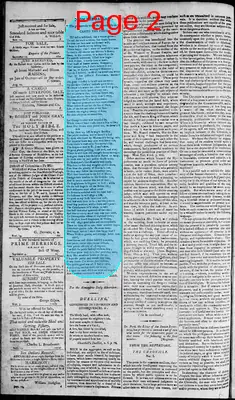
Literary
September 18, 1804
Alexandria Daily Advertiser
Alexandria, Virginia
What is this article about?
Satirical poem in verse form mocking Napoleon Bonaparte's alleged crimes and imperial ambitions, ridiculing British King George's naval policy, and envisioning a French invasion imposing foreign foods on the British Isles, ending with praise for America's virtuous governance.
Clipping
OCR Quality
95%
Excellent
Full Text
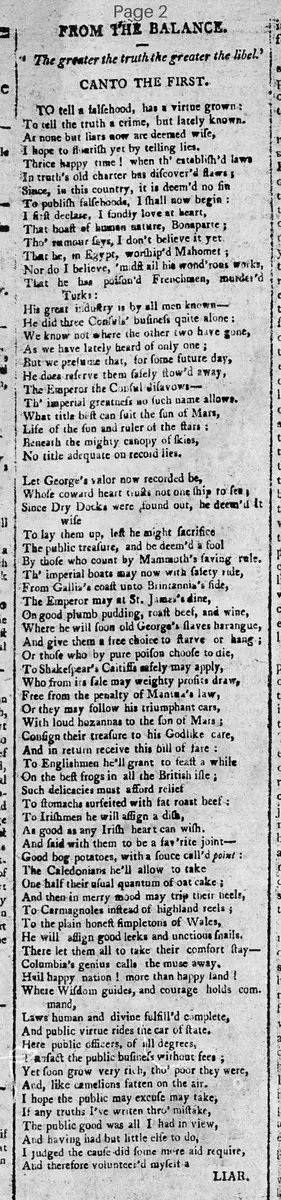
FROM THE BALANCE.
"The greater the truth the greater the libel."
CANTO THE FIRST.
To tell a falsehood, has a virtue grown:
To tell the truth a crime, but lately known.
As none but liars now are deemed wise,
I hope to thrive yet by telling lies.
Thrice happy time! when th' established law
In truth's old charter has discover'd flaws
Since, in this country, it is deem'd no sin
To publish falsehoods, I shall now begin:
I first declare, I fondly love at heart,
That boast of human nature, Bonaparte;
Tho' rumour says, I don't believe it yet.
Nor do I believe, 'midst all his wond'rous works,
That he, in Egypt, worship'd Mahomet;
That he has poison'd Frenchmen, murder'd
Turks:
His great industry is by all men known—
He did three Consuls' business quite alone:
We know not where the other two have gone,
As we have lately heard of only one;
But we presume that, for some future day,
He does reserve them safely stow'd away,
The Emperor the Consul disavows—
Th' imperial greatness no such name allows.
What title fit can suit the son of Mars,
Life of the sun and ruler of the stars:
Beneath the mighty canopy of kings,
No title adequate on record lies.
Let George's valor now recorded be,
Whose coward heart trusts not one ship to sea
Since Dry Docks were found out, he deem'd it
wise
To lay them up, lest he might sacrifice
The public treasure, and be deem'd a fool
By those who count by Mammoth's saving rule.
Th' imperial boats may now with safety ride,
From Gallia's coast unto Britannia's side,
The Emperor may at St. James's dine,
On good plumb pudding, roast beef, and wine,
Where he will soon old George's slaves harangue,
And give them a free choice to starve or hang;
Or those who by pure poison choose to die,
To Shakspeare's Caustics safely may apply,
Who from its sale may weighty profits draw,
Free from the penalty of Malta's law,
Or they may follow his triumphant cars,
With loud huzzas to the son of Mars;
Consign their treasure to his Godlike care,
And in return receive this bill of fare:
To Englishmen he'll grant to feast a while
On the best frogs in all the British isle;
Such delicacies must afford relief
To stomachs surfeited with fat roast beef:
To Irishmen he will assign a dish,
As good as any Irish heart can wish.
And aid with them to be a fav'rite joint—
Good bog potatoes, with a sauce call'd point:
The Caledonians he'll allow to take
One half their usual quantum of oat cake;
And then in merry mood may trip their heels,
To Carmagnoles instead of highland reels;
To the plain honest simpletons of Wales,
He will assign good leeks and unctuous snails.
There let them all to take their comfort stay—
Columbia's genius calls the muse away.
Hail happy nation! more than happy land!
Where Wisdom guides, and courage holds com-
mand,
Laws human and divine fulfill'd complete,
And public virtue rides the car of state.
Here public officers, of all degrees,
Transact the public business without fees;
Yet soon grow very rich, tho' poor they were,
And, like chameleons fatten on the air.
I hope the public may excuse my task,
If any truths I've written thro' mistake,
The public good was all I had in view,
And having had but little else to do,
I judged the cause—did some more aid require,
And therefore volunteer'd myself a
LIAR.
"The greater the truth the greater the libel."
CANTO THE FIRST.
To tell a falsehood, has a virtue grown:
To tell the truth a crime, but lately known.
As none but liars now are deemed wise,
I hope to thrive yet by telling lies.
Thrice happy time! when th' established law
In truth's old charter has discover'd flaws
Since, in this country, it is deem'd no sin
To publish falsehoods, I shall now begin:
I first declare, I fondly love at heart,
That boast of human nature, Bonaparte;
Tho' rumour says, I don't believe it yet.
Nor do I believe, 'midst all his wond'rous works,
That he, in Egypt, worship'd Mahomet;
That he has poison'd Frenchmen, murder'd
Turks:
His great industry is by all men known—
He did three Consuls' business quite alone:
We know not where the other two have gone,
As we have lately heard of only one;
But we presume that, for some future day,
He does reserve them safely stow'd away,
The Emperor the Consul disavows—
Th' imperial greatness no such name allows.
What title fit can suit the son of Mars,
Life of the sun and ruler of the stars:
Beneath the mighty canopy of kings,
No title adequate on record lies.
Let George's valor now recorded be,
Whose coward heart trusts not one ship to sea
Since Dry Docks were found out, he deem'd it
wise
To lay them up, lest he might sacrifice
The public treasure, and be deem'd a fool
By those who count by Mammoth's saving rule.
Th' imperial boats may now with safety ride,
From Gallia's coast unto Britannia's side,
The Emperor may at St. James's dine,
On good plumb pudding, roast beef, and wine,
Where he will soon old George's slaves harangue,
And give them a free choice to starve or hang;
Or those who by pure poison choose to die,
To Shakspeare's Caustics safely may apply,
Who from its sale may weighty profits draw,
Free from the penalty of Malta's law,
Or they may follow his triumphant cars,
With loud huzzas to the son of Mars;
Consign their treasure to his Godlike care,
And in return receive this bill of fare:
To Englishmen he'll grant to feast a while
On the best frogs in all the British isle;
Such delicacies must afford relief
To stomachs surfeited with fat roast beef:
To Irishmen he will assign a dish,
As good as any Irish heart can wish.
And aid with them to be a fav'rite joint—
Good bog potatoes, with a sauce call'd point:
The Caledonians he'll allow to take
One half their usual quantum of oat cake;
And then in merry mood may trip their heels,
To Carmagnoles instead of highland reels;
To the plain honest simpletons of Wales,
He will assign good leeks and unctuous snails.
There let them all to take their comfort stay—
Columbia's genius calls the muse away.
Hail happy nation! more than happy land!
Where Wisdom guides, and courage holds com-
mand,
Laws human and divine fulfill'd complete,
And public virtue rides the car of state.
Here public officers, of all degrees,
Transact the public business without fees;
Yet soon grow very rich, tho' poor they were,
And, like chameleons fatten on the air.
I hope the public may excuse my task,
If any truths I've written thro' mistake,
The public good was all I had in view,
And having had but little else to do,
I judged the cause—did some more aid require,
And therefore volunteer'd myself a
LIAR.
What sub-type of article is it?
Satire
Poem
What themes does it cover?
Political
War Peace
What keywords are associated?
Napoleon Satire
British Politics
Political Verse
French Invasion
American Praise
Literary Details
Title
Canto The First.
Subject
Satire On Bonaparte And British Policy
Key Lines
To Tell A Falsehood, Has A Virtue Grown:
To Tell The Truth A Crime, But Lately Known.
I First Declare, I Fondly Love At Heart,
That Boast Of Human Nature, Bonaparte;
Let George's Valor Now Recorded Be,
Whose Coward Heart Trusts Not One Ship To Sea
The Emperor May At St. James's Dine,
On Good Plumb Pudding, Roast Beef, And Wine,
Hail Happy Nation! More Than Happy Land!
Where Wisdom Guides, And Courage Holds Command,